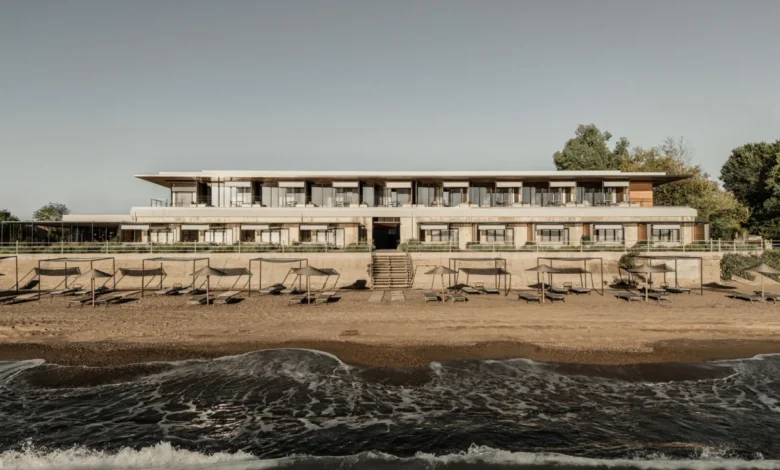
The evolution of the Dexamenes Seaside Hotel on the western coast of the Peloponnese represents a sophisticated study in architectural continuity and the poetic preservation of industrial heritage. Originally a 1920s-era distillery and winery, the site has been meticulously transformed into a luxury boutique hotel that avoids the clichés of Mediterranean resort design. Instead, it embraces the raw, brutalist beauty of its past. The latest extension by K-Studio serves as a new chapter in this ongoing narrative, reinforcing the idea that the project is not a static completion but a maturing entity that grows and adapts like the very wine once produced within its concrete walls.
Located on the Kourouta beach, the project sits at the intersection of history and modern hospitality. The original structure was a product of the "Currant Crisis" of the late 19th and early 20th centuries, which forced Greece to pivot from exporting dried grapes to converting them into wine and spirits. This industrial necessity birthed the massive concrete tanks—the "dexamenes"—that now form the backbone of the hotel’s guest rooms. The extension continues this philosophy of "quiet reinvention," adding new layers of functionality and aesthetic refinement without disrupting the site’s historical resonance.
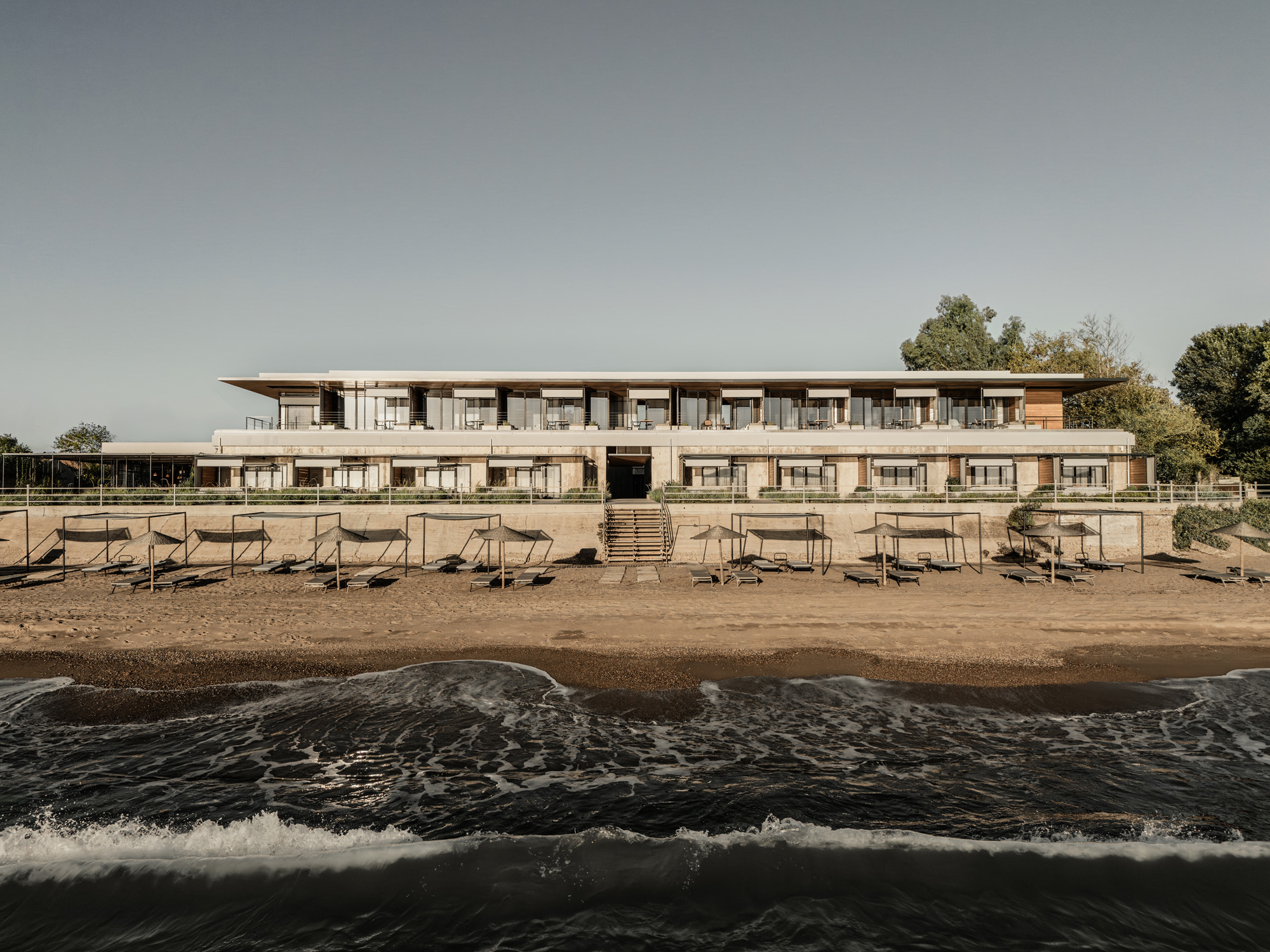
Historical Context: From Industrial Necessity to Modern Luxury
To understand the significance of the Dexamenes extension, one must look back to the early 1900s. The Peloponnese was the heart of Greece’s currant production. When the international market for raisins collapsed, the Greek government supported the creation of industrial wineries to process the surplus. The Dexamenes site was built directly on the coastline to facilitate the loading of wine onto ships destined for overseas markets.
By the mid-20th century, the factory fell into disuse, standing as a derelict industrial skeleton for decades. While many developers might have seen the site as a candidate for demolition, the vision for Dexamenes was different. The goal was to preserve the industrial "honesty" of the site. The concrete tanks, which were built to hold thousands of liters of wine, were characterized by their thick, reinforced walls and utilitarian proportions.
The initial phase of the hotel conversion, which garnered international architectural acclaim, focused on converting two blocks of concrete tanks into guest suites. The extension moves beyond this initial footprint, introducing new spaces that bridge the gap between the heavy industrial shells and the soft, natural landscape of the Ionian Sea.
Architectural Philosophy and Materiality
K-Studio’s approach to the extension is rooted in the concept of "entropy." This acknowledges that the building will change over time—the concrete will weather, the steel will patina, and the vegetation will reclaim the edges. Rather than fighting this process, the architects have integrated it into the design.
The materiality of the extension remains consistent with the original palette:
- Concrete: The dominant material, left exposed to showcase the textures of the original formwork.
- Steel: Used for slender structural elements and window frames, providing a sharp contrast to the mass of the concrete.
- Wood and Plywood: Introduced in the interiors to provide warmth and a sense of human scale within the cavernous industrial volumes.
- Glass: Large expanses of glazing are used to dissolve the boundaries between the interior suites and the sea views.
The extension introduces a more nuanced relationship with the outdoors. While the original tanks were introverted, protective spaces, the new additions utilize light-touch interventions to open the hotel up to its surroundings. Pergolas made of reclaimed wood and steel provide dappled shade, mimicking the traditional agricultural structures found in the Greek countryside.
Chronology of Development
The transformation of Dexamenes has occurred in distinct stages, reflecting a slow-growth model that prioritizes quality and narrative over rapid expansion:
- Phase I (2018-2019): The primary conversion of the first two rows of wine tanks into 34 guest suites. This phase established the "tank-to-room" typology, where the 20-centimeter-thick concrete walls were preserved, and new openings were cut with surgical precision.
- Phase II (2020-2022): The development of communal areas, including the conversion of the old engine room into a restaurant and the addition of a boutique and cultural space. This phase focused on the "social heart" of the hotel.
- The Extension (2024-2026): The current phase adds specialized suites, enhanced wellness facilities, and expanded garden areas. This phase focuses on the "spatial maturity" of the hotel, ensuring that the increasing number of guests can still find pockets of solitude and quietude.
Supporting Data and Technical Specifications
The engineering of the Dexamenes extension is a feat of adaptive reuse. Converting industrial tanks into habitable spaces requires significant upgrades to thermal insulation and moisture management, all while maintaining the "raw" look of the concrete.
- Thermal Performance: To keep the interior climate stable without thick layers of modern cladding, the architects utilized internal insulation layers paired with high-performance glazing.
- Structural Integrity: The extension utilizes the existing foundation of the factory, minimizing the carbon footprint associated with new excavations and concrete pouring.
- Sustainability: By repurposing thousands of tons of existing concrete, the project has avoided the massive CO2 emissions that would have resulted from a new-build resort of similar scale. The use of local materials and traditional construction techniques further reduces the project’s environmental impact.
Official Responses and Project Reception
Industry experts have praised K-Studio for their restraint. Critics from the architectural community have noted that Dexamenes stands as a rebuttal to the "over-polished" luxury typical of the Mediterranean.

"The Dexamenes project is a lesson in how to listen to a site," says an analyst from the Hellenic Institute of Architecture. "Instead of imposing a new identity, K-Studio has allowed the site’s own history to dictate the aesthetic. The extension is not an addition in the traditional sense; it is an unfolding of the site’s inherent potential."
Representatives from Design Hotels, the collective to which Dexamenes belongs, have highlighted the project as a premier example of "Slow Tourism." They argue that the hotel’s success lies in its ability to offer guests a sensory connection to the past, where the smell of the sea and the texture of the weathered concrete create a unique sense of place that cannot be manufactured in a new building.
Broader Impact and Implications for Hospitality
The Dexamenes Seaside Hotel Extension serves as a blueprint for the future of sustainable tourism in Greece and beyond. As the global tourism industry faces increasing pressure to reduce its environmental footprint, the adaptive reuse of industrial ruins offers a viable path forward.
Furthermore, the project has had a significant impact on the local economy of the Elis region. By turning a forgotten industrial site into a world-class destination, Dexamenes has brought high-value tourism to a part of the Peloponnese that was previously overlooked in favor of more famous islands like Mykonos or Santorini. This has spurred a renewed interest in the cultural and agricultural heritage of the mainland, encouraging other developers to look at historical structures with fresh eyes.
The extension of Dexamenes proves that luxury does not require the erasure of history. By embracing the "gentle projection into the future" mentioned by the architects, the hotel offers a model of development that is both culturally respectful and economically vibrant. As the concrete continues to age and the gardens grow denser, the hotel will only become more deeply rooted in its coastal landscape, a testament to the enduring power of thoughtful, site-specific architecture.
In the grander scheme of Mediterranean architecture, Dexamenes represents a shift toward "Industrial Romanticism." It challenges the notion that hospitality must be soft and ornate, proving instead that there is profound beauty in the stark, the functional, and the weathered. As K-Studio completes this latest extension, the hotel stands not just as a place to stay, but as a living museum of Greece’s industrial evolution and a beacon for the possibilities of modern design.
Related posts: