Poly Auction Hong Kong High Jewelry Sale Achieves Notable Totals Led by Exceptional Jadeite and Diamond Treasures

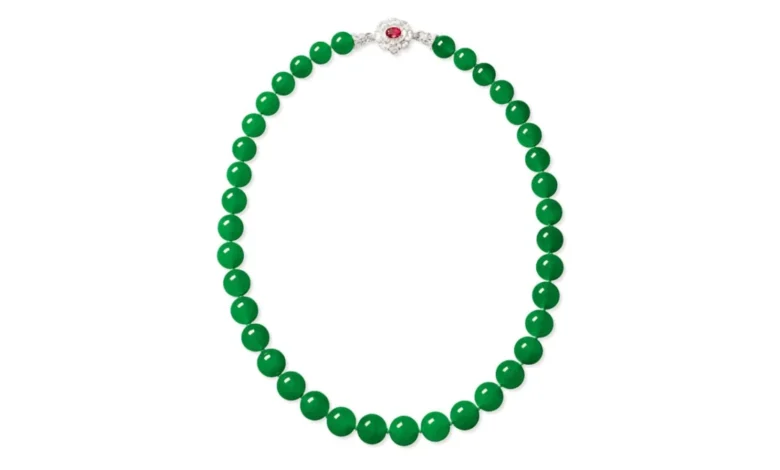
The spring auction season in Hong Kong has long served as a bellwether for the global luxury market, and the recent High Jewelry & Watches sale conducted by Poly Auction on April 6 provided a comprehensive look at current collector sentiment and the enduring demand for rare geological specimens. The event was headlined by a magnificent jadeite, ruby, and diamond necklace that successfully fetched HKD 14.4 million, equivalent to approximately $1.8 million. While the sale price reflects the high intrinsic value of the materials and the craftsmanship involved, it notably landed below the initial presale estimate, which had been set between HKD 20 million and HKD 30 million ($2.6 million to $3.8 million). This discrepancy between the high-end estimates and the final hammer price offers a nuanced view of a market that remains active but is increasingly characterized by price sensitivity and a discerning, value-oriented buyer base.
The centerpiece of the auction, the jadeite necklace, is a masterwork of lapidary art and jewelry design. It features 38 graduated jadeite beads, each selected for its vibrant green hue, high translucency, and uniform texture—qualities that are paramount in the valuation of what is often referred to in Asian markets as the "King of Gems." The necklace is secured by a sophisticated clasp that bridges the aesthetic gap between traditional Eastern preferences and Western jewelry motifs, featuring an oval-cut ruby weighing 1.51 carats, complemented by a suite of multi-shaped diamonds. The integration of high-quality rubies and diamonds with jadeite is a hallmark of top-tier auction pieces, intended to appeal to international collectors who appreciate the fusion of different gemstone traditions.
The Dynamics of the High Jewelry & Watches Sale
The April 6 auction was not merely defined by its top lot but by the breadth of its catalog, which saw 121 lots successfully change hands. The curation focused on a diverse array of assets, including colorless diamonds, fancy colored gemstones, natural pearls, and "signed" pieces from the world’s most prestigious jewelry houses. Brands such as Chopard, Van Cleef & Arpels, and Cartier were well-represented, alongside a robust horological section featuring timepieces from Omega, Patek Philippe, and Rolex. The success of these branded lots underscores a continuing trend in the luxury sector where "provenance" and "brand equity" provide a layer of security for investors during periods of economic fluctuation.

In the diamond category, the standout performer was a ring featuring a round brilliant-cut diamond weighing 7.36 carats. This stone, graded as E-color and VVS1-clarity, represents the upper echelon of diamond quality. In the world of gemology, an "E" color grade indicates that the diamond is virtually colorless, trailing only the "D" grade in the Gemological Institute of America (GIA) scale. The VVS1 (Very, Very Slightly Included) clarity grade ensures that any internal characteristics are nearly impossible to detect even under 10x magnification by a trained professional. This ring achieved a sale price of HKD 2 million ($257,413), surpassing its presale estimate of HKD 1.3 million to HKD 1.8 million. The fact that this lot exceeded expectations while the top jadeite lot fell short suggests a robust and perhaps more predictable demand for high-specification white diamonds compared to the more subjective and specialized jadeite market.
Jadeite Dominance and Market Nuances
Jadeite remains the spiritual and financial heart of the Hong Kong jewelry auction scene. Following the lead necklace, several other jadeite pieces saw significant activity. A suite consisting of a ring and a pair of earrings, each featuring jadeite cabochons of exceptional quality surrounded by marquise-cut diamonds, sold for HKD 1.7 million ($214,513). This lot had been estimated at HKD 1.5 million to HKD 2.5 million, again showing a final price toward the conservative end of the spectrum. Another individual ring, starring a single jadeite cabochon framed by a complex arrangement of baguette, marquise, and circular-cut diamonds, fetched HKD 1.4 million ($183,865), aligning closely with its HKD 1.2 million to HKD 1.8 million estimate.
The valuation of jadeite is notoriously complex, relying on the "Three Cs" of the jade world: Color, Clarity (translucency), and Cut (finishing). Unlike diamonds, which have a standardized international pricing index, jadeite value is often determined by the depth of its "water" (the way light travels through the stone) and the presence of the coveted "Imperial Green" hue. The results at Poly Auction suggest that while the appetite for jadeite is constant, buyers are currently unwilling to engage in the aggressive bidding wars seen in previous decades, opting instead for pieces that represent fair market value.
Colored Gemstones and the Colombian Emerald Premium
Beyond jadeite and diamonds, the auction highlighted the rising international profile of colored gemstones, particularly emeralds. A pair of earrings featuring two substantial oval-cut Colombian emeralds—one weighing 5.61 carats and the other 5.26 carats—achieved a sale price of HKD 1.4 million ($183,865). These stones were suspended from clusters of pear, baguette, and circular-cut diamonds, creating a classic high-jewelry silhouette.

The "Colombian" designation is a critical factor in the valuation of emeralds. Colombia has been the world’s premier source of emeralds for centuries, with mines like Muzo and Chivor producing stones with a unique chromium-rich chemical composition that results in a vivid, "glowing" green color. Large, matched pairs of emeralds over five carats each are exceedingly rare, as finding two stones of similar color and clarity is a logistical challenge for jewelers. The sale price, which fell within the HKD 1.3 million to HKD 1.8 million estimate, confirms that high-quality colored stones remain a staple of the sophisticated collector’s portfolio.
Horological Performance and Brand Heritage
The "Watches" portion of the sale reflected the broader stabilization of the luxury watch market. The inclusion of Patek Philippe and Rolex is a requirement for any major Hong Kong sale, as these brands dominate the secondary market. Patek Philippe, known for its "Holy Trinity" status in watchmaking, typically attracts collectors interested in high complications and artisanal finishing. Rolex, conversely, serves as a high-liquidity asset, with models like the Daytona, Submariner, and GMT-Master II maintaining strong value retention.
The presence of Omega in the top-tier listings also indicates a growing appreciation for the brand’s historical significance and technical innovations, such as the Co-Axial escapement. As the costs of Patek Philippe and Rolex continue to reach record highs, many collectors are diversifying into Omega’s high-end Speedmaster and Seamaster references, which offer a similar blend of heritage and mechanical prowess at a different price point.
Broader Implications for the Hong Kong Luxury Market
The results of the Poly Auction sale provide several insights into the current state of the luxury economy in Asia. First, the fact that the top lot sold for $1.8 million, despite missing its high estimate, proves that there is still significant capital available for ultra-high-net-worth acquisitions. However, the missed estimate serves as a reminder that auction houses must be increasingly careful with their valuations in a high-interest-rate environment where "easy money" is less prevalent.

Second, the success of the 7.36-carat diamond ring suggests that "safe" assets—stones with GIA certifications and clear quality benchmarks—are currently outperforming more speculative or subjective items. In times of economic uncertainty, investors often pivot toward standardized commodities, and a high-grade colorless diamond is the closest the jewelry world has to a standardized currency.
Third, the consistent performance of jadeite, even at lower estimates, reinforces Hong Kong’s position as the global capital for this specific gemstone. While Western auction houses in New York or London may lead in colored diamonds or historical tiaras, Hong Kong remains the only place where a 38-bead jadeite necklace can command a multi-million dollar price tag.
Conclusion and Future Outlook
Poly Auction’s April 6 sale successfully navigated a complex market landscape, balancing the prestige of high-value jadeite with the reliable appeal of diamonds and branded watches. The total sale of 121 lots indicates a healthy level of liquidity in the market, even if the era of runaway price inflation for top-tier lots has cooled.
As the industry looks toward the upcoming autumn sales, the focus will likely remain on "investment-grade" pieces. Collectors are increasingly looking for stones that possess not only beauty but also a high degree of rarity and documented origin. The performance of the Colombian emeralds and the E-color diamond at this sale suggests that the path forward for auction houses lies in offering pieces that meet rigorous technical standards. For Poly Auction, this sale reinforces its status as a major player in the Asian circuit, capable of moving significant inventory and setting the tone for the regional luxury trade. The market may be more cautious than in years past, but for the right piece of "frozen music"—whether it be a Patek Philippe movement or a strand of Imperial Green jadeite—the bidders are still very much in the room.