Techtextil and Texprocess Innovation Awards 2026 Announce Breakthroughs Redefining the Technical Textiles Landscape

The stage is set for a paradigm shift in the technical textiles industry as the recipients of the prestigious Techtextil and Texprocess Innovation Awards 2026 have been unveiled. Scheduled to coincide with the major exhibitions taking place in Frankfurt next week, from April 21st to 24th, these awards shine a spotlight on a sector undergoing profound evolution. The eleven Techtextil honorees and six Texprocess award winners represent a diverse array of innovations spanning materials, chemistry, processing, and digitalization. Their collective achievements underscore a dynamic industry actively engaged in redefining performance benchmarks, championing sustainability, and scaling industrial applications to unprecedented levels.
The Techtextil exhibition, a leading international trade fair for technical textiles and nonwovens, has long served as a crucial platform for showcasing advancements that push the boundaries of material science and application. This year’s awards, presented ahead of the exhibition, highlight the industry’s proactive response to pressing global challenges, from environmental regulations to the demand for higher performing and more sustainable solutions. The Texprocess exhibition, conversely, focuses on the machinery, processes, and technologies for the manufacture of garments and textiles, making the synergy between these two events vital for understanding the complete value chain of innovation.
Techtextil Innovation Award Winners: A Deep Dive into Sustainable and High-Performance Materials
The Techtextil Innovation Awards, recognizing pioneering work in the technical textiles sector, have honored eleven companies across six distinct categories. This year’s recipients demonstrate a remarkable commitment to environmentally responsible practices and the development of materials with enhanced functional properties.
New Concept: Pioneering PFAS-Free Solutions and Nanotechnology Integration
For decades, per- and polyfluoroalkyl substances (PFAS) have been the cornerstone of water, oil, and stain-repellent finishes in technical textiles. However, mounting global regulatory pressure, driven by environmental and health concerns, has created an urgent imperative for viable alternatives.
Bäumlin & Ernst’s EC0Tex Process: Aurora-Inspired Plasma Coating
The Swiss yarn manufacturer Bäumlin & Ernst, in collaboration with Empa (the Swiss Federal Laboratories for Materials Science and Technology), has presented a groundbreaking solution with its EC0Tex process. This innovative approach draws inspiration from the visual spectacle of the aurora borealis, employing plasma technology to apply an ultra-thin organosilicon coating to individual filaments. This method yields a durable, water-repellent, and quick-drying yarn without the use of PFAS or water. A significant environmental benefit is that the material degrades into harmless silicon dioxide at the end of its lifecycle, aligning with circular economy principles. This advancement is particularly critical as regulatory bodies worldwide, including the European Chemicals Agency (ECHA), are increasingly scrutinizing and restricting the use of PFAS due to their persistence and potential bioaccumulation.
aweXome Ray’s axrial: Bridging Nanotechnology and Textile Manufacturing
South Korea’s aweXome Ray has achieved a significant technological leap with axrial, a process that converts carbon nanotubes into continuous textile filaments for the first time. This breakthrough effectively bridges the gap between the highly advanced field of nanotechnology and traditional textile manufacturing. The resulting ultra-light and conductive materials open up a vast spectrum of new possibilities. These include the development of electrically active textiles for wearable electronics and smart garments, as well as the creation of advanced structural components for demanding applications in the automotive and aerospace industries. The integration of carbon nanotubes promises enhanced strength-to-weight ratios and novel functionalities previously unattainable with conventional textile fibers.
New Chemicals and Dyes: Towards Systemic Change in Textile Chemistry
The chemical and dye sector is witnessing a profound shift, moving beyond incremental improvements towards fundamental, systemic changes aimed at embedding sustainability at the molecular level.
CITEVE’s Waste-Derived Textile Printing Pastes
The Portuguese technology center CITEVE has developed innovative textile printing pastes derived predominantly from industrial and agricultural waste streams. This pioneering process champions environmental responsibility by replacing petrochemical ingredients with bio-based polymers such as collagen and chitosan. Furthermore, pigments are sourced from biomass residues, demonstrating a holistic approach to resource utilization. The process is designed for industrial compatibility, ensuring that these sustainable alternatives can be seamlessly integrated into existing manufacturing workflows, thereby minimizing adoption barriers. This initiative is particularly relevant as the textile industry grapples with its significant environmental footprint, often linked to the heavy reliance on petroleum-based chemicals.
H&B Materials’ Molecular Approach to Water Repellency
French start-up H&B Materials is taking a molecular engineering approach to achieve PFAS-free water repellency. Their innovative finish utilizes plant-based fatty acids, sourced from agricultural waste, which are then grafted directly onto cellulose fibers. This technique creates a durable, fiber-integrated water-repellent effect that achieves top industry ratings for performance while remaining fully compatible with existing textile finishing lines. This dual benefit of high performance and compatibility with established infrastructure makes it a highly attractive and practical solution for manufacturers seeking to transition away from harmful chemicals.
New Materials: Harnessing By-products and Enhancing Biodegradability
Material innovation remains a central pillar of the technical textiles industry’s transformation, with a growing emphasis on renewable resources and enhanced end-of-life options.

spek Design’s FormLig: Knitted Wood Composites
The FormLig project, led by spek Design, showcases the transformative potential of lignin, a largely underutilized by-product of the pulp and paper industry. Lignin is being converted into a processable textile composite. When combined with cellulose fibers, this composite can be knitted, shaped, and set into rigid forms. This offers a compostable alternative for a range of applications, including sustainable packaging solutions and materials for horticulture. The successful valorization of lignin represents a significant step towards a more circular bioeconomy within the textile sector.
Senbis Polymer Innovations’ Mariva: Biodegradable Biopolyester
From the Netherlands, Senbis Polymer Innovations introduces Mariva, a new class of biopolyester engineered to offer the performance characteristics of conventional synthetic materials while boasting biodegradability and recyclability. A critical advantage of Mariva is its compatibility with existing polyester production lines, which significantly accelerates its potential for industrial adoption. This development is crucial for reducing the persistent waste associated with conventional plastics and offers a viable pathway towards more sustainable synthetic materials.
New Products: Smart Textiles and Climate-Responsive Architecture
The application of advanced materials is leading to the creation of novel products that address contemporary challenges in areas such as automotive interiors and building envelopes.
NUO’s FlexHolz: Bio-Based Flexibility for Automotive Interiors
NUO’s FlexHolz is an innovative material that merges wood veneers with natural fiber textiles, bound together by lignin-based adhesives. This creates a flexible, fully bio-based material that is already finding its way into automotive interiors. Through a process of laser micro-segmentation, FlexHolz achieves an unprecedented balance between rigidity and flexibility. This allows for dynamic design possibilities and enhanced comfort in vehicle cabins, while also contributing to the automotive industry’s push for lighter and more sustainable materials.
University of Stuttgart’s FlectoLine: AI-Driven Adaptive Facades
In the realm of architecture, the University of Stuttgart’s FlectoLine project is revolutionizing the building envelope. This system features fiber-reinforced façade modules that dynamically adapt to environmental conditions, guided by artificial intelligence (AI). The FlectoLine system has demonstrated its ability to significantly reduce indoor temperatures and improve thermal comfort without requiring additional energy input. This innovative application highlights the potential of textiles to actively contribute to climate-responsive design, creating more sustainable and comfortable built environments.
Production Technologies: Sustainable Fiber Spinning and Advanced Recycling
The production of high-performance technical textiles is also undergoing a sustainability overhaul, with innovations in fiber spinning and recycling processes taking center stage.
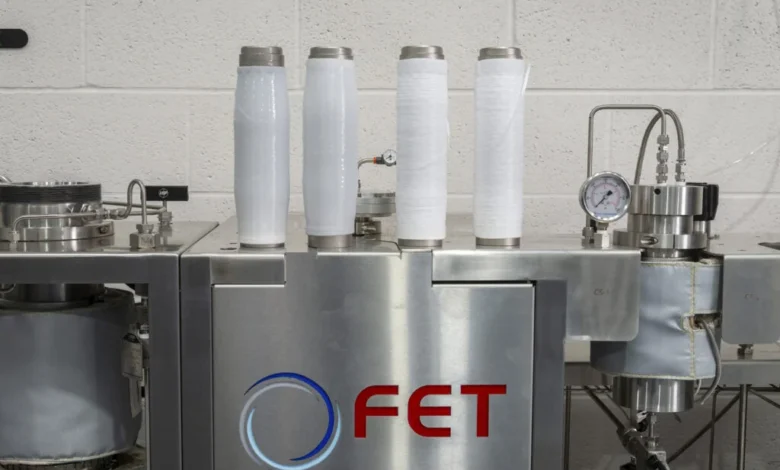
Fibre Extrusion Technology (FET)’s Sustainable UHMWPE Gel Spinning
Ultra-high-molecular-weight polyethylene (UHMWPE) is renowned for its exceptional strength, making it a premier fiber material for demanding technical textile applications. However, its traditional production via gel spinning has been environmentally problematic. The conventional process involves mixing UHMWPE with oil to create a gel, which is then extruded into fine strands. Subsequently, toxic solvents like hexane or dichloromethane are used to wash out the oil, with approximately 100 kilograms of solvent required per kilogram of yarn. UK textile machinery manufacturer Fibre Extrusion Technology (FET) has addressed this critical issue by developing a sustainable gel spinning process for UHMWPE yarns. This new process eliminates the need for hexane or dichloromethane, instead utilizing supercritical carbon dioxide (scCO2). scCO2 is a non-toxic medium, often a by-product of other industrial processes, and its use in waterless dyeing for textiles is already established. This innovation significantly reduces the environmental impact and health risks associated with UHMWPE fiber production.
Samsara Eco’s EosEco: Enzyme-Based Textile Recycling
Australia’s Samsara Eco has developed a revolutionary enzyme-based recycling technology called EosEco. This technology leverages AI-engineered "plastic-eating" enzymes to break down polyester, nylon 6, and the particularly resilient nylon 6.6. This enzymatic degradation enables the creation of high-quality regenerated new fibers, offering a truly circular solution for textile waste. The precision of enzyme action allows for the selective depolymerization of specific polymer chains, minimizing degradation and preserving fiber integrity.
re.solution’s Electrifying Chemical Recycling
While chemical textile recycling holds immense promise for closed-loop systems, processes like hydrolysis, effective for mixed textiles, generate substantial chemical waste. Recovering fiber components typically requires acid, which results in significant salt sludge. German start-up re.solution is pioneering a transformative approach by replacing the acid step with electricity. Their innovative process reportedly achieves substantial savings, with reductions of 94% in chemicals and 74% in water compared to conventional chemical recycling methods. This electrochemical approach represents a significant advancement in making textile recycling more resource-efficient and environmentally benign.
Texprocess Innovation Award Winners: Automating and Optimizing Textile Manufacturing
The Texprocess Innovation Awards celebrate advancements in machinery, processes, and technologies for the textile and garment manufacturing industries. This year’s six awardees underscore the drive towards greater automation, precision, and intelligent integration in production.
Robotextile’s Flow Gripper: Revolutionizing Automated Fabric Handling
The Challenge of Flexible Materials in Robotics
The inherent flexibility, deformability, and air permeability of textiles present significant challenges for conventional robotic systems, which are typically designed for rigid objects. This has historically limited the extent of automation in textile manufacturing, particularly in tasks involving the handling of multiple fabric layers.

Robotextile’s Solution: Airflow-Powered Gripping
Germany’s Robotextile has developed a flow gripper designed to automatically separate fabric layers from a stack. This retrofittable gripper utilizes controlled airflows to autonomously pick up and transport textiles within a factory environment. Unlike traditional vacuum or mechanical grippers, the airflow system can adapt to the nuanced properties of different fabrics, ensuring a reliable and gentle grip. This innovation is set to transform the automation of tasks such as the preparation of fabric layers for jeans, car seat covers, or airbags, which are currently often manually separated before subsequent processes like sewing, printing, or laminating. The widespread adoption of such systems could significantly boost productivity and consistency in garment and textile production.
CryoTec by the Technical University of Applied Sciences Wildau: Leveraging Ice for Precise Gripping
The Technical University of Applied Sciences Wildau is exploring a novel approach: freezing. Their CryoTec system capitalizes on the adhesive properties of ice. By spraying a small amount of water onto a fabric and allowing it to freeze slightly, the system creates a grippable surface. This results in a full-surface, reversible adhesion that allows for precise and uniform gripping of textiles. This method offers an alternative to traditional gripping mechanisms and could be particularly beneficial for delicate or complex fabric manipulations.
AiDLab’s WiseEye: AI-Powered Real-Time Textile Inspection
The Manual Bottleneck of Quality Control
Visual inspection of textiles, a critical step in quality control, has traditionally been a largely manual and time-consuming process. Human inspectors can be prone to fatigue and subjective assessment, leading to inconsistencies.
AI’s Role in Enhancing Accuracy and Efficiency
The Laboratory for Artificial Intelligence in Design (AiDLab) in Hong Kong is demonstrating how AI can fundamentally transform this process. Their WiseEye AI-powered inspection technology integrates cameras with self-learning AI algorithms to detect and assess faults in various textile materials in real time. According to AiDLab, WiseEye achieves an impressive accuracy rate of approximately 90%, significantly improving efficiency and consistency in quality control. This real-time capability allows for immediate corrective actions, reducing waste and improving overall product quality.
Amann’s AeoniQ Fil: Biodegradable Threads for Mono-Material Textiles
The Challenge of Mixed Materials in Biodegradable Products
Even when textile products are made from biodegradable materials, their recyclability can be compromised by the use of non-biodegradable components, such as synthetic sewing threads. Seams made of polyester, for example, prevent products from being true mono-materials, hindering effective recycling.
AeoniQ Fil: A Sustainable Solution for Seams
To address this critical issue, thread manufacturer Amann has developed AeoniQ Fil, a biodegradable sewing and embroidery thread made from wood pulp-based fibers. AeoniQ Fil is set to make its official market debut at Texprocess. This innovation is crucial for enabling the production of truly mono-material, biodegradable textile products, thereby facilitating a more complete circularity in the textile lifecycle.
Vizoo’s CAST: An Integrated Design and Simulation Tool
German technology company Vizoo has developed CAST, a comprehensive design tool that combines a camera-light setup with 3D technology and AI. Vizoo claims CAST is the first application to seamlessly integrate digital fabric communication, product simulation, and an intuitive user interface. This tool aims to streamline the design process, allowing for more accurate visualization and prototyping of textile products, ultimately reducing development time and material waste.
CITEVE’s Robot-Controlled T-Shirt Production Cell
Portuguese technology center CITEVE is showcasing a pioneering robot-controlled T-shirt production cell that integrates AI-based gripping and automated sewing. This advanced system can identify fabric pieces directly on the cutting table in real time and intelligently calculates optimal grasp points based on the shape, size, and material properties of each piece. This level of automated precision in garment assembly represents a significant step forward in flexible manufacturing for apparel.
A Ceremony of Innovation and a Glimpse into the Future
A special awards ceremony will be held at Messe Frankfurt on April 21st in Hall 9.1, bringing together the innovators and industry leaders to celebrate these remarkable achievements. Guided tours of the Texprocess Innovation Awards exhibits are also being arranged, offering attendees an opportunity to engage directly with the technologies and products that are shaping the future of the technical textiles and textile processing industries. The Techtextil and Texprocess exhibitions, running concurrently, provide an invaluable platform for networking, knowledge exchange, and business development, reinforcing Frankfurt’s position as a global hub for textile innovation. The innovations highlighted by these awards signal a future where performance, sustainability, and industrial efficiency are not mutually exclusive but are instead intrinsically linked, driving the technical textiles sector towards a more responsible and advanced era.
Related posts: