Nike Air Max Dolce Returns for Holiday 2026 with Faux Crocodile Skin Colorways

The modern footwear landscape is defined by the intersection of unexpected trends, where archival silhouettes are frequently resurrected to better suit contemporary consumer tastes than they did during their initial runs. This phenomenon is vividly demonstrated in the latest announcement from Nike, which is preparing to release two distinct iterations of the archival Nike Air Max Dolce. Set to arrive during the holiday 2026 season, the upcoming “Black Croc” and “Pink Croc” editions capitalize heavily on two of the most dominant current movements in the sneaker industry: the surging popularity of faux exotic leather finishes and the blurring lines between formal footwear and casual athletic shoes, often referred to as the sneaker-loafer hybrid trend.
Priced at $170, the forthcoming releases will be available through Nike’s official webstore as well as select third-party retail partners. By introducing a synthetic crocodile skin upper to a silhouette that originally debuted at the turn of the millennium, Nike is signaling a broader design strategy that re-examines early-2000s experimental footwear through a modern, luxury-leaning lens.
Design Breakdown of the Nike Air Max Dolce Croc Pack
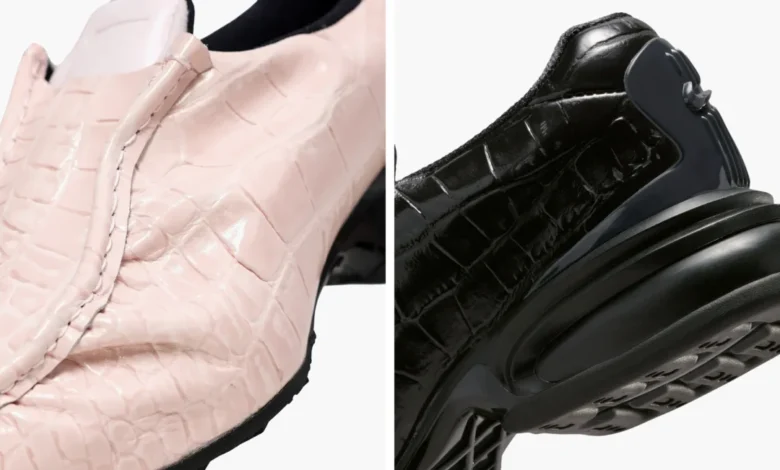
The Nike Air Max Dolce “Black Croc” and “Pink Croc” editions showcase contrasting approaches to color blocking while utilizing the same underlying material update. The “Black Croc” iteration leans fully into a stealth aesthetic, featuring a monochromatic blackout treatment across its laceless, glossy synthetic upper. The design is unified by a raised heel housing an opaque Air Max unit that matches the overarching dark tone. The only subtle deviation in color occurs at the TPU heel counter, which employs a moderately lighter shade of black to add textural and tonal depth. Completing the interior of the shoe is a specialized black-and-white insole detailed with a cyber-grid print, a nod to the technological motifs that frequently appeared in footwear design during the early 2000s.
In contrast, the “Pink Croc” edition utilizes a more diverse and vibrant color-blocking scheme. This version features a light pink synthetic crocodile skin upper paired with an even lighter shade of pink implemented on the heel stabilizer. To ground the pastel upper, both the interior lining and the sole unit—which similarly incorporates an opaque Air Max cushioning system—are rendered in solid black.
These upcoming inline colorways represent a significant departure from the standard configuration of the Air Max Dolce. Typically, the silhouette features a molded structural cage placed atop the foot, echoing the cyber-grid pattern found on the insoles, alongside a series of tech-inspired linear graphics along the sidewalls. By replacing these technical overlays with a uniform synthetic crocodile skin, Nike has streamlined the shoe’s profile. This material choice aligns closely with recent trends observed across the wider footwear market, where exotic textures have elevated casual athletic models into more sophisticated, dress-adjacent categories.
Chronology and Historical Context of the Air Max Dolce
To understand the current revival of the Nike Air Max Dolce, it is necessary to examine its origins within the broader timeline of Nike’s design history. The shoe originally made its debut in 2001, a period characterized by aggressive experimentation within the Air Max line. At the turn of the millennium, Nike designers frequently explored futuristic, avant-garde aesthetics, resulting in a wave of unconventional silhouettes that pushed the boundaries of athletic footwear engineering.
However, the market in 2001 was often unprepared for such radical departures from traditional design languages. Like many of its contemporaries from that era, the Air Max Dolce failed to achieve mainstream commercial traction upon its initial release. It was widely categorized as a product ahead of its time, ultimately fading into the archives as a footnote in the extensive history of the Air Max franchise.
The timeline of the shoe’s modern resurgence began in earnest earlier this year, when renowned fashion label Comme des Garçons selected the silhouette for a high-profile collaborative revival. The partnership successfully reintroduced the obscure model to a contemporary audience, proving that the fashion world’s appetite for early-2000s obscurity had matured. Capitalizing on the momentum generated by the Comme des Garçons collaboration, Nike has chosen to integrate the Air Max Dolce into its standard inline product calendar, ensuring that the archival model transitions from a limited runway piece to a more widely accessible commercial offering.
The Intersection of Current Sneaker Trends
The decision to apply faux crocodile skin to the Air Max Dolce is not happening in a vacuum; it directly reflects broader shifts in consumer preferences that have dominated the footwear sector over recent years. The first major trend influencing this release is the exponential growth of the "sneaker loafer" and hybrid formal-athletic categories. Consumers increasingly demand footwear that bridges the gap between formal office attire and streetwear comfort, leading brands to experiment with traditional dress shoe textures—such as leather, suede, and embossed exotic skins—applied to athletic sole units.
Concurrently, faux exotic finishes have permeated the mainstream sneaker market. Releases such as recent "Croc Pack" iterations across various classic Air Max models demonstrate that consumers are eager for tactile, premium-feeling materials on heritage silhouettes. By marrying a glossy, laceless synthetic crocodile upper with the technical foundation of an Air Max cushioning unit, Nike has effectively fused these two parallel trends into a single cohesive product. This hybrid approach allows the brand to appeal to fashion-forward consumers who favor avant-garde shapes while maintaining the day-to-day comfort associated with athletic footwear.
Market Implications and Broader Industry Impact
The holiday 2026 release of the Nike Air Max Dolce “Black Croc” and “Pink Croc” carries several notable implications for Nike’s broader product strategy. As competition within the lifestyle sneaker market intensifies, major athletic brands have increasingly leaned into their archives to unearth forgotten silhouettes, treating their historical catalogs as untapped reservoirs for fresh design narratives.
By resurrecting models that failed during their initial runs—such as the Air Max Dolce—brands mitigate the risk of creative stagnation while offering knowledgeable consumers something genuinely distinct from over-saturated legacy models like the Air Force 1 or Air Max 90. Furthermore, the $170 price point positions the shoe firmly within the mid-tier lifestyle category, making it accessible to a wide demographic of sneaker enthusiasts and casual shoppers alike.
Industry analysts note that inline adaptations following high-profile designer collaborations—such as the trajectory established by Comme des Garçons and subsequently adopted by Nike—serve as an effective barometer for consumer demand. If the Air Max Dolce resonates well during its holiday 2026 rollout, it could pave the way for additional colorways, material upgrades, and potentially more collaborative iterations in the future. As the boundary between athletic performance and luxury fashion continues to dissolve, models like the Air Max Dolce illustrate how historical archives can be successfully re-contextualized to meet the demands of the modern consumer.