The Silent Sabotage: How Typosquatting and Negative SEO are Targeting the Luxury Jewelry E-commerce Sector

The first sign that something was fundamentally wrong for many luxury jewelry retailers did not arrive via a customer complaint or a sudden drop in transaction volume. Instead, it manifested as a quiet, ominous line in Google Search Console reports: referring domains had surged by several hundred within a single week. These new referring domains were not industry-relevant, nor were they reputable news outlets. Upon closer inspection, these domains—all linked to luxury jewelry retailers—shared a coordinated, predatory pattern. This represents a new, sophisticated threat landscape for e-commerce, where the target is not the company’s bank account, but its search engine visibility.
This phenomenon, a dangerous fusion of typosquatting and negative SEO, has been quietly infiltrating the luxury jewelry space for approximately eighteen months. Unlike traditional cyber-fraud, which relies on phishing or credit card theft, this attack is patient, highly technical, and often remains undetected until organic search rankings begin a steady, unexplained decline that mimics a standard algorithm update.
The Mechanics of the Attack: A Modern Digital Siege
Typosquatting is traditionally understood as the registration of domain names that mimic established brands through minor misspellings—a missing letter, an extra character, or a transposed vowel. In its classic, malicious form, these sites host fake storefronts designed to harvest credit card data or login credentials. However, the current iteration of this threat is fundamentally different.
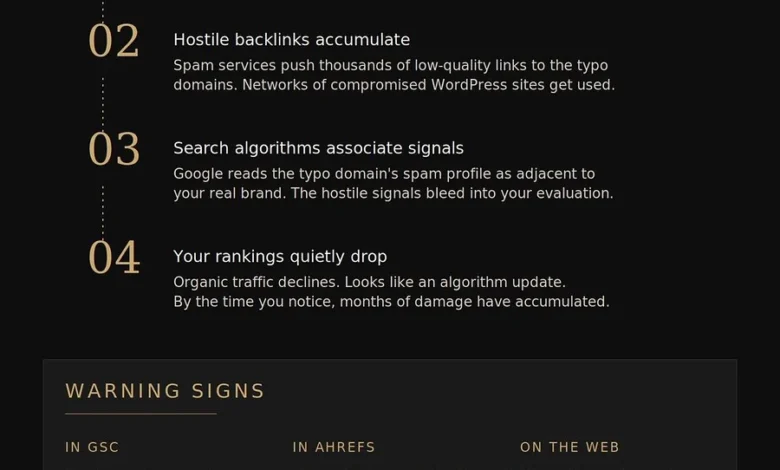
In the modern pattern observed by security researchers and digital analysts, these typosquat domains are not hosting functional pages, phishing portals, or e-commerce storefronts. In many cases, they are entirely empty, parked domains with no content and no outbound links. Their utility lies solely in their inbound link profile. Attackers build thousands of backlinks to these dummy domains using spam-heavy, low-quality sources. By rapidly constructing a toxic backlink profile for a domain that is visually similar to a legitimate brand, the attackers force Google’s algorithms to associate the legitimate brand’s identity with a vast, spam-ridden network.
The owner of Opulent Jewelers, an entity that has been actively monitoring this trend, notes that the strategy exploits the way search engines evaluate brand identity. Google does not merely assess links to a primary domain; it analyzes the broader signal landscape surrounding a brand name. When a domain that is a minor variation of a legitimate brand accumulates thousands of spam backlinks, that negative signal can bleed into the assessment of the actual, high-value site, leading to a loss of search authority and visibility.
The Vulnerability of the Luxury Jewelry Market
The targeting of luxury jewelry brands is not incidental. The industry possesses specific characteristics that make it an attractive target for these types of coordinated digital campaigns.
First, the economic impact is immediate. The luxury pre-owned jewelry market is defined by high average order values. A minor fluctuation in search rankings—even a drop of only 5% in organic traffic—can translate into significant, quantifiable revenue loss when individual transactions regularly reach four or five figures.
Second, the keyword landscape is both highly specific and intensely competitive. Phrases such as "pre-owned Cartier Love bracelet" or "authenticated Van Cleef Alhambra" represent high commercial intent. Because there is a limited inventory of authoritative, trusted retailers, the search engine results pages (SERPs) are fiercely contested. By successfully depressing a competitor’s ranking by even a single position, an attacker can siphon off substantial traffic and revenue.
Third, the industry’s reliance on trust creates a unique vulnerability. Authentication is the cornerstone of the pre-owned luxury market. Retailers invest heavily in detailed product descriptions, provenance documentation, and educational content to establish legitimacy. Because this content is inherently rich in value for organic search, it becomes the primary target for attackers seeking to undermine the brand’s authority.
Chronology of the Escalation
Industry analysts first began to notice the intensification of this pattern in late 2024. What initially appeared to be sporadic, routine spam turned out to be a highly coordinated, large-scale operation. Investigators identified a clear infrastructure behind these attacks, consisting of:
- Link-spam services: Automated tools that facilitate the mass-creation of low-quality backlinks.
- Compromised WordPress sites: Networks of legitimate but neglected sites that have been hacked to inject commercial anchor text.
- Aged-domain marketplaces: Platforms used to acquire and recycle hostile backlink profiles across multiple, successive targets.
By early 2025, the volume of these incidents had reached a critical threshold, prompting calls for increased awareness among independent retailers and boutique owners who are often the least equipped to detect and mitigate these sophisticated technical attacks.
Diagnostic Indicators for Retailers
For the average e-commerce business owner, detecting this threat requires a shift in how they interpret data from Google Search Console and backlink monitoring tools like Ahrefs or Semrush.
Key indicators in Google Search Console include:
- Anomalous spikes: Unexplained increases in referring domains during periods without active marketing campaigns.
- Suspicious anchor text: A surge in links using brand names combined with aggressive commercial keywords (e.g., "buy [brand] cheap," "discount [product]").
- Geographic mismatches: Sudden link surges originating from countries or regions where the brand has no established customer base or market presence.
- Indexed ghost pages: The appearance of unknown, unlinked pages in the site’s search index.
Indicators from backlink monitoring tools include:
- Spam classification: A rising number of new referring domains categorized as "spam" by automated detection algorithms.
- Obfuscated paths: Referring URLs containing randomized hash strings or incoherent patterns.
- High-volume outbound links: Links originating from domains that host hundreds or thousands of unrelated, low-quality outbound links, which is a hallmark of compromised, "zombie" websites.
Strategic Defensive Measures
Addressing this threat requires a multi-layered, proactive defense strategy.
1. Systematic Disavowal
The foundational step is the diligent maintenance of a Google Search Console disavow file. This tool instructs Google to ignore specific referring domains during the site’s authority evaluation. For brands under active attack, this is not a one-time task; it requires a persistent, weekly or monthly cycle of auditing and updating the file to neutralize new spam domains as they appear.
2. Formal Spam Reporting
While not a guaranteed "delete" button, utilizing Google’s official spam reporting forms is essential. Retailers should focus on the "paid links" category, as it aligns most closely with the behavior of these link-spam networks. By providing documented evidence, companies contribute to the long-term refinement of Google’s spam-detection algorithms, which benefits the wider ecosystem.
3. Legal Recourse
When the impact is severe, legal intervention becomes necessary. The Uniform Domain-Name Dispute-Resolution Policy (UDRP) administered by WIPO provides a mechanism for canceling or transferring cybersquatting domains. This process typically takes between 60 to 75 days. Furthermore, the Anticybersquatting Consumer Protection Act (ACPA) in the United States offers a path for federal litigation, potentially allowing for statutory damages ranging from $1,000 to $100,000 per domain. Both processes are significantly bolstered by federal trademark registration, underscoring the importance of formal IP protection for small and medium-sized enterprises.
4. Comprehensive Documentation
Every instance of a typosquat domain, including WHOIS data, backlink profiles, and a timeline of discovery, must be archived. This documentation is the bedrock of any successful legal action or reconsideration request submitted to search engines.
Pitfalls to Avoid
In the heat of an attack, retailers often resort to reactionary measures that prove counterproductive. Cloudflare’s phishing reporting tools, for instance, are specifically designed for credential theft and are ineffective against typosquatting/negative SEO, often leading to wasted administrative resources.
Similarly, the impulse to purchase the typosquat domains in a defensive maneuver is ill-advised. Doing so forces the brand to inherit the toxic backlink profile of the domain, effectively poisoning the brand’s own digital footprint. Finally, public confrontation with the suspected operators is discouraged. These entities operate on automated infrastructure, and public attention often serves only to confirm the success of their disruption, potentially encouraging further attacks.
The Future of Digital Brand Protection
The persistence of this attack vector highlights a structural challenge in how search engines function: the difficulty of isolating brand identity signals from the broader, often chaotic, link-based landscape of the internet. Until algorithmic capabilities evolve to better distinguish between organic and malicious link velocity, the burden of protection remains with the brands themselves.
For independent jewelry retailers, the primary barrier to safety is not a lack of tools, but a lack of awareness. As the industry continues to digitize, the ability to monitor, document, and respond to these subtle, technical threats will become as vital to a company’s survival as its physical security and inventory management. The most effective defense is a collective one: an informed industry that shares intelligence on these patterns is the best deterrent against those who seek to profit from the manipulation of digital trust.