Bangladesh Garment Workers Face Severe Crackdown Amid Escalating Minimum Wage Protests and Arrest of Union Leaders

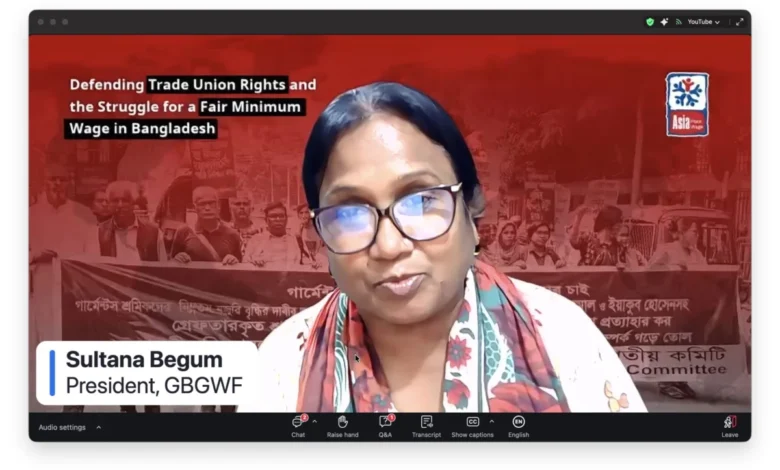
The ready-made garment (RMG) sector in Bangladesh is facing a profound crisis as escalating minimum wage protests collide with an intensifying government and industrial crackdown. On Tuesday morning, Sultana Begum, president of the Green Bangla Garments Workers Federation, delivered an impassioned plea during an Asia Floor Wage Alliance (AFWA) webinar, detailing the deteriorating economic precarity of the nation’s millions of apparel workers and highlighting an increasingly hostile environment for basic labor rights. Just minutes after the virtual conference concluded, Begum was dragged away and detained by police, underscoring the severe risks faced by labor representatives in the world’s second-largest apparel exporter.
Begum’s arrest is part of a broader, alarming trend that has seen at least 60 individuals, including prominent trade union leaders, detained since the beginning of November. The ongoing unrest has paralyzed major industrial enclaves such as Ashulia, Gazipur, and Savar, resulting in violent clashes, hundreds of factory closures, and heightened anxiety among international fashion brands heavily reliant on Bangladeshi manufacturing.
The Economics of Survival: Why Workers Are Demanding 32,000 Taka
At the heart of the current crisis is a profound gap between official compensation and the stark realities of everyday life in Bangladesh. For months, garment workers and their advocates have been spearheading a movement calling for a monthly minimum wage of 32,000 Bangladeshi taka ($256). This figure represents a dramatic 156 percent increase from the current guaranteed baseline of 12,500 taka ($100), which was established following contentious negotiations in late 2023.
According to labor leaders, the demand for 32,000 taka is not arbitrary. It is calculated based on actual household expenditures, persistent inflation, and the soaring cost of essential goods—including food, housing, healthcare, transportation, and education—which have continuously outpaced wage growth since January 2022.
Empirical evidence compiled by AFWA-affiliated trade unions supports these claims. A comprehensive survey of nearly 300 garment workers across 30 export-oriented factories revealed that while combined family incomes hover around 31,800 taka ($255), actual monthly household expenditures average 45,202 taka ($362). Individual garment workers earned an average of 15,300 taka a month, an amount sufficient to cover a mere 34 percent of total household financial needs. Consequently, 62 percent of surveyed workers reported carrying debt, highlighting a systemic cycle of financial insecurity.
"Garment workers are not asking for luxury; they are demanding the right to live with dignity," Begum stated prior to her arrest. "The cost of basic necessities has increased significantly. Yet, workers’ wages remain entirely insufficient."
Chronology of Unrest and the Breakdown of Dialogue
The current wave of labor unrest is the latest chapter in a turbulent history of wage negotiations within Bangladesh’s foundational export sector. The timeline of the recent escalation highlights a deteriorating relationship between labor unions, factory owners, and state authorities:
- Late 2023: Massive minimum wage protests crippled the RMG sector, leading to the deaths of four workers, hundreds of injuries, and the filing of dozens of criminal cases against thousands of unnamed workers. These legal burdens were later dropped by the interim government in 2025.
- Early November 2025: A fresh wave of minimum wage protests erupts, driven by severe inflation. Police and security forces deploy water cannons, tear gas, and stun grenades against demonstrators blocking highways and clashing with authorities.
- Mid-November 2025: The number of arrested individuals climbs to at least 60, including 10 regional leaders from IndustriALL Bangladesh Council affiliates. Union offices and leaders’ homes are subjected to police raids.
- Monday, November: A crucial meeting of the minimum wage board is abruptly postponed after a worker representative falls ill, further inflaming worker tensions and delaying employer proposals.
- Tuesday Morning: Sultana Begum speaks at the AFWA webinar, condemning the harassment of union leaders and the use of fabricated criminal charges. Minutes after the event, she is detained by police.
- Upcoming Milestones: The minimum wage board is scheduled to reconvene, with a final wage structure decision expected in December, and the first revised salary payments slated to reach workers by January 2027.
The Industrial and Legal Battlegrounds
As demonstrations have intensified, confrontations between protestors and security forces have turned violent. Workers have responded to perceived state suppression by blocking major transport arteries, torching vehicles, and throwing bricks. In response, authorities have deployed heavy-handed measures, leading to at least one confirmed worker death and the indefinite shutdown of hundreds of factories. In industrial zones like Ashulia, Gazipur, and Savar, approximately 65 factories have invoked the "no work, no pay" provision of the Bangladesh Labor Act, leaving thousands of employees without income during the impasse.
Legal aid organizations have raised serious alarms regarding the nature of the prosecutions facing detained workers and labor organizers. Tayebur Rahman, assistant director at the Bangladesh Legal Aid and Services Trust (BLAST), noted that many of the criminal cases are "fabricated," often utilizing vague or backdated charges. Workers have reported facing prosecution for alleged offenses that supposedly occurred months prior to the primary incidents of unrest, creating a climate of fear and severely complicating legal defense efforts.
Global Brands and International Pressure
The ongoing turmoil has drawn swift reactions from international apparel giants and industry associations. On Sunday, the American Apparel & Footwear Association (AAFA)—representing major brands such as H&M Group, Gap Inc., PVH Corp., Levi Strauss & Co., VF Corp., and Inditex—sent an urgent letter to Prime Minister Tarique Rahman. The letter pressed the government for a fair, sustainable wage outcome achieved through a "credible and inclusive process" that respects freedom of association and collective bargaining rights.
Stephen Lamar, president and CEO of the AAFA, emphasized the necessity of tripartite consultations and adequate safeguards against violence, intimidation, and discrimination. This international intervention echoes similar appeals made by global buyers during the 2023 wage crisis, reflecting deep apprehension among multinational corporations regarding supply chain stability and ethical sourcing compliance.
Broader Economic Implications and Regional Competitiveness
Risk analysts and labor experts warn that the ongoing crisis carries profound economic and geopolitical implications for Bangladesh. Joseph Parkes, senior Asia analyst at Verisk Maplecroft, noted that continuous labor upheaval threatens to test the patience of international buyers who have already weathered consecutive years of political volatility, energy shortages, and power cuts.
"The wage protests will further test the faith of international buyers," Parkes said. "Christmas ordering has already been upended by the cumulative impact of power cuts and gas shortages, and the current unrest will push delays and disruption into next year." Furthermore, analysts suggest that persistent instability risks driving international buyers toward more predictable regional competitors, such as India and Vietnam.
At the same time, experts point out that the structural challenges of wage determination require a more scientific, data-driven approach. Towfiqul Islam Khan, additional research director at the Centre for Policy Dialogue in Dhaka, argued that wage negotiations too often devolve into an adversarial bargaining game rather than a transparent, evidence-based process supported by reliable inflation and cost-of-living data. Consequently, workers have internalized the belief that disruptive street mobilization is the only viable mechanism to secure meaningful compensation adjustments.
The Corporate Responsibility Dilemma
As the December decision date for the new minimum wage structure approaches, labor advocates and international coordinators continue to demand accountability from all stakeholders. Wiranta Ginting, international coordinator at the AFWA, stressed that wage negotiations cannot be genuinely fair in an environment defined by police repression, arbitrary arrests, and the silencing of worker representatives.
"What happened to Sultana Begum and other trade union leaders and workers is not only a Bangladesh problem; this is happening inside the global supply chains that fill fashion retail stores," Ginting stated. "Every fashion brand profiting from Bangladeshi garment workers owns a share of this responsibility, and they must use it to demand the release of every arrested union leader and worker."
As the nation navigates this critical juncture, the convergence of economic desperation, political volatility, and human rights concerns leaves the future of Bangladesh’s vital garment industry hanging in the balance, with millions of workers waiting to see if their demand for dignity will be met with reform or repression.