The Evolution of Vintage Jewelry Collecting and the Rise of Sustainable Personal Adornment in the Modern Era

The landscape of luxury jewelry consumption has undergone a significant transformation over the past decade, moving away from mass-produced contemporary pieces toward a more curated, sustainable, and historically grounded approach. This shift is exemplified by the growing community of collectors who utilize social media platforms to document their journeys and trade rare artifacts. Among these collectors is Allison, the curator behind the influential Instagram account @HollywoodGold, whose collection represents a convergence of environmental consciousness, 1970s aesthetic revivalism, and a specialized interest in numismatic and initial-based jewelry. Her trajectory from a passive recipient of jewelry to an active, informed curator reflects broader market trends in the secondary luxury sector, where the provenance and craftsmanship of previous eras are increasingly prioritized over modern retail offerings.

The Shift Toward Sustainable Luxury and Vintage Appreciation
The contemporary jewelry market is increasingly influenced by the principles of the circular economy. As consumers become more aware of the environmental and ethical implications of precious metal mining and gemstone extraction, the appeal of vintage and antique jewelry has surged. Allison’s transition into serious collecting was catalyzed by a deliberate move toward an environmentally friendly lifestyle. This shift, which began with household changes and a preference for pre-owned apparel, eventually extended to her jewelry acquisitions.
The preference for "used" or "vintage" jewelry is not merely a matter of cost-saving—though the source material notes that vintage pieces can often be acquired at a fraction of the price of new luxury items—but also a recognition of superior craftsmanship. During the mid-to-late 20th century, particularly the 1970s, jewelry design was characterized by bold, sculptural uses of yellow gold and a high level of hand-finishing that is often absent in today’s CAD-designed, mass-manufactured pieces. By choosing vintage, collectors like Allison participate in a form of "glamorous conservation," preserving historical art forms while reducing the demand for new mining.

A Chronological Overview of Collection Development
The development of a private jewelry collection typically follows a recognizable chronology: initial acquisition through gift-giving, followed by a period of education, and finally, the transition to self-purchasing and thematic curation.
- The Formative Phase: For many years, Allison’s exposure to high-quality jewelry was limited to gifts received from her husband. During this period, jewelry was viewed as an "indulgent" luxury rather than a field of study or a personal investment.
- The Educational Phase: As interest grew, so did the pursuit of knowledge. Understanding the hallmarks, maker’s marks, and stylistic nuances of different eras is a prerequisite for successful collecting in the vintage market.
- The Sustainable Pivot: The integration of environmental values led to the discovery of the vintage market. This was the turning point where jewelry moved from being a gift to a self-curated expression of identity.
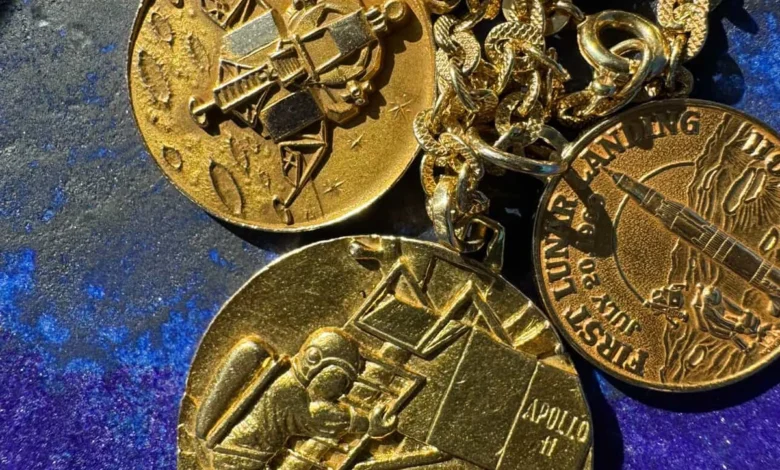
- Thematic Specialization: Modern collecting often involves "the hunt" for specific motifs. For Allison, this solidified into two primary areas: commemorative lunar landing pieces and "A" initial signet rings.
Thematic Curation: Space Exploration and Personal Identity
One of the most distinct aspects of the @HollywoodGold collection is its focus on the 1969 lunar landing. The Apollo 11 mission was a watershed moment in human history that triggered a global explosion of commemorative merchandise, including high-end jewelry. Prominent houses such as Van Cleef & Arpels produced limited-edition pieces to celebrate the event. Allison identifies the Van Cleef moon landing pendant as her "white whale"—an industry term for a rare, highly coveted item that remains elusive due to its scarcity and high market value.

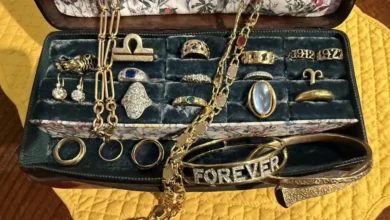
The second pillar of her collection involves "A" initial rings, specifically vintage and antique signets. This pursuit highlights a common challenge for female collectors of antique jewelry: the historical gender bias in sizing. Historically, signet rings were symbols of authority and legal standing, primarily worn by men. Consequently, many of the finest surviving examples are found in larger sizes (10 or 11). The effort to source these pieces in smaller sizes for a female hand requires significant patience and a deep network of specialized dealers.
Beyond these intentional themes, the collection has organically expanded to include Guadalupe medals and "vintage nudies"—a subgenre of 20th-century jewelry that features stylized human figures, reflecting the liberated social attitudes of the 1960s and 70s.

The Digital Transformation of the Jewelry Marketplace
The methodology of jewelry acquisition has been revolutionized by digital platforms. While traditional auction houses like Sotheby’s and Christie’s remain relevant for blue-chip pieces, the "everyday" high-end vintage market has migrated to Instagram and eBay. Allison notes that her schedule necessitates an almost exclusive reliance on online shopping, a sentiment echoed by many modern professionals.
This digital shift has fostered a peer-to-peer ecosystem where collectors buy directly from trusted curators. Sellers such as @thefabnab, known for a specialty in rubies, and @a_golden_gem, a specialist in gold chains, represent a new class of "micro-dealers" who provide a more personalized and transparent experience than traditional storefronts. However, the importance of physical events remains; Los Angeles-based fairs like Pickwick Vintage and A Current Affair continue to serve as vital touchpoints for collectors to verify quality and craftsmanship in person.

Supporting Data: The Growth of the Pre-Owned Luxury Market
The trends observed in individual collections are mirrored in global economic data. According to reports from McKinsey & Company, the pre-owned jewelry market is expected to grow at a compound annual growth rate (CAGR) of 8% to 12% through 2025. Several factors drive this growth:
- Value Retention: Unlike many contemporary luxury goods that depreciate immediately after purchase, vintage gold jewelry often retains or increases in value based on the spot price of gold and its historical significance.
- Sustainability Demands: Younger generations of collectors (Millennials and Gen Z) are significantly more likely to purchase pre-owned goods to align with their environmental values.
- Uniqueness: In an era of algorithmic fashion, the desire for "one-of-a-kind" pieces has made vintage items more desirable than current season "it" bags or jewelry.
Analysis of Implications: Style as a Perspective
The philosophy underpinning the @HollywoodGold collection suggests that jewelry is not merely an accessory but an extension of personal style, which Allison defines as "having a perspective" and "how one lives their life." This perspective views adornment as a form of freedom of speech and creative output.

The broader implication for the jewelry industry is a move toward "story-driven" inventory. Consumers are no longer satisfied with generic luxury; they seek pieces with a narrative, whether that narrative is the 1969 moon landing, the history of a family signet, or the preservation of 1970s design language. This shift challenges traditional retailers to reconsider their approach to sustainability and the secondary market.
Broader Impact on the Collector Community
The rise of collectors like Allison has democratized the world of high-end jewelry. By sharing her collection, her rescue animals (including Pete the bearded dragon), and her sourcing process, she contributes to a community that values authenticity over pretension. This community-driven model of collecting serves as an educational resource for new enthusiasts, teaching them how to spot quality, understand market values, and build a collection that reflects their personal history rather than fleeting trends.

In conclusion, the story of @HollywoodGold is a microcosm of the modern jewelry world. It is a world where the bold gold of the 1970s meets the digital age, where environmental ethics drive aesthetic choices, and where the hunt for a rare lunar medal is as much about historical preservation as it is about personal style. As the market for vintage jewelry continues to expand, the emphasis on curation, sustainability, and individual narrative will likely remain the defining characteristics of the next generation of collectors.