Decoding the 2026 Holiday Shopping Paradigm: A Comprehensive Analysis of Black Friday Winners, Losers, and Emerging Consumer Trends

The landscape of American consumerism underwent a fascinating transformation during the pivotal post-Thanksgiving weekend of 2026, punctuated by record-breaking online expenditures, weather-induced logistical disruptions, and a fundamental shift in how generations approach the annual holiday shopping ritual. While the traditional narrative of Black Friday has evolved significantly over the past decade—stretching further into the calendar year and moving seamlessly between digital storefronts and physical shopping malls—the core event remains a vital barometer for the health of the retail sector. As early data from analytics firms and on-the-ground reports begin to paint a clearer picture, industry analysts are dissecting a complex season defined by aggressive discounting, weather crises, and an unexpected resurgence in experiential, brick-and-mortar deal-hunting.
The overarching macroeconomic environment heading into the fourth quarter of 2026 cast a long shadow over holiday retail strategies. Inflationary pressures, while stabilized compared to previous years, left consumers exceptionally price-conscious and rigorously disciplined regarding their spending. Shoppers entered the holiday season with carefully calculated budgets per recipient, forcing major retailers to rethink traditional promotional cadences. Rather than employing the historical playbook of starting with modest price cuts and slowly deepening discounts as Christmas approached, brands recognized that hesitation would cost them market share. Consequently, Black Friday 2026 emerged as a high-stakes arena of aggressive, deep-discount pricing right out of the gate.
Record-Breaking Digital Spending and the Evolution of the Consumer Mindset
Despite widespread economic caution, U.S. consumers demonstrated an unwavering appetite for holiday commerce, both in brick-and-mortar stores and across digital platforms. According to comprehensive data released by Adobe Analytics, consumer spending on online channels alone surpassed an astonishing $13 billion on Black Friday, representing a robust year-on-year increase of more than 11%. This digital surge reflects a multi-year trend of shoppers initiating their holiday gift procurement earlier than ever—with some commencing their lists as early as the summer months—while continuing to execute major purchases throughout the post-Thanksgiving weekend.
However, the sheer volume of online traffic did not detract from physical retail spaces, provided the incentive was substantial enough. Retail experts stationed across various regional malls noted that traffic was heavily concentrated around brands offering dramatic price reductions. Industry analysts observed that unless a retailer or brand immediately slashed prices by 30% to 50%—with many doorbusters reaching an aggressive 60% to 70% off—they struggled to capture meaningful foot traffic. In a market where every dollar needed to stretch to its absolute limit, consumers refused to settle for marginal savings.
Chronology of a Crisis: The Deflation of a Centennial Tradition
The most dramatic narrative arc of the holiday weekend unfolded before the official start of Black Friday, centering on a monumental logistical disruption in New York City. The historic Macy’s Thanksgiving Day Parade, celebrating its landmark 100th anniversary, faced an unprecedented obstacle: a severe, fast-moving winter storm that ravaged much of the East Coast with catastrophic gale-force winds.
For nearly a century, the iconic parade has served as a beloved American institution, broadcast to millions of households nationwide and drawing immense crowds to the streets of Manhattan. However, as meteorological forecasts confirmed the arrival of hazardous wind speeds capable of destabilizing the massive character balloons and endangering the lives of millions of spectators, marching bands, and support staff, corporate leadership faced an agonizing decision. On Wednesday, just hours before the scheduled festivities, Macy’s executives made the prudent, safety-first determination to postpone the centennial pageantry to Saturday, effectively deflating the giant balloons and pausing preparations.
The storm’s severe impact across the Eastern Seaboard validated the cancellation as a necessary precaution, preventing potential tragedies associated with flying debris and structural instability. Despite the immense logistical headache, financial cost, and initial disappointment for travelers, the postponement proved to be a temporary setback. When the parade finally commenced on Saturday under clearer skies, it transformed into a joyful, highly successful celebration of a century of holiday magic, ultimately preserving the heritage of the institution without compromising public safety.
Winners of the Weekend: Department Stores, Doorbusters, and Social Commerce
While the retail ecosystem experienced mixed results, several key players emerged as clear victors by aligning their strategies with modern consumer demands.
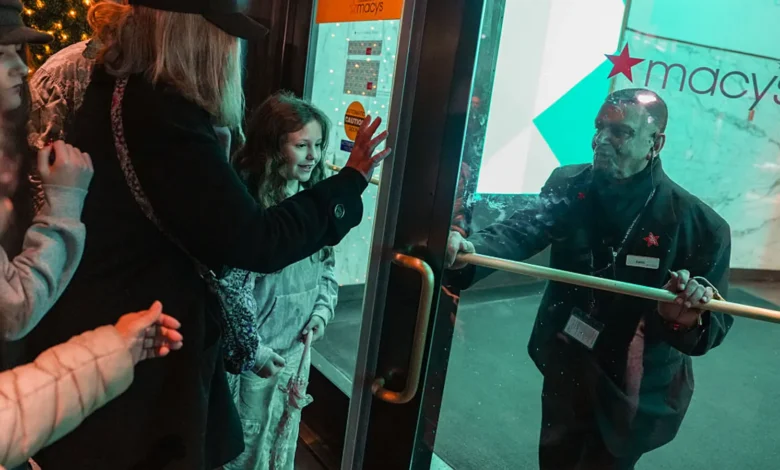
Macy’s Inc. and its upscale subsidiary Bloomingdale’s stood out as premier physical destinations for holiday shoppers. While several traditional department store anchors in suburban malls experienced lackluster foot traffic, Bloomingdale’s enjoyed brisk, steady crowds. Meanwhile, namesake Macy’s locations dominated regional malls, largely driven by an aggressive pricing strategy. By offering deep doorbuster discounts during critical morning hours—including jaw-dropping 70% off promotions—Macy’s successfully commanded the lion’s share of mall-goers, proving that department stores can still drive physical engagement when the value proposition is overwhelmingly attractive.
Another significant winner of the weekend was the revival of the traditional doorbuster. After years of diminished emphasis on early-morning doorbusters, 2026 saw a powerful resurgence of limited-time specials, early-bird prizes, and substantial incentives. Data from Salesforce indicated that approximately one-third of consumers planned to arrive at retail locations early in the morning to secure Black Friday promotions, a trend heavily spearheaded by Gen Z shoppers. Younger consumers increasingly view early-morning shopping not merely as a chore, but as an experiential moment worthy of social sharing and storytelling.
Retailers leaned heavily into this cultural shift. Target elevated its traditional engagement strategy by distributing gift cards ranging from $25 to $1,000 to the first 100 shoppers at participating locations. Brands such as Lowe’s, Kohl’s, J.C. Penney, Michael’s, and Bass Pro Shops similarly reported strong turnouts driven by targeted morning promotions. This appetite for experiential, high-value shopping also translated into a vibrant social atmosphere inside physical stores, where groups of shoppers browsed together, sampled seasonal goods, and carried multiple bags, signaling a return to strategic yet enthusiastic purchasing.
Perhaps the most structural shift observed during Black Friday 2026 was the profound maturation of social media and artificial intelligence as direct drivers of e-commerce revenue. Historically, social media platforms served primarily as upper-funnel marketing tools to drive brand awareness rather than direct transactional sales. However, research from Salesforce revealed that social media-driven traffic accounted for 7% of all online orders in the U.S., marking an impressive year-on-year increase of more than 80%, with global social orders multiplying sixfold. Platforms like Facebook and Instagram anchored this surge. Furthermore, consumer interactions with AI-powered shopping assistants and chatbots experienced a 110% year-over-year increase in traffic, demonstrating that digital consumers are increasingly trusting automated recommendations to guide their holiday purchasing decisions.
Losers of the Weekend: The Squeezed Off-Price Sector
Conversely, the off-price retail sector—typically a dominant force in modern American retail due to its relentless focus on everyday low pricing—faced an unexpected hurdle during the Black Friday weekend. Over recent years, off-price giants like T.J. Maxx and Burlington have steadily captured market share from traditional department stores by guaranteeing consistent, competitive value without the need for manufactured holiday promotional events.
However, the sheer intensity of the price slashing across mainstream department stores and mass merchants during Black Friday 2026 temporarily neutralized the competitive advantage of off-price retailers. When major competitors aggressively advertised steep percentage-off promotions, doorbusters, and carefully curated budget gifting sections—such as Target’s $5 baseline items and Walmart’s "Deals for Every Budget" campaigns—the standard value proposition of off-price stores felt less urgent. Field reports indicated that off-price locations remained relatively quiet throughout the Friday shopping window, largely because they refrained from participating in deeper holiday discounting beyond their normal operating models. This dynamic suggests that while off-price retailers remain formidable long-term competitors, they may need to adapt their promotional agility during marquee retail events to prevent consumers from migrating toward deeper, headline-grabbing holiday markdowns.
Broader Implications and Outlook for the Remainder of Q4
The early indicators from Black Friday 2026 provide vital insights into the trajectory of the remainder of the fourth-quarter holiday shopping season. The overarching takeaway for industry analysts is that consumer demand remains resilient, but it is entirely conditional upon perceived value and experiential engagement.
Retailers who attempted to play it safe with conservative initial discounts risk losing momentum as shoppers carefully allocate tight budgets across their gift lists. Conversely, brands that embraced aggressive discounting out of the gate—while successfully integrating omnichannel strategies like social commerce and AI-driven recommendations—captured vital consumer loyalty and transaction volume.
As the holiday season progresses toward its December crescendo, the lessons of Black Friday 2026 will undoubtedly guide inventory management, promotional adjustments, and marketing expenditures. The ability to seamlessly blend digital innovation with high-impact physical experiences will likely determine which retailers successfully navigate the remainder of the fiscal year and emerge victorious in an increasingly competitive marketplace.