Australian photographer and conservationist Jon McCormack’s latest photobook, Patterns: Art of the Natural World, published by Damiani and timed for Earth Day on April 22, 2026, presents a profound exploration of the interconnectedness and inherent intelligence within the natural world. The project, born from a significant reevaluation of his artistic practice during the global COVID-19 pandemic, marks a departure from his previous expansive travels. McCormack’s enforced period of stillness, confined to a single location, cultivated a deeper, more deliberate approach to observation, ultimately revealing the universal language of patterns that transcends diverse scales and environments.
McCormack describes the pivotal shift that occurred during the pandemic: "Repetition removed distraction. Because I wasn’t constantly moving on to a new destination, I could no longer rely on the excitement of elsewhere. I had to let the subject reveal itself more slowly." This intentional slowing down allowed him to move beyond the immediate visual spectacle and delve into the underlying structures that shape natural phenomena. The resulting collection showcases an extraordinary range of subjects, from the dynamic movement of a bear mid-shake to the intricate, microscopic designs found in rocks like jasper and quartzite. These seemingly disparate elements are unified by their shared patterns, evoking a sense of childlike wonder and curiosity that McCormack deeply values. "Something about fossil and rock photography makes me feel as though I’m tapping into my inner child," he notes. "There’s a joyful sense of curiosity and wonder that comes from closely studying something so simple, yet so extraordinary."
The Pandemic’s Catalytic Effect on Artistic Vision
The COVID-19 pandemic, which began in early 2020, brought unprecedented global travel restrictions. For many artists whose work relied on exploration and diverse landscapes, this presented a significant challenge. However, for Jon McCormack, this period of constraint proved to be a profound catalyst for artistic growth. Confined to his immediate surroundings, McCormack found himself revisiting the same locations repeatedly. This sustained, intimate engagement with a limited geography forced a radical shift in his perspective.
"COVID changed the scale at which I was paying attention," McCormack explained in an interview. "Before that period, much of my photographic life was built around movement, travel, fieldwork, and the sense that the next place might reveal the next image. When the world closed down, that outward momentum disappeared almost overnight. I was left with a much smaller radius, but in an unexpected way, that limitation became clarifying."
He elaborated on this transformative experience: "I began returning to the same stretch of coast in Northern California again and again. At first, I approached it as anyone might: wide scenes, sunsets, the obvious landscape photographs. But repetition has a way of stripping away the easy answers. Once the obvious pictures were exhausted, I had to look harder. What emerged was a very different relationship with the natural world. I became less interested in the grand view and more attentive to the way light moved across water, the way foam gathered around rocks, and the way tiny changes in tide could completely alter the visual structure of a scene."

This period, from early 2020 through much of 2021 and into 2022 for many, saw McCormack developing a practice that prioritized depth over breadth. He realized that the world was not diminished by his limited travel, but rather revealed new layers of complexity. "That period taught me that the world is far more alive, varied, and inventive than we often allow ourselves to notice. I wasn’t discovering a new place every week, but I was discovering that the same place is never actually the same. In that sense, COVID narrowed my geography but expanded my seeing. It pushed me away from novelty and toward attention, and that shift eventually became foundational to Patterns."
The Unifying Principle of Pattern
The genesis of Patterns can be traced to McCormack’s realization that a unifying principle was emerging from his focused observations. Initially, his post-lockdown work consisted of smaller, impressionistic landscapes. However, he found that these individual images lacked a cohesive narrative for a book. This realization prompted a deeper inquiry into what truly connected his subjects.
"I don’t edit that much, and that hasn’t changed," McCormack stated regarding his process. "However, the way I think about photography has changed a lot. At the beginning, the work I was making during COVID was more narrowly conceived, with small, impressionistic landscapes that were almost variations on a single motif. There was a visual sensibility I liked, but not yet a larger idea capable of carrying a book. At one point I laid the work out and felt it simply wasn’t holding together. That was an important moment because it forced me to ask what I was really trying to photograph."

The breakthrough came with the recognition of pattern as the organizing principle. This insight allowed him to bridge seemingly disparate subjects. "What I eventually understood was that the organizing principle wasn’t place at all. It was pattern. Once that clicked, my subject choice changed from being about category or subject matter to being about resonance. Aerial photographs, ice caves, microscopic forms, animal markings, fossils, and shorelines could all speak to one another if they shared the same structural or rhythmic intelligence. I stopped thinking so much in terms of ‘landscape image,’ ‘macro image,’ or ‘microscope image,’ and instead thought about how forms echoed across scale."
This conceptual shift profoundly influenced his approach to storytelling in photography. "That also changed how I think about storytelling. I’m now more interested in projects that emerge from a way of seeing than from a checklist of locations or subjects. A strong body of work, for me, is less about coverage and more about coherence, about whether the images deepen one another. Patterns became a story not because it documented one place or one ecosystem, but because it traced a visual language that appears again and again throughout the natural world."
Patterns as Nature’s Language
For McCormack, patterns are more than just aesthetically pleasing arrangements; they represent the intrinsic intelligence and underlying order of the natural world. He posits that these recurring structures are not accidental but are the result of fundamental forces at play.

"Patterns are one of the clearest ways I experience both the beauty and the intelligence of the natural world," McCormack explained. "They are visual evidence that nature is not chaotic in the simplistic sense we sometimes imagine. Across wildly different scales and subjects, similar structures keep appearing: spirals, branching forms, tessellations, waves, repetitions, symmetries, and fractures. You can find them in coastlines, feathers, fossils, plants, glaciers, animal coats, mineral structures, and even microscopic life. To me, that recurrence suggests not sameness, but relationship."
He further elaborated on the profound meaning he derives from these visual connections: "What moves me personally is that patterns sit at the meeting point of art and process. They are beautiful, but they are not decorative accidents. They are shaped by pressure, flow, growth, chemistry, gravity, evolution, wind, water, and time. In other words, they are the visible traces of forces acting on the world. When I photograph them, I feel I’m not just photographing surface appearance. I’m photographing evidence, signs of how life and matter organize themselves."
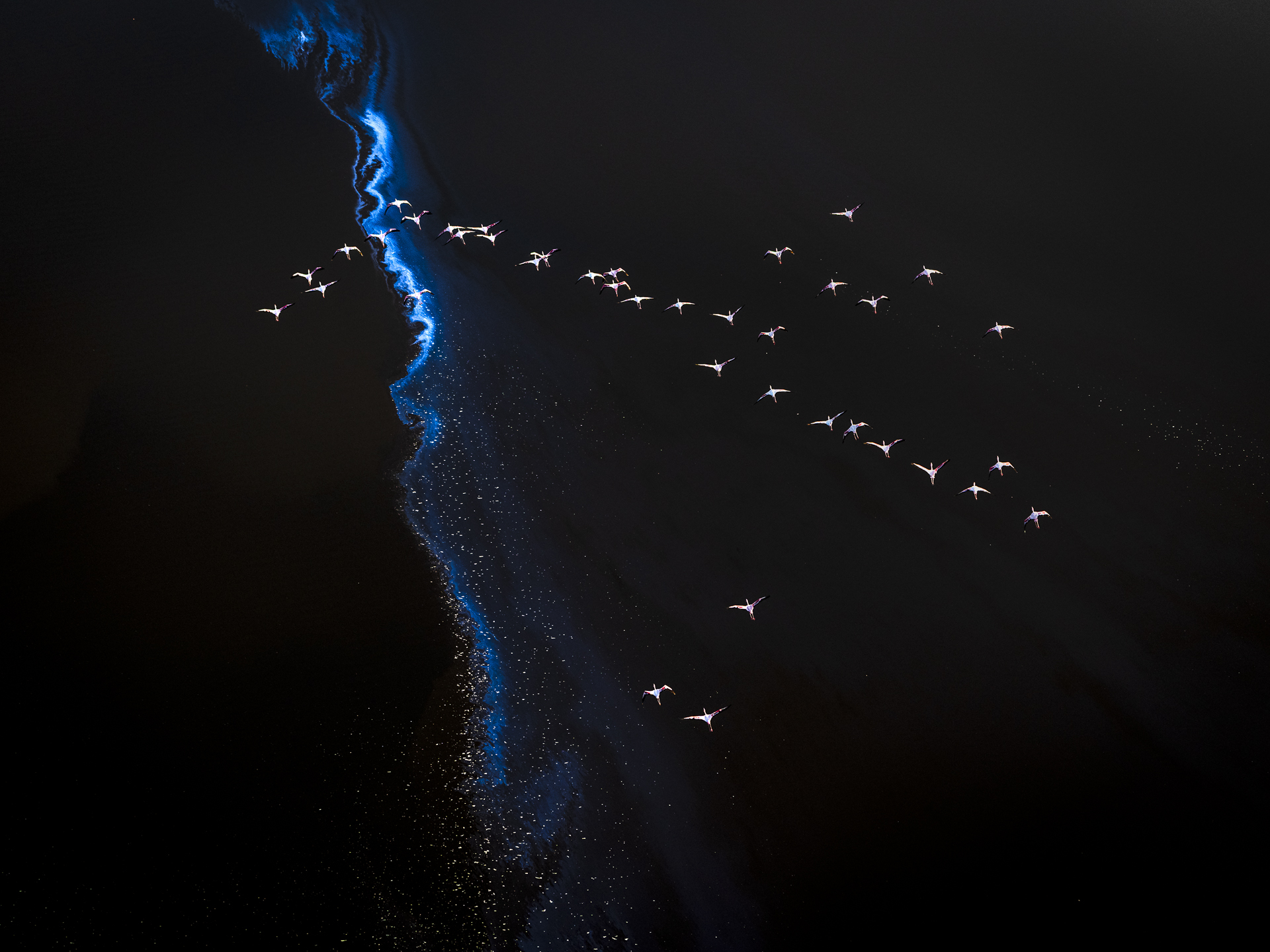
This conviction led him to dedicate an entire book to the concept of pattern, believing it to be a fundamental thread connecting all living things. "Patterns is an attempt to show that what links a salt lake, an ice cave, a fossil, and a microscopic organism is not just visual resemblance, but a shared belonging within one living system."

The Microscopic Realm and the Collapse of Scale
McCormack’s exploration extends to the microscopic world, revealing patterns that are as complex and compelling as those found in grand landscapes. His process for capturing these images involves intricate techniques, including focus stacking, to overcome the challenges of extremely shallow depth of field.
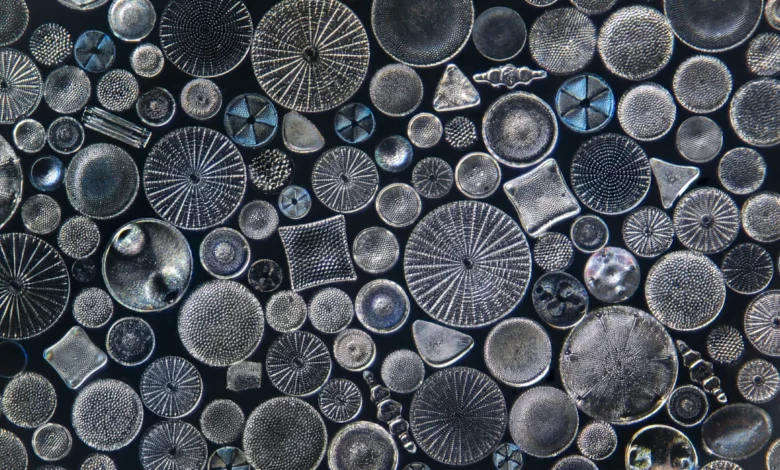
"The microscopic images begin with the same impulse as the larger landscape work: curiosity about hidden structure," McCormack shared. "I’m interested in forms that most of us pass through life never seeing, yet which carry an extraordinary sense of order, intricacy, and design. To photograph them, I work through a microscope, which requires a very different technical process from photographing in the field, but conceptually it is part of the same search. Most of my microscopic images require focus stacking of up to 25 images because the depth of field is miniscule."
The significance of these microscopic subjects lies not merely in their scale but in their thematic resonance with the larger patterns in the book. "What attracts me to microscopic subjects is not simply that they are small or surprising. It is that they often reveal the same formal principles I’m seeing at larger scales," he stated. "A diatom, for example, may contain a level of geometry and elegance that feels every bit as powerful as an aerial river system or a glacial formation. In the context of Patterns, that matters enormously, because the book is trying to collapse our assumptions about scale. It asks the viewer to see that a pattern does not become less profound because it is tiny, nor more profound because it is monumental."

His selection process for microscopic subjects, as with all his work for the book, is guided by a dual criterion: visual impact and thematic coherence. "As for deciding what to photograph, I look for subjects that do two things. First, they need to stand on their own as visually compelling images. Second, they need to participate in the larger conversation of the book. I’m always asking whether a microscopic photograph extends the visual language of the project. Does it echo something elsewhere in the sequence? Does it deepen the idea that nature repeats certain structures across scale? If it does, then it belongs. If it is merely novel, it probably doesn’t."
Nature’s Articulate Voice
McCormack’s introduction to Patterns eloquently captures his belief that the natural world is not merely a backdrop but an active communicator. "Beneath the surface of what we see lies structure, repetition, and intelligence, proof that the world is not just alive, but speaking," he writes. This sentiment underscores his perspective that the patterns observed are evidence of profound processes shaping our planet.
"That comment is really about paying attention," McCormack elaborated. "The world often presents itself first as surface, color, drama, atmosphere, spectacle. Those things matter, and photography can certainly begin there. But when I stay with a subject longer, I start to sense that beneath appearance, there is organization. Forms repeat. Rhythms recur. Similar solutions arise in very different contexts. At that point, nature begins to feel less like scenery and more like expression."

He clarifies his use of the word "speaking": "When I say the world is ‘speaking,’ I don’t mean that metaphor in a mystical or sentimental way. I mean that the visible world is full of legible traces of process. Patterns are the record of forces at work. They show where water has flowed, where ice has compressed, where minerals have crystallized, where organisms have adapted, and where time has layered change upon change. In that sense, nature is constantly communicating how it came to be what it is."
McCormack sees photography as a crucial tool for deciphering this communication. "Photography, at its best, helps me enter that conversation. It slows me down enough to recognize that what first appears abstract or beautiful also carries information and meaning. And when those same visual structures begin turning up in very different places, in an animal marking, a fossil spiral, a shoreline, or a microscopic form, I experience a strong sense of continuity. The world feels less fragmented. It feels articulate, interconnected, and deeply alive. That, ultimately, is what Patterns is trying to share. Recent coverage of the book describes these recurring forms as the ‘hidden visual language of the natural world,’ and that phrase resonates with me because it captures both the poetry and the underlying truth of what I see."
Supporting Conservation and Global Reach
The impact of Patterns: Art of the Natural World extends beyond its artistic and philosophical contributions. All proceeds from the book will support Vital Impacts, the nonprofit organization founded by renowned photographer Ami Vitale. Vital Impacts is dedicated to funding conservation efforts and empowering emerging storytellers worldwide, aligning perfectly with McCormack’s own conservationist ethos.

Furthermore, McCormack’s work will be showcased in significant exhibitions in 2026. In New York, his images will be featured outdoors on 6-by-6-foot photocubes throughout the South Street Seaport as part of Photoville, running from April 22 to June 14, 2026, in collaboration with the South Street Seaport Museum. Concurrently, a solo exhibition titled "Elements of Wonder: Where Nature Becomes Art" will open at CENTER Santa Fe on April 17, 2026, and will be on display through May 17, 2026, offering the public a comprehensive look at the themes explored in his new book. These exhibitions underscore the growing recognition of McCormack’s unique vision and his ability to translate complex scientific and ecological concepts into universally resonant visual art. The book’s release and accompanying exhibitions mark a significant moment for nature photography, emphasizing the interconnectedness of all life and the profound beauty found in the planet’s inherent patterns.