Italian Footwear Industry Navigates Global Headwinds with Domestic Resilience

The esteemed Italian footwear industry, a cornerstone of the nation’s "Made in Italy" reputation, finds itself grappling with a complex tapestry of global economic uncertainties and geopolitical unrest. Despite these significant international challenges, the sector is witnessing a noteworthy upswing in domestic demand, offering a crucial lifeline amidst turbulent export markets. This dual narrative emerges from the latest comprehensive data compiled by the Centro Studi of Confindustria Accessori Moda for Assocalzaturifici, the national association representing the country’s renowned shoemakers.
According to the detailed analysis released by the trade organization, the pervasive geopolitical tensions are proving to be a formidable impediment to the sector’s anticipated recovery. Exports, which historically constitute an overwhelming proportion – approximately 90 percent – of the industry’s total turnover, have already begun to exhibit discernible signs of difficulty in the nascent months of the current year. This early indication suggests a challenging path ahead for a sector heavily reliant on its global footprint.
The first quarter of 2026 underscored these concerns with tangible figures. Export volume experienced a notable decline of 3.6 percent, while export value simultaneously contracted by 1.6 percent when compared against the corresponding January through March period of 2025. This contraction in international sales directly impacted the overall financial performance, with total turnover for the first quarter of 2026 dipping by 2.7 percent, settling at 3 billion euros. These statistics paint a clear picture of the adverse effects of a volatile global economic landscape on one of Italy’s most iconic manufacturing sectors.
Giovanna Ceolini, the respected President of Assocalzaturifici, articulated the industry’s collective sentiment in a recent statement, affirming that these reported results "confirm the concerns" that had been voiced by companies during forecasts gathered at the close of last January. Her remarks underscore a sense of shared apprehension within the industry regarding the trajectory of international trade and its implications for Italian shoemaking.
Ceolini further elaborated on the prevailing conditions, explaining, "Against this backdrop, the domestic market has seen a slight recovery in consumption, though not enough to offset the slowdown in international markets, which remain the sector’s main driver. Geopolitical tensions are compounding these difficulties." This statement highlights the critical imbalance between a moderately recovering domestic front and the significantly more impactful downturn in international trade, emphasizing the indispensable role of global markets for the industry’s prosperity.
Geopolitical Fault Lines and Export Performance
Indeed, the data meticulously collected by Assocalzaturifici unequivocally demonstrates the heavy toll that international tensions are exacting on the industry’s results. Exports to the Middle East, a region frequently affected by conflict and instability, recorded a precipitous decline of 33 percent in the first quarter of 2026. This downturn was particularly acute in March alone, where exports plummeted by a staggering 62 percent, directly following the intensification of regional conflicts. The volatility in this critical market underscores the direct correlation between geopolitical events and economic performance, disrupting established trade routes and consumer confidence.
Similarly, exports destined for countries within the former Soviet bloc, a region still grappling with the ramifications of ongoing conflicts and sanctions, experienced a significant contraction of 21 percent. This reduction reflects the broader economic and political isolation affecting trade relationships with these nations, further limiting market access for Italian footwear manufacturers.
The United States, a historically vital market for high-end Italian footwear, also presented a challenging picture. The industry has been contending with the burden of additional import tariffs imposed since the spring of 2025, which have undoubtedly impacted pricing strategies and market competitiveness. In the first quarter of 2026, the US market recorded a 7.4 percent decline in value for Italian footwear exports. These tariffs, often stemming from broader trade disputes or punitive measures, add another layer of complexity for exporters already navigating fluctuating demand and currency exchange rates. The cumulative effect of these trade barriers has made it more difficult for Italian brands to maintain their market share and profitability in one of the world’s largest consumer markets.
Within the European Union, a key trading bloc for Italy, performance was mixed. France, a consistently strong partner, saw the value of Italian footwear exports increase by 5 percent. This positive trend occurred despite a 3.6 percent decline in volume, suggesting a shift towards higher-value products or perhaps an increase in average unit price. France remarkably retains its position as the leading destination for "Made in Italy" footwear, a testament to enduring cultural ties and consumer preference for Italian design and quality. In stark contrast, Germany, Europe’s largest economy, exhibited the sharpest slowdown among major partners, with Italian footwear exports plummeting by 10 percent in the first quarter. This decline is likely influenced by Germany’s broader economic deceleration and reduced consumer spending power amidst inflationary pressures and energy crises.
Domestic Resilience and Trade Balance Dynamics
Despite the pronounced difficulties on the export front, the sector’s trade balance exhibited an encouraging strengthening. In Q1 2026, the trade balance surged to 1.3 billion euros, marking a substantial 10.9 percent increase compared to the same period in 2025. This positive development is largely attributable to a significant slowdown in imports, which fell by a considerable 9.5 percent in value. The reduction in imports suggests a potential shift in domestic consumer preferences towards locally produced goods or perhaps a general tightening of household budgets, leading to fewer purchases of foreign footwear. This strengthens the overall net trade position for Italy, partially mitigating the impact of declining exports.
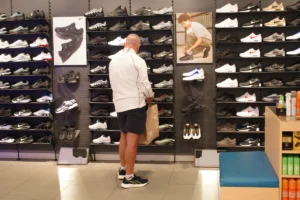
On the domestic front, the signals are distinctly more encouraging, offering a glimmer of hope amidst the global turbulence. Italian households demonstrated robust spending on footwear during the first quarter, allocating 1.28 billion euros. This represented a healthy increase of 1.7 percent in value and 2.1 percent in volume compared with the first quarter of 2025. This domestic resurgence was notably propelled by strong demand for women’s shoes and, significantly, trainers. Assocalzaturifici’s report highlights the growing dominance of athletic and casual footwear, with trainers, alongside other sports footwear, now accounting for a substantial 41 percent of total domestic spending. This trend mirrors a broader global shift towards comfort and athleisure wear, indicating that Italian consumers are embracing more casual styles for everyday use. The domestic market’s vitality provides a crucial buffer, preventing an even steeper decline in overall industry performance.
Production, Employment, and Structural Challenges
While domestic demand offers some solace, the production and employment landscape continues to present significant challenges. The number of active footwear manufacturing companies in Italy experienced a reduction of 85, accompanied by a loss of 808 employees compared with the end of 2025. This contraction underscores the severe pressures faced by manufacturers, including rising operational costs, reduced international orders, and the general economic slowdown. The closure of companies and job losses have ripple effects, impacting local economies and the artisanal heritage embedded within the Italian footwear industry.
A particularly concerning indicator is the continued high utilization of short-time working schemes (known as Cassa Integrazione Guadagni in Italy). Within the broader leather supply chain, hours of wage supplementation, although showing a 40 percent reduction from their peaks in 2025, still stood at a substantial 6.2 million hours. This figure is more than three times the pre-pandemic level, signaling that despite some improvements, a significant portion of the workforce remains underutilized or at risk. These schemes, while providing a social safety net, reflect an underlying structural vulnerability and a lack of full operational capacity across many firms.
Calls for Action and Strategic Imperatives
Giovanna Ceolini reiterated the profound unpredictability of the international economic environment, which continues to drive up costs and induce hesitation among international buyers. She underscored the twin challenges of "rising raw material and energy costs" as a "further cause for concern." These inflationary pressures directly erode profit margins, particularly for smaller and medium-sized enterprises (SMEs) that form the backbone of the Italian footwear industry. Furthermore, the persistent decline in the number of companies and employees on the production front adds to the urgency.
In response to these multifaceted challenges, Ceolini issued a clear call to action: "It is essential to take action to support internationalization, strengthen competitiveness and ensure stability for a sector that remains strategic for Made in Italy." This statement encapsulates the critical strategic imperatives for the industry’s future.
Broader Context: The "Made in Italy" Legacy
The Italian footwear industry is not merely an economic sector; it is a global emblem of "Made in Italy" excellence, synonymous with unparalleled craftsmanship, innovative design, and superior quality. For centuries, Italian shoemakers have honed their skills, passing down intricate techniques through generations, creating products that are highly coveted worldwide. This rich heritage makes the current struggles particularly poignant, as the erosion of the industry threatens not just economic output but also a vital part of Italy’s cultural identity and global brand power.
The industry’s interconnectedness with the broader Italian fashion and luxury goods ecosystem means that its challenges reverberate throughout the entire supply chain, from leather tanneries to component manufacturers and design studios. A downturn in footwear can signal broader pressures on the luxury sector, which is a significant contributor to Italy’s GDP and global prestige.
Historically, the Italian footwear sector has demonstrated remarkable resilience, weathering past economic crises, shifts in consumer tastes, and technological disruptions. From adapting to mass production in the post-war era to embracing global fashion trends and e-commerce in recent decades, the industry has shown a capacity for innovation and reinvention. However, the current confluence of geopolitical instability, persistent inflation, and lingering post-pandemic adjustments presents a uniquely complex challenge, demanding concerted efforts from both industry leaders and governmental bodies.
Future Outlook and Adaptation Strategies
Looking ahead, the Italian footwear industry must strategically adapt to navigate the unpredictable global landscape. Supporting internationalization will involve exploring new, stable markets, diversifying export portfolios, and leveraging digital platforms to reach global consumers directly. Strengthening competitiveness will necessitate continued investment in research and development, fostering sustainable production practices, and embracing technological advancements, such as automation and 3D printing, to enhance efficiency and reduce costs without compromising quality.
Innovation in design and materials, particularly focusing on sustainability, will be crucial. Consumers are increasingly demanding ethically produced and environmentally friendly products, and Italian brands have an opportunity to lead in this space, reinforcing their reputation for quality with a commitment to responsible manufacturing.
Governmental support, as advocated by Assocalzaturifici, will be vital. This could manifest as targeted export promotion programs, financial aid for companies struggling with high energy and raw material costs, incentives for digitalization and green transition, and diplomatic efforts to ease trade tensions and open new markets. Ensuring stability for the sector means safeguarding its skilled workforce, nurturing new talent, and preserving the artisanal knowledge that underpins its global appeal.
In conclusion, the Italian footwear industry stands at a critical juncture. While robust domestic demand and a strengthened trade balance offer encouraging signs of resilience, the persistent headwinds from global geopolitical tensions, trade tariffs, and inflationary pressures demand proactive and strategic responses. The sector’s ability to innovate, adapt, and secure targeted support will determine its capacity to not only weather the current storm but also emerge stronger, continuing its legacy as a beacon of "Made in Italy" excellence on the global stage.