Lands End Enters the College Football Marketing Arena With Immersive Tailgate Tour and Influencer Strategy

The autumn air across America is routinely thick with the scent of charcoal smoke, the roar of packed stadiums, and the unmistakable saturation of corporate sports marketing. While heavyweights like Celsius and Home Depot command prime-time real estate with multi-year sponsorships tied to broadcasts like ESPN College GameDay, heritage apparel brands are finding innovative ways to infiltrate the Saturday ritual. Among them is Lands End, the classic catalog pioneer founded in 1963, which has launched a strategic, multi-city college football marketing blitz designed to reintroduce the brand to a broader, multi-generational demographic.
The campaign kicked off quietly yet effectively on social media when Midwest-based lifestyle creator Lindsey Bosway, who commands an Instagram following of 120,000, published a sponsored reel showing her journey back to her alma mater for a weekend football game. Crucially, Bosway was not donning the merchandise of traditional sports drink or home improvement giants; she was sporting Lands End. This targeted influencer partnership forms just one pillar of a wider, fast-moving seasonal strategy engineered under the direction of Sarah Sylvester, who stepped into the role of chief marketing officer roughly six months ago as the company’s first CMO in nearly a decade.
The initiative signals a notable pivot for a company historically reliant on direct mail catalogs and a steadfast reputation for dependable outerwear, swimwear, and its iconic canvas tote bags. By aligning itself with the emotional resonance of game days, collegiate rituals, and in-person consumer touchpoints, Lands End is aggressively modernizing its operational playbook under the leadership of a newly installed executive team.
A Multifaceted Game-Day Playbook: The Tote Tailgate Tour
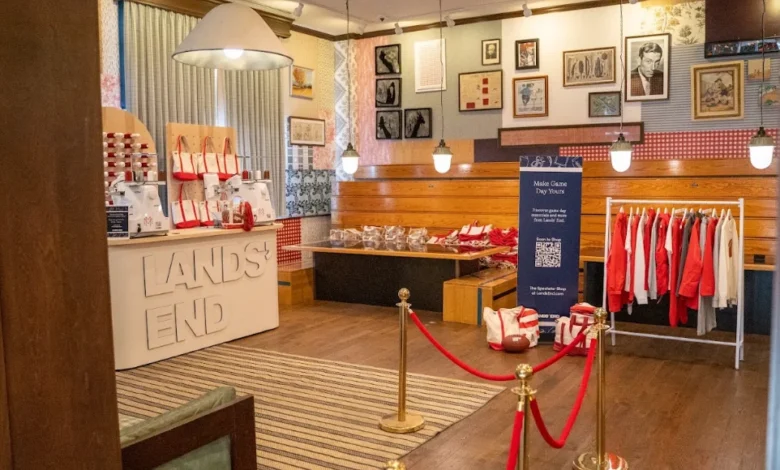
At the heart of Lands End’s autumn campaign is the "Tote Tailgate Tour," a traveling activation hitting three distinct college towns during peak football season: Bloomington, Indiana; Ann Arbor, Michigan; and Oxford, Mississippi. To execute the pop-up experiences, Lands End joined forces with Hilton’s Graduate Hotels line, embedding its brand presence directly into the fabric of localized weekend celebrations.
The tour features curated on-site activations designed to appeal to alumni, current students, and visiting families alike. Highlights of the pop-up events include Poindexter Coffee Shop takeovers offering complimentary coffee to guests, custom product personalization stations, and collegiate-inspired merchandise displays that showcase classic apparel essentials tailored to each university’s signature colorways.
According to brand executives, the decision to launch the tour stemmed from a collaborative brainstorm between the marketing and merchandising departments. As the product teams prepared fall inventories featuring new iterations of classic rugby shirts and a recently debuted clear tote bag—ingeniously engineered to comply with stringent stadium bag policies—Sylvester recognized an immediate opportunity to capitalize on the cultural phenomenon of college football.
The clear tote bag itself, launched just last month, represents a modern evolution of the brand’s traditional canvas staple. By adapting a historic product to meet contemporary regulatory hurdles at sporting venues, Lands End positions itself as a practical solutions provider for modern consumers. This philosophy echoes a similar summer activation where the brand teamed up with convenience store chain Wawa to release a specialized tote bag tailored to fit the retailer’s signature Shorti hoagie.
Strategic Timing and the Execution of a Rapid-Fire Campaign
In the world of corporate retail marketing, major seasonal campaigns are frequently planned, budgeted, and tested up to a year in advance. However, Sylvester’s approach to the college football push required a much more agile timeline.
Because the concept materialized organically from ongoing merchandising updates, the entire campaign was brought to life in roughly two to three months. While Sylvester acknowledges that a six-month runway is typically preferred for major strategic rollouts, the accelerated timeframe underscores a broader internal shift toward speed and opportunistic execution.
"I like to be a little bit more planful and get ahead of things," Sylvester noted. "It’s nice to give yourself more like six months, but there’s a fine balance of being super strategic and planful, [and] then also seeing a good idea and just moving fast to make it happen."
This willingness to pivot and experiment aligns with a broader pattern of cultural responsiveness from the brand. Earlier this year during the winter sports season, Lands End released an unofficial Olympic-themed collection, demonstrating a growing appetite for capitalizing on iconic cultural moments that resonate with its core customer base.
Leadership Transitions and Institutional Transformation
The current marketing push arrives amid a broader corporate transformation at Lands End. The company recently appointed a new chief executive officer, Charlie Cole, who took the helm approximately two months ago. Together with Sylvester, the new leadership team is tasked with revitalizing a brand that has spent the past several years attempting to balance its storied mail-order heritage with modern digital performance marketing.
Founded in Chicago in 1963 as a supplier of yachting equipment and clothing before pivoting to a major catalog operation, Lands End has watched the retail landscape transform entirely over six decades. Today, while digital channels and performance advertising absorb a significant portion of marketing budgets, physical touchpoints and experiential activations have re-emerged as crucial drivers of customer acquisition.
Sylvester emphasized that the brand views itself fundamentally as a "solutions-oriented" enterprise, with swimwear and outerwear serving as its two largest commercial pillars. By extension, marketing investments are increasingly evaluated through the lens of utility—determining precisely where Lands End can deliver the right product to the consumer at the exact moment of need.
The Role of Authentic Influencer Partnerships
In contemporary retail marketing, influencer collaborations are rarely viewed as experimental add-ons; instead, they have become foundational to driving top-of-funnel awareness. For Lands End, executing the Tote Tailgate Tour required integrating local creators who possess genuine ties to the communities where the pop-ups take place.
Rather than enlisting macro-influencers with broad, generic followings, the brand has focused on sourcing authentic regional voices. Lindsey Bosway’s Instagram post serves as a prime example. As an Indiana University graduate returning to her alma mater with a close friend, her content relied on genuine nostalgia rather than overt commercialism. Similar locally resonant partnerships have been established for the stops in Ann Arbor and Oxford, ensuring that the brand’s messaging resonates credibly with hyper-local audiences.
"Influencers are table stakes now as part of marketing," Sylvester said, highlighting the necessity of peer-to-peer recommendations in building consumer trust.
Broader Implications and Outlook for the Holiday Season
The success of the college football initiative serves as a crucial testing ground for Lands End as it looks ahead to the high-stakes fourth-quarter holiday shopping period. With consumer discretionary spending under constant scrutiny and competition for attention intensifying across digital and physical channels, the ability to merge real-world activations with digital content creation has become a vital competitive advantage.
Industry analysts note that heritage brands often struggle to bridge the gap between legacy consumer segments—such as long-time catalog subscribers—and younger demographics accustomed to experiential, community-driven retail. By embedding itself into multi-generational events like college football game days and leveraging localized influencers, Lands End is attempting to bridge this generational divide.
As the Tote Tailgate Tour concludes its current run, the company plans to synthesize the operational learnings and visual assets generated on-site to fuel its upcoming holiday campaigns. According to Sylvester, showing up in real life will remain a central pillar of the company’s forward-looking strategy.
"We are working toward an experience to continue to allow people to experience Lands End in real life, that we can then also use as content to kind of help fuel the holiday season," Sylvester concluded. As the traditional retail calendar continues to evolve, Lands End’s calculated blend of heritage utility and agile, experiential marketing offers a clear blueprint for how legacy brands can command attention on crowded autumn Saturdays.