Marques Almeida Redefines Its Grunge Roots With a Milan Debut That Balances Grown-Up Occasion Wear and Undiminished Rebellion

The international fashion landscape witnessed a significant geographic and stylistic transition on Sunday as London fashion week staples Marta Marques and Paulo Almeida staged their debut Milanese runway show for their namesake label, Marques’Almeida. Known historically for their gritty, fiercely independent East London aesthetic, the designer duo utilized their spring presentation not only to showcase a brand-new collection rich in architectural lower-body detailing, but also to signal a broader, more mature evolution in their design philosophy. For an industry accustomed to pigeonholing indie labels into static definitions of youth subculture, the Milan debut served as a complex meditation on what happens when the rebellious customer base of 2011 grows up without entirely shedding its edge.
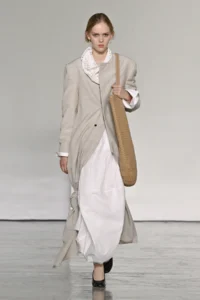
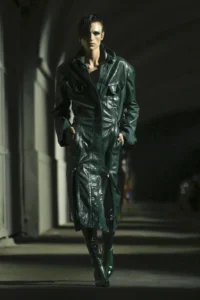
The collection itself was an exercise in structural contrast and lower-body dynamism. From the outset, the focus of the silhouettes was firmly anchored from the waist down. Peplums cinched the waistlines of lean taffeta tops that cascaded into dramatic barrel-leg trousers, while geometric panels jutted aggressively from both sides of asymmetrical handkerchief dresses. Cargo cotton miniskirts were paired unexpectedly with billowing, floor-sweeping trains in velvety silk, creating a friction between utilitarian practicality and opulent evening wear. Furthermore, maxi ruffles traced the edges of shantung sundresses, and silver sequins—rendered in both maxi and mini scales—decked out snazzy evening pants that commanded attention under the runway lights.
Behind the clothes lay a deliberate conceptual pivot. Speaking to a clutch of reporters in a backstage briefing ahead of the show, Marta Marques elaborated on the shifting parameters of their creative output.
"We’re exploring this kind of occasion wear and this more dressy approach, always with that grungy undertone," Marques explained, noting how the realities of their clientele’s changing lifestyles have dictated a shift in trajectory. "What’s occasion wear for, what customers need it for, and that definitely changes the way we’re approaching design maybe in a more grown-up way."
Even as she acknowledged this maturation, Marques was careful to push back against the absolute narrative that the brand has simply grown up and left its roots behind. Instead, she framed the Milan showing as an exploratory testing ground—a deliberate step that reflects the natural evolution of the business rather than a forced commercial rebrand. "I think it suits where we are," she offered, capturing the pragmatic yet forward-looking mindset that has guided the brand through more than a decade of shifting fashion paradigms.
A Decade-Long Evolution: From East London DIY to Milanese Runways
To fully understand the weight of the Marques’Almeida Milan debut, one must examine the chronology of the brand’s origins. Founded in 2011 out of an unassuming East London studio, Marta Marques and Paulo Almeida quickly carved out a distinctive niche defined by raw edges, distressed denim, and a palpable DIY ethos. Emerging from the prestigious Central Saint Martins MA program, the duo rejected traditional tailoring in favor of an undone, deconstructed aesthetic that immediately resonated with a club-savvy, countercultural demographic.
Over the subsequent decade, the brand navigated the notoriously volatile waters of independent fashion. They won the prestigious LVMH Prize in 2014, a watershed moment that provided both financial backing and global visibility, allowing them to scale their operations while maintaining their uncompromising design codes. Over the years, they experimented with various presentation formats, ranging from intimate showroom appointments to energetic London runway shows that celebrated the eclectic energy of the British capital.
However, the decision to relocate their spring presentation to Milan represents a strategic pivot. Milan Fashion Week, traditionally associated with legacy luxury houses, heritage tailoring, and high-octane glamour, offers a different commercial and critical ecosystem compared to London. For a brand historically celebrated for its unpolished grunge, stepping into the polished corridors of Milanese fashion is a calculated risk. It places them in direct conversation with a global luxury buyer, testing whether their distinct brand of elevated deconstruction can resonate within a more formal retail and editorial framework.
Balancing the Underground Past with Polished Occasion Wear
The core tension of the spring collection lay in this very paradox: how to satisfy the demands of dressier, more sophisticated occasion wear without alienating the core audience that fell in love with their uncompromisingly underground origins. The resulting wardrobe was explicitly curated for a DIY-minded, club-savvy individual who has evolved over the years—someone who may now require garments for formal events, boardrooms, or evening galas, but who still rejects conventional politeness.
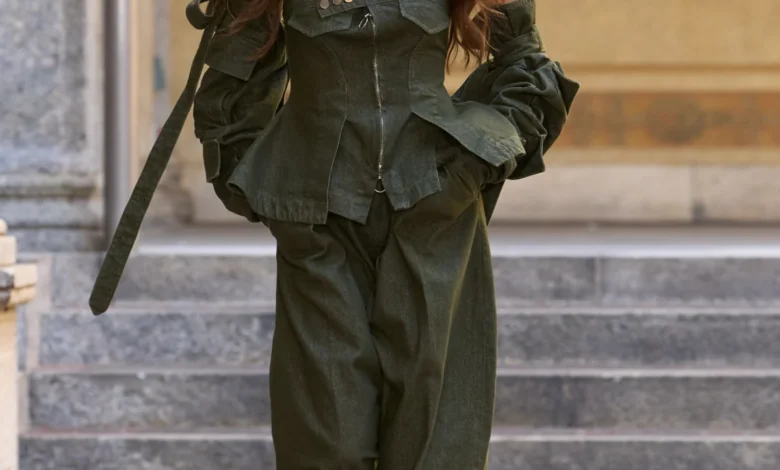
This duality was executed through a series of subtle styling choices and textile juxtapositions. Elements of the brand’s seminal proposition echoed throughout the collection: the offbeat plaid checks of asymmetrical dresses provided a nostalgic nod to their early grunge collections; the Goth undertones of a handsome black silk bias frock recalled dark, nocturnal London club scenes; and the utilitarian grunge spirit of a military green bustier paired with baggy pants grounded the collection in gritty realism.
Even when the designers played by the rulebook of composure and polite dressing, hidden subversive elements suggested a much tougher, more complex narrative. A base-layer-like Lycra bodysuit was juxtaposed with a voluminous balloon skirt, creating an intriguing silhouette that merged sportswear with high fashion. Club-ready, high-platform chunky sneakers were styled underneath floor-sweeping slipdresses, injecting an unmistakable dose of youth-culture rebellion into evening attire. In another look, a scarf-like top was wrapped tightly around the torso, layered over a flowing silk frock that added movement and fragility to the ensemble.
"It is not so put together," Marques noted, encapsulating the anti-establishment ethos that continues to prevent the brand from sliding into generic bourgeois elegance.
Broader Implications and Industry Analysis
The shift toward occasion wear by brands traditionally rooted in youth subcultures reflects a broader macroeconomic and demographic trend within the contemporary fashion industry. As the core consumer base of independent designers who launched in the early 2010s enters their thirties and forties, their lifestyle requirements shift. The demand for distressed denim and aggressively raw-edged garments declines, replaced by a need for sophisticated, versatile pieces that can transition from daytime professional environments to evening social settings.
For independent labels, successfully navigating this lifecycle transition is critical to long-term survival. Brands that fail to mature risk alienating their aging consumer base, while brands that mature too quickly risk losing the cultural cachet and authenticity that made them relevant in the first place. Marques’Almeida’s Milan debut indicates that the designers are acutely aware of this tightrope walk. By retaining grungy undertones, unconventional layering, and footwear choices that challenge traditional evening wear codes, they are attempting to bridge the gap between their storied past and their commercial future.
Furthermore, the geographic relocation to Milan underscores the changing geography of contemporary independent fashion. As major fashion capitals experience shifts in sponsorship, production costs, and buyer attendance, designers are increasingly willing to experiment with alternative platforms to reach international audiences. Whether Marques’Almeida will permanently anchor its operations in Milan or continue its history of nomadic experimentation remains to be seen. However, if this spring collection is any indication, the brand’s evolution is being managed with a sharp eye on both commercial viability and creative integrity.
Ultimately, the Milan presentation proved that growing up does not require abandoning one’s identity. By refining their silhouettes, elevating their textile choices, and leaning into the complexities of modern occasion wear, Marta Marques and Paulo Almeida have charted a sustainable path forward. They have demonstrated that the spirit of East London subculture can be successfully translated into the sophisticated lexicon of Milanese luxury, provided it is delivered with an unwavering commitment to authenticity and a refusal to be entirely "put together."
Related posts: