Mastering Your Wedding Budget: Essential Financial Tools and Comprehensive Planning Guides for Modern Couples

Planning a wedding is widely recognized as one of life’s most emotionally rewarding milestones, yet it frequently serves as one of the most significant financial undertakings a couple will face. As couples look ahead to their celebrations, navigating the complexities of modern wedding economics requires a high degree of organization, strategic foresight, and meticulous record-keeping. Recent industry data indicates that the average cost of a wedding continues to rise, driven by inflation, supply chain adjustments for imported florals and decor, and increasing vendor rates. In response to these economic pressures, couples are increasingly abandoning traditional, ad-hoc planning methods in favor of structured digital solutions designed to maximize cost efficiency and eliminate financial anxiety.

Financial transparency and rigorous budget tracking have consequently shifted from secondary considerations to absolute prerequisites for a successful event. Industry experts note that without a centralized system to monitor estimated versus actual expenditures, couples routinely exceed their initial financial limits by twenty to thirty percent. This overspending is rarely the result of reckless abandon; rather, it stems from overlooked incidental costs—such as service gratuities, administrative fees, unexpected alterations, and sales taxes—that accumulate quietly in the background. To address these systemic challenges, digital organization tools have emerged as essential assets, bridging the gap between romantic aspirations and fiscal reality.

The Evolution of Digital Wedding Planning Tools

In the past, wedding planning relied heavily on physical binders, paper receipts, and fragmented word-of-processing documents, a methodology that often led to misplaced contracts, missed payment deadlines, and miscalculated totals. The digital revolution transformed this landscape, introducing dynamic spreadsheet templates compatible with major productivity suites like Google Sheets and Microsoft Excel. These platforms allow for real-time collaboration between partners, instantaneous formula calculations, and secure cloud storage, ensuring that vital financial and logistical data remains accessible at a moment’s notice.

Recognizing the acute need for standardized, user-friendly financial frameworks, industry veterans and detailed-oriented planners have developed specialized resources tailored to contemporary couples. These tools range from streamlined, single-focus financial trackers to exhaustive, multi-sheet project management systems. By analyzing the structural components of these resources, couples can better understand how to allocate funds across diverse categories such as venue procurement, catering, artistic documentation, and attire.

The Core Foundation: The Free Wedding Budget Spreadsheet

For couples seeking a direct, unencumbered approach to financial management, foundational spreadsheet models provide an accessible entry point into wedding accounting. Modeled after the actual budgeting documents utilized by seasoned event professionals and founders, these free resources are engineered to function as a continuous financial companion from the initial engagement phase through the final post-wedding vendor settlements.

Available for both Google Sheets and Microsoft Excel, the primary utility of a dedicated budget spreadsheet lies in its ability to establish a realistic baseline. Users begin by inputting their total available funds, after which the template assists in distributing those resources across standard industry percentages: typically allocating roughly forty to fifty percent to venue and catering, ten percent to photography and videography, and the remainder to attire, entertainment, florals, and stationery.

As planning progresses, the spreadsheet functions as a live ledger. Couples can continuously update estimated costs with actual contractual figures, monitor payment schedules to avoid late fees, and log specific confirmation statuses for every procured service. Furthermore, a dedicated vendor tracking section ensures that contact information, deposit records, and balance-due dates are centralized, significantly reducing the administrative burden typically associated with managing a dozen or more independent suppliers.

Scaling Up: The Comprehensive All-in-One Wedding Planning Ecosystem

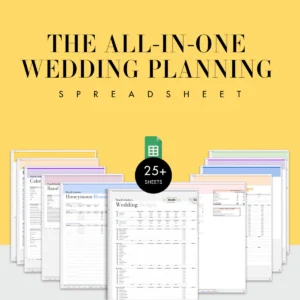
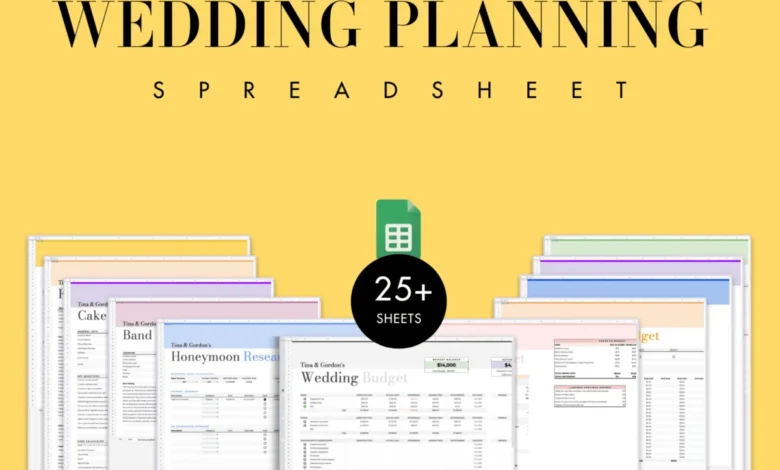
While a budget spreadsheet addresses the monetary aspect of an event, large-scale celebrations involve dozens of interlocking moving parts that extend far beyond finances. To accommodate the demand for holistic project management, comprehensive all-in-one wedding planning suites have been introduced to the market. Typically comprising upwards of twenty-five interconnected sheets, these premium packages transform a standard spreadsheet program into a robust enterprise resource planning (ERP) tool tailored specifically for nuptial events.

Priced competitively during promotional windows—such as seasonal discounts reducing standard rates from one hundred and five dollars to sixty-nine dollars—these comprehensive ecosystems cover every conceivable logistical requirement. The architecture of these advanced planners is built on extensive industry research, offering specialized calculators that remove the guesswork from complex purchasing decisions.

Among the standout features are specialized calculators for food and beverage provisioning. For instance, the drinks and alcohol cost calculator utilizes guest count, duration of the reception, and consumption habits to generate precise purchasing quantities for wine, spirits, beer, and non-alcoholic alternatives, preventing both costly over-ordering and embarrassing shortages. Similarly, the cake cost calculator factors in slice counts, tier structures, and design complexity to evaluate bakery quotes objectively.

Logistical Mastery: From Guest Lists to Honeymoon Logistics

Beyond financial metrics, the holistic planning spreadsheet addresses the intricate choreography of the wedding weekend itself. Effective guest list management is facilitated through dedicated tracking sheets that monitor RSVP statuses, dietary restrictions, formal mailing addresses, and specific seating arrangements. The integration of seating plan modules allows couples to visualize table configurations, ensuring that family dynamics and social circles are balanced harmoniously within the venue space.

Vendor research and comparison sheets form another critical pillar of the comprehensive planner. Dedicated tabs for photographers, videographers, florists, caterers, and entertainment allow couples to evaluate multiple vendor proposals side-by-side based on pricing packages, included deliverables, and contractual terms. This side-by-side analytical capability empowers couples to negotiate from an informed position, ensuring optimal value for their investment.

Moreover, the scope of these advanced planners extends beyond the wedding day itself, encompassing pre-and-post-event activities. Specialized travel and honeymoon research sheets assist in comparing destination options, booking accommodations, and establishing separate travel budgets. Concurrently, detailed packing lists tailored separately for brides and grooms—covering wedding weekend essentials as well as international honeymoon gear—ensure that no critical item is left behind. Additional micro-modules, such as wedding-day timelines, decor checklists, emergency kit inventories, and registry gift trackers, complete the ecosystem, providing a centralized operational hub for the entire celebration lifecycle.

Economic Implications and Industry Analysis

The proliferation of advanced digital planning tools reflects broader shifts in consumer behavior within the multi-billion-dollar wedding industry. Modern consumers increasingly demand transparency, customization, and self-service efficiency. By utilizing standardized templates for budget allocation and vendor research, couples are better equipped to navigate market volatility, including fluctuating vendor pricing and supply chain constraints.

Financial analysts note that proactive budgeting directly correlates with lower levels of stress and a reduced likelihood of entering marital life burdened by wedding-related debt. When couples utilize dynamic spreadsheets that automatically calculate net balances and project future expenses, they can make objective, values-based compromises rather than reactive financial decisions under pressure. Whether opting for a streamlined, complimentary budget tracker or investing in an exhaustive multi-sheet planning suite, contemporary couples possess unprecedented access to the organizational infrastructure necessary to execute their ideal celebration efficiently, accurately, and within their designated financial parameters.