Technical Precision in High-Volume Production
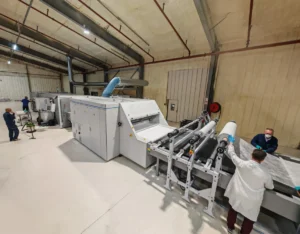
The KA-195 system functions as an integrated production hub, streamlining the previously fragmented process of compression, bag forming, and final sealing. In an era where manufacturing efficiency is measured by cycle times and material waste reduction, the machine’s capability to process up to 12 units per minute provides a substantial throughput increase for mid-to-large-scale manufacturers.
At the heart of the system is a servo-controlled compression plate, which serves as the primary differentiator between the KA-195 and traditional, less precise compression machinery. By utilizing advanced sensor technology and programmable logic, manufacturers can dictate the precise final height of the packaged product. This is not merely a mechanical task; it is a critical quality control measure. Different filling materials—ranging from traditional polyester fiberfill and memory foam to down, feathers, and synthetic clusters—behave differently under pressure. Excessive compression can permanently degrade the "loft" or resilience of a pillow, rendering it unsellable upon unpacking. The KA-195 mitigates this by allowing operators to set specific compression recipes, ensuring that shipping volume is minimized without sacrificing the structural integrity of the product.
The Evolution of Textile Logistics
To understand the significance of the KA-195, one must look at the historical context of textile shipping. Historically, pillows and duvets were shipped in their "natural" state, resulting in high shipping costs due to the "air" inside the shipping containers. As global logistics costs have climbed—driven by fluctuating fuel prices and the implementation of tighter carbon emission regulations for freight carriers—the industry has been forced to innovate.
The evolution of vacuum and compression packaging has occurred in several stages over the last two decades. Initially, manual compression bags were used, requiring labor-intensive sealing processes. This eventually gave way to semi-automated units that could seal bags but lacked the sophisticated feedback loops required for consistent compression. The introduction of the KA-195 marks the third generation of this evolution: a fully integrated, automated, and digitally controlled system that interfaces directly with the manufacturer’s ERP (Enterprise Resource Planning) systems.
Chronology of Innovation at ACG Kinna
ACG Kinna, based in the textile-rich region of Sweden, has long been a pioneer in automated machinery for the home textile industry. The development of the KA-195 did not happen in a vacuum; it is the result of a multi-year R&D cycle:

- 2022-2023: Initial market analysis identified a growing gap in the market for "smart" compression systems that could handle diverse product shapes and materials without manual intervention.
- Early 2024: Prototype testing began at ACG Kinna’s facility, focusing on the integration of HMI (Human-Machine Interface) systems that allow for quick product changeovers.
- Late 2025: Beta testing with select European manufacturing partners allowed the company to fine-tune the servo-control parameters for different filling materials.
- September 2026: Official market launch of the KA-195, targeting both the European and North American markets.
Data-Driven Manufacturing Implications
The move toward automation like the KA-195 is supported by compelling economic data. According to recent reports from the textile logistics sector, shipping costs for bulky home goods can account for up to 25% of the total landed cost of a product. By reducing the volume of a pillow through controlled compression, manufacturers can often increase the number of units per pallet by 40% to 60%.
For a manufacturer producing 500,000 units annually, this level of density improvement translates to hundreds of fewer shipping containers annually. When calculated against modern sustainability metrics—specifically the reduction of Scope 3 emissions related to transport—the return on investment (ROI) for the KA-195 is realized not only in direct labor savings but also in significantly reduced logistics overhead and a smaller environmental footprint.
Operational Flexibility and Smart Features
Beyond compression, the KA-195 is designed for a modular production environment. Modern retail demands often require unique branding, such as the insertion of care instruction leaflets, the application of promotional stickers, or the punching of handles for consumer convenience. The KA-195 integrates these secondary processes into the primary workflow.
The machine’s HMI allows for the storage of dozens of product "recipes." When a manufacturer switches from a luxury down pillow to a budget-tier synthetic cushion, the operator simply selects the corresponding profile on the touchscreen. The system then automatically adjusts the compression plate pressure, the seal time, and the bag-forming parameters. This reduces downtime—which is often the most expensive hidden cost in high-volume production lines—from what could be a 30-minute manual recalibration to a few seconds of digital selection.
Industry Perspective and Market Impact
Industry analysts observe that the move toward such high-level automation is no longer optional for firms operating in high-cost labor markets. As manufacturers in Asia and Eastern Europe continue to scale, Western firms are leveraging technology to maintain margins.
"The industry is moving toward a model of ‘intelligent packaging,’" says an independent manufacturing consultant familiar with the sector. "It’s not just about getting the product into a bag anymore; it’s about ensuring the packaging adds value to the logistics chain. ACG Kinna’s focus on controlling the ‘recovery characteristics’ of the product shows that they understand the core tension between shipping efficiency and product quality."

By automating the "human" elements of the packaging line—such as leaflet insertion and handle punching—the KA-195 also addresses the chronic labor shortages currently impacting the manufacturing sector in developed nations. By redeploying workers from repetitive, low-value packaging tasks to higher-level roles like machine supervision and quality control, manufacturers can improve both operational efficiency and staff retention.
Future-Proofing the Production Line
As the KA-195 hits the market, the broader implications for the textile industry are clear: the future of home goods manufacturing lies in the integration of smart, adaptable hardware. The ability to handle varying product dimensions and densities with high repeatability is the new benchmark for excellence.
Furthermore, the system’s design anticipates the future of e-commerce. With the rise of direct-to-consumer (DTC) sales, the need for robust, retail-ready packaging that can survive the rigors of individual parcel shipping—as opposed to bulk pallet shipping—is paramount. The KA-195’s ability to create vacuum-secured, perfectly formed packages makes the final product not only easier to ship on a pallet but also more durable during the "last mile" delivery process, reducing damage rates and return costs.
In summary, the ACG Kinna KA-195 represents more than just a piece of hardware; it is a strategic tool for manufacturers looking to survive and thrive in a volatile market. By balancing the competing needs of logistics density, product quality, and operational agility, ACG Kinna has provided a solution that addresses the fundamental requirements of modern textile manufacturing. As the industry continues to push toward full Industry 4.0 integration, the KA-195 stands as a testament to the power of precision engineering in driving sustainable growth. For manufacturers, the choice is increasingly clear: invest in intelligent automation or risk being left behind in a sector that is rapidly evolving toward total efficiency.