Reimagining the Paris Wine Tasting of 1976: FictionWorks Transforms a Former Charlotte Taco Joint into Napa Bistro and Wine Bar Stonecrest

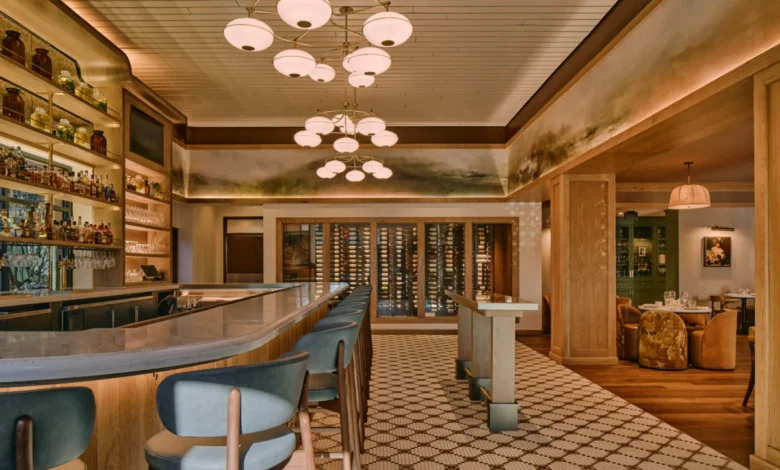
Nestled within the bustling commercial landscape of Charlotte, North Carolina—one of the fastest-growing metropolitan areas in the American Southeast—a former fast-casual taco restaurant has undergone a dramatic metamorphosis. The newly opened Napa Bistro and Wine Bar Stonecrest emerges not merely as another dining establishment, but as an architectural and interior design triumph masterminded by multidisciplinary studio FictionWorks, in collaboration with architecture firm In Situ Studio. Spanning a generous 6,500 square feet, the venue bridges the Atlantic and the continent, fusing the timeless, sophisticated aesthetics of a traditional Parisian bistro with the rustic, grounded charm of a Napa Valley agricultural farmhouse.

This ambitious hospitality project, brought to life for the Napa Restaurant Group, draws its primary conceptual narrative from a monumental historical milestone: the legendary 1976 Paris Wine Tasting, commonly known as the Judgment of Paris. By anchoring the design philosophy in an event that fundamentally disrupted the global wine hierarchy and proved that Californian winemakers could rival the established estates of France, the design team has forged a space that is as intellectually stimulating as it is visually captivating. Completed in a swift, highly coordinated nine-month timeline, the restaurant successfully reconfigures a flat, open-plan commercial shell into an intimate, multi-room culinary destination tailored for contemporary diners.
Architectural Chronology and Spatial Transformation
The realization of Napa Bistro and Wine Bar Stonecrest required navigating a complex set of structural and logistical hurdles typical of adaptive reuse projects. Working within the confines of an existing building footprint that previously housed a completely different culinary concept meant that the design and construction teams had to be exceptionally strategic with their resources. The project commenced with an intensive planning phase led by In Situ Studio, focusing on how to dismantle the rigid openness of the previous layout and replace it with a layered, residential sequence of interconnected dining spaces.

Over the course of less than nine months, the design team executed a precise hierarchy of spatial interventions. Recognizing the financial and structural constraints of retrofitting an existing envelope, FictionWorks deployed a calculated budgeting strategy. The core of the budget was funneled directly into high-impact, tactile elements that would command the visitor’s immediate attention: bespoke millwork, custom lighting fixtures, and an elaborate stained-glass installation. Conversely, secondary and more utilitarian elements—such as durable mosaic flooring, understated tabletops, and curated thrifted artwork—were approached with practical efficiency.
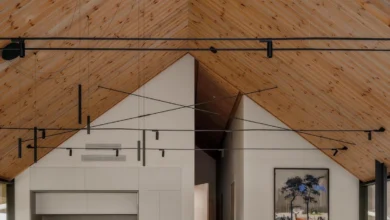
To counteract the notoriously high noise levels inherent in large, bustling dining environments, the architects integrated advanced acoustic engineering. A curved, vaulted ceiling outfitted with a specialized acoustic system by Baswa Acoustics was installed throughout the central areas. This technical intervention not only softens ambient sound, ensuring intimate conversations remain private, but also contributes significantly to the rhythmic, architectural flow of the interior architecture.

Materiality, Color Theory, and Design Influences
The interior palette of Napa Bistro and Wine Bar Stonecrest is a masterclass in cross-cultural design synthesis. Drawing inspiration from three distinct aesthetic traditions—the verdant, sun-drenched vineyards of Northern California, the warm, nostalgic earth tones of 1970s interior design, and the refined, urban elegance of Parisian cafe culture—the space achieves a remarkable visual depth.
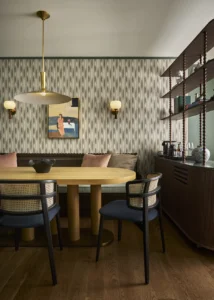
Rich, deep forest greens and saturated warm wood tones form the foundational layer of the interior, punctuated by deliberate flashes of amber, bronze, and polished brass. These hues intentionally evoke the rich chromatic spectrum of aged wines without falling into the trap of thematic pastiche or dated styling. Grounding the expansive floor plan is a classic black-and-white mosaic tile installation from Daltile’s Keystone collection. This geometric floor pattern provides a sharp, crisp contrast to the softer, more organic textures found at eye level, such as the worn leather upholstery of the custom banquettes and the plush booths lining the perimeter walls.

Lighting design plays a pivotal role in modulating the atmosphere throughout the day, transitioning seamlessly from bright, airy daytime lunches to moody, candlelit dinner services. Custom lighting fixtures, including oversized linen pendant lamps and sculptural metal chandeliers, are strategically positioned to complement the influx of natural light while casting dramatic shadows across the textured walls.
Artistry and Local Community Integration
Beyond its architectural shell, Napa Bistro and Wine Bar Stonecrest distinguishes itself through a rigorous curation of bespoke artwork and artisan-crafted details. At the heart of this artistic program is a custom stained-glass installation crafted from hand-blown glass rondels. Referencing the distinct aesthetic of 1970s glasswork, the sculptural glass piece takes its visual cue from the "punt"—the deep indentation found at the base of a wine bottle—tying the physical architecture back to the restaurant’s vinous identity.

The curation of the walls bridges geographical divides by pairing pieces from national and regional talents. A series of distinctive photographic prints and digital artworks by California-based artist Julia Crane are seamlessly intertwined with works by local creatives rooted in the Charlotte community. This dual-source art program ensures that while the restaurant looks outward to global wine history and West Coast aesthetics, it remains firmly rooted in its immediate Southeastern home.
According to FictionWorks co-founders Andrea De Camps and Olivia King, every single element within the establishment was chosen with a singular objective in mind. "The goal was to create a restaurant that feels approachable enough for a casual weeknight dinner while offering the sense of occasion people look for when celebrating a great meal and a bottle of wine," the co-founders noted. Every design decision—spanning the spatial architecture, material selection, lighting choreography, and artwork—was engineered to foster a deeper appreciation for gastronomy, oenology, and cultural history.

Historical Context and Industry Implications
To fully understand the spatial and conceptual weight of Napa Bistro and Wine Bar Stonecrest, one must examine the historical weight of its inspiration: the 1976 Paris Wine Tasting. Organized by British wine merchant Steven Spurrier, the blind tasting pitted top French wines against up-and-coming Californian contenders. To the shock of the international wine establishment, California Chardonnays and Cabernet Sauvignons swept top honors across the board. This watershed moment permanently altered the global wine map, shattering the monopoly of European prestige and proving that excellence could emerge from unexpected places.
By channeling this narrative into the very fabric of a suburban Charlotte restaurant, the design and ownership teams have created a physical manifestation of disruption and re-evaluation. Transforming an ordinary, run-down commercial space into a high-design culinary destination mirrors the very trajectory of New World winemaking itself.

As urban centers across the American Southeast experience unprecedented demographic shifts and economic expansion, dining establishments are increasingly required to offer more than just sustenance; they must deliver immersive, narrative-driven spatial experiences. Napa Bistro and Wine Bar Stonecrest stands as a testament to the power of adaptive reuse, proving that with strategic budget allocation, visionary architectural collaboration, and a clear conceptual anchor, even a former fast-casual restaurant can be elevated into a sophisticated venue that honors history while boldly redefining the contemporary dining landscape.