Roksanda Ilinčić Channels Textile Icon Françoise Grossen and Brutalist Architecture in a Triumphant Exploration of Tactility and Daywear

Roksanda Ilinčić has officially joined the vanguard of contemporary European fashion designers casting a brilliant, overdue spotlight on the contributions of pioneering female textile artists. For her latest collection, the visionary Serbian-born designer found profound inspiration in the monumental, tactile sculptures of Françoise Grossen. Known for her revolutionary work with knotted, braided, and looped industrial ropes, Grossen’s artistic legacy provided a rich conceptual framework for Ilinčić, deeply informing the structural and material narrative of the presentation.
This artistic synergy highlights a broader, increasingly vital movement within the upper echelons of luxury fashion. Designers are looking beyond traditional fine art references—such as painting and classical sculpture—to embrace craft-based disciplines historically marginalized as domestic or feminine. By translating Grossen’s avant-garde fiber art into high-fashion silhouettes, Ilinčić bridges the gap between high art and wearable design, offering a masterclass in texture, scale, and emotional resonance.
The Intersection of Craft, Gender, and Textile Art
Backstage before the show, amid the rising hum of anticipation, Ilinčić expounded on the emotional and physical pull she felt toward Grossen’s creations. The designer articulated a deeply held philosophy regarding the innate human connection to fiber, touch, and the domestic sphere.
“There’s something very earthly, very female about it. You know, women sitting, braiding, braiding hair, braiding dresses, braiding garments,” Ilinčić enthused, her hands gesturing to emphasize the rhythmic, universal nature of the craft. “That kind of tactility, craftsmanship, and something quite domestic, but taken to a totally different level, is something I absolutely love.”
This philosophy manifested tangibly throughout the runway presentation. In one standout look, Ilinčić incorporated a tightly braided spine running down the length of a masterfully executed, bias-cut brown silk gown, imbuing the fluid garment with unexpected structural integrity. Later, she framed the bustier of her glossy, panniered finale dresses with looser, more voluminous braids crafted from velvety Neoprene, creating a striking juxtaposition between rigid architectural volume and soft, touchable fiber.
Further exploring the boundaries of surface embellishment, Ilinčić utilized delicate eyelash fringe to animate a deceptively simple little black dress (LBD). Stray, errant threads were intentionally draped across pillow-like accessories and over the dynamic godets jutting sharply from her sweeping evening gowns. As the models walked, these loose threads caught the natural breeze blowing through the venue, introducing an organic, unpredictable element of movement to the high-fashion garments.
Architectural Roots and the Brutalist Backdrop
The choice of venue played an equally pivotal role in shaping the aesthetic and emotional resonance of the presentation. Ilinčić selected the Natural Dye and Wellbeing Garden at London’s National Theatre, a setting chosen quite deliberately to honor her lifelong fascination with Brutalist architecture.
For the designer, the stark, imposing concrete structures were not merely a stark backdrop, but a comforting reminder of her formative years. “I grew up with it,” said Ilinčić, gesturing casually to the raw concrete slabs jutting at sharp, unforgiving angles behind her. “I think it’s stood the test of time.”
The dialogue between Brutalist architecture and Grossen’s fiber art created a compelling visual tension throughout the show. The unyielding, monolithic geometry of exposed concrete provided a heavy, grounding counterpoint to the lightness, fluidity, and meticulous hand-craftsmanship of Ilinčić’s textiles. This interplay between hard and soft, permanent and ephemeral, underscored the intellectual depth that has long defined the Roksanda brand.
Expanding Horizons: The Strategic Push Into Daywear
While Ilinčić has built an international reputation as a master of dramatic eveningwear, red-carpet gowns, and artistic color blocking, her latest collection marked a significant, deliberate evolution in her design trajectory. Responding directly to the shifting lifestyles and demands of her core demographic, the designer used the runway to aggressively flex her muscles in the realm of sophisticated daywear.
“They’ve been asking: They want me to offer them everything for seven days a week from us. So I’m branching out,” Ilinčić explained with a characteristic shrug, acknowledging the commercial imperatives driving her creative expansion.
The modern luxury consumer increasingly demands versatility, looking to independent designer brands to supply not just statement pieces for special occasions, but elevated, reliable staples for daily professional and casual wear. Ilinčić met this challenge head-on, translating her signature artistic sensibility into functional, everyday silhouettes without sacrificing the intellectual rigor of her work.
Among the daywear offerings was an exceptionally tailored, sophisticated version of a beige safari jacket, sharply punctuated with contrasting black patch pockets that offered both utility and graphic impact. This was accompanied by a meticulously constructed shirtdress, featuring short, jutting sleeves and an engaging jumble of ticking stripes that played with optical perception and classic tailoring motifs.
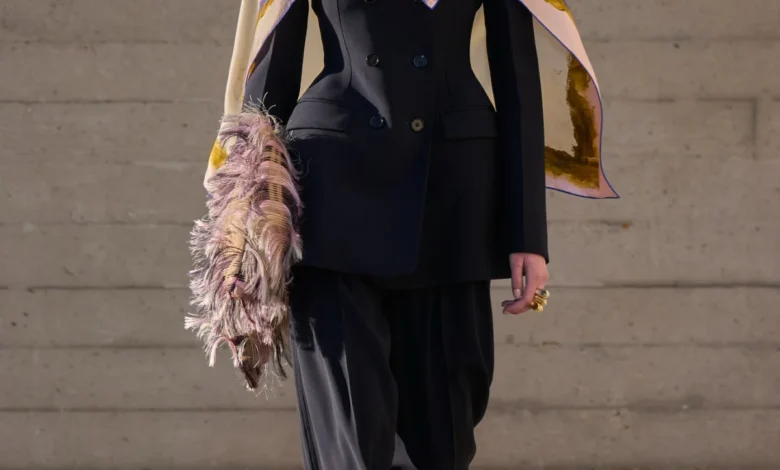
Perhaps the most compelling evidence of her daywear prowess was a killer black pantsuit featuring a tightly nipped, hourglass jacket. The precision of the tailoring and the authority of the silhouette bore a distinct elegance that would not have looked out of place on a historic Dior runway, yet it retained the modern, independent spirit unique to London fashion. To inject a signature burst of color and artistic flair, Ilinčić casually knotted a vibrant silk scarf over the shoulder, transforming a classic corporate silhouette into a wearable canvas.
Contextualizing the Collection Within the Broader Fashion Landscape
Ilinčić’s strategic pivot toward comprehensive daywear and her deep dive into fiber art arrive at a crucial juncture for independent luxury design houses. As the global fashion industry navigates economic uncertainties and shifting consumer values, brands are under immense pressure to balance creative integrity with commercial viability.
Historically celebrated for her fearless use of color and sculptural volume, Ilinčić has steadily cultivated a fiercely loyal clientele comprising art collectors, cultural figures, and professional women who value intellectual fashion over fleeting trends. By expanding her product categories to encompass full seven-day wardrobes, the designer is securing her business model against market volatility while deepening her relationship with existing clients.
Furthermore, the alignment with female textile artists like Françoise Grossen positions Ilinčić at the forefront of a major cultural shift. In recent seasons, the fashion world has experienced a profound reevaluation of craft, sustainability, and manual labor. As consumers become increasingly fatigued by mass-produced uniformity and fast-fashion cycles, garments that celebrate slow, deliberate handcraft—such as braiding, knotting, and weaving—carry an elevated emotional and monetary value.
Industry analysts have noted that collaborations and conceptual homages to female artists not only enrich the narrative depth of a collection but also resonate powerfully with modern, socially conscious buyers. By elevating textile art to the level of high sculpture, Ilinčić challenges the traditional hierarchy of the arts, asserting that fashion is a legitimate medium for sculptural and artistic expression.
Implications for the Future of the Roksanda Brand
The triumphant reception of this spring collection signals a promising new chapter for Roksanda Ilinčić. By successfully marrying her architectural foundations with tactile, craft-driven textile explorations, she has reaffirmed her status as one of the most intellectually stimulating designers working in London today.
The expansion into versatile daywear addresses a long-standing commercial gap, positioning the brand to capture a larger share of its clients’ total wardrobe budgets. As Ilinčić continues to refine her vision for the modern, multi-faceted woman—one who commands boardrooms, art galleries, and evening galas with equal poise—her ability to merge high art with everyday utility will undoubtedly serve as a cornerstone of her enduring success.
Ultimately, the presentation at the National Theatre was more than a mere showcase of seasonal garments; it was a holistic artistic statement. Through the echoes of Brutalist concrete, the tactile memory of Grossen’s knotted ropes, and the sharp execution of an everyday wardrobe, Roksanda Ilinčić proved that thoughtful, narrative-driven fashion is not only culturally relevant, but remarkably resilient.