Stitch Fix Revamps Private-Label Strategy with AI and Targeted Design to Drive Revenue Growth

The modern retail landscape is undergoing a quiet revolution, driven by shifting consumer habits, economic pressures, and the aggressive integration of artificial intelligence into traditional supply chains. At the forefront of this transformation is Stitch Fix, the personalized styling and e-commerce pioneer founded in 2011. Facing a complex macroeconomic environment and increasingly value-conscious shoppers, the company has executed a calculated pivot regarding its proprietary offerings. Rather than casting a wide net with a sprawling inventory, Stitch Fix has strategically chosen to go "narrow and deep," streamlining its private-label portfolio while vastly expanding the product categories within those core brands.
This strategic realignment has
emerged as a primary engine for the company’s recent financial resilience. For its fiscal year 2025, Stitch Fix managed a portfolio of 16 distinct private-label brands. Recognizing inefficiencies and a mismatch with how modern consumers actually build their wardrobes, leadership consolidated the lineup down to 10 core labels. However, pruning the portfolio did not mean scaling back ambition. Instead, the company expanded these surviving brands into non-apparel categories—such as footwear, jewelry, handbags, belts, and cold-weather accessories.
According to Amy Sullivan, Vice President of Buying and Private Brands at Stitch Fix, the philosophy behind the shift is rooted in practical lifestyle needs rather than rigid categorization. Historically, traditional fashion retail has operated on siloed concepts, designating specific labels strictly as "workwear" or "everyday casual." However, consumer behavior rarely follows such linear boundaries. By crafting more versatile, highly intentional brands that can span multiple use cases while remaining distinctly differentiated from one another, Stitch Fix has been able to foster deeper brand loyalty and position itself as a comprehensive closet-building destination.
The Evolution of Stitch Fix Private Labels: A Chronological Overview
The journey of Stitch Fix’s proprietary brands reflects the company’s maturation from a novel styling box startup into a sophisticated omnichannel apparel retailer. Understanding this trajectory provides essential context for the current restructuring.
The company first dipped its toes into proprietary design in 2013 with the launch of its initial women’s private labels. This move allowed Stitch Fix to capture higher profit margins and offer unique items that could not be found elsewhere, distinguishing its styling boxes from traditional department store offerings. Building on the success of the women’s division, the platform expanded its private-label footprint to include men’s collections in 2016, followed by kids’ apparel in 2018.
Over the ensuing years, these private labels grew in number, eventually peaking at 16 brands by fiscal year 2025. Yet, as the retail environment shifted and consumer expectations evolved toward versatility and value, management realized that quantity was superseding quality and clarity. The subsequent consolidation to 10 strategic brands marked a major turning point. By late 2025 and moving into 2026, these streamlined brands began aggressive cross-category expansions. For instance, the Montgomery Post brand rolled out handbags in the spring of 2026, while established names like 41 Hawthorn, Market & Spruce, and Montgomery Post introduced women’s belts and cold-weather accessories by the fall of 2026.
Data-Driven Merchandising and the Integration of Artificial Intelligence
What separates Stitch Fix’s private-label strategy from traditional fashion houses is its heavy reliance on direct consumer data and advanced machine learning models. By the end of August 2026, the styling service maintained a robust active client base of 2.277 million users. Every time a client interacts with a stylist, provides feedback, or keeps an item, data points are generated.
Stylists collect qualitative and quantitative feedback, which merchandising teams analyze to identify persistent wardrobe gaps. These insights dictate where private and national brands must step in to fulfill unmet customer desires. Furthermore, artificial intelligence plays a pivotal role across the entire product lifecycle—from trend forecasting and design kick-offs to client rating aggregation.
Stitch Fix utilizes proprietary AI tools to analyze visual data gathered by employees conducting international comparison shopping trips in fashion capitals such as Paris, New York, and London. The technology processes these visual trends, helping merchandising experts determine which aesthetics align with specific brand identities. For example, AI-driven analysis might indicate that a retro bandana motif is a natural fit for Market & Spruce, whereas relaxed-fit denim resonates more strongly with the design ethos of The Commons.
Beyond trend forecasting, merchandising experts use generative AI prompts to accelerate physical product development. By inputting specific criteria—such as requesting a sweater yarn that is non-itchy yet offers structural stretch—designers can fast-track the prototyping phase before applying human expertise to finalize the garments.
Client sentiment is continuously measured through "Style Shuffle," a gamified feature where users rate clothing concepts. In 2026 alone, clients submitted more than 14 million ratings across nearly 2,800 digital images, directly influencing upcoming private-label collections.
Micro-Targeting: The Case Study of the Teacher Capsule
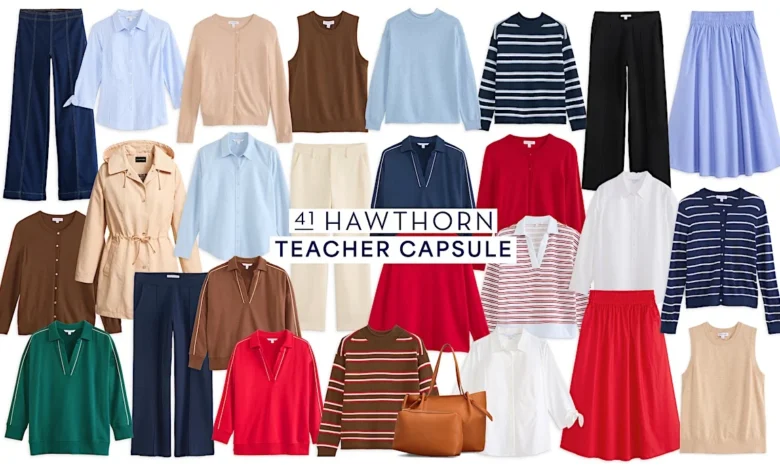
A prime example of Stitch Fix’s data-driven, problem-solving approach to private labeling is the teacher-focused capsule collection launched in August 2026 under the 41 Hawthorn brand.
The initiative was born out of direct feedback from more than 5,000 clients who work as educators. The data revealed distinct, practical pain points: 57% of responding teachers demanded clothing that accommodated physical movement, coverage, stretch, and functional storage like deep pockets, while 35% requested coordinated, mix-and-match capsule options. One kindergarten teacher noted that she spent roughly 80% of her working hours sitting on the floor while still needing to look professional enough for morning parent drop-offs.
In response, Stitch Fix designed items tailored precisely to these professional demands ahead of the back-to-school season. The resulting collection featured machine-washable staples such as the "Lessons to Lounge Trouser," the "Cozy Cash Cardigan," and a specialized three-quarter-sleeve button-down shirt designed so educators would not have to constantly roll up their sleeves while grading papers.
The teacher capsule proved to be a resounding commercial success, performing among the top-tier items for the fall season. Crucially, the appeal extended beyond educators to the broader consumer base, proving that hyper-targeted design can solve universal wardrobe dilemmas.
Financial Performance and the Private-Label Advantage
Stitch Fix’s private-label evolution occurs against a backdrop of broader financial recovery and macroeconomic caution. For fiscal year 2026, the company reported overall year-over-year revenue growth of 6.4%. During the fourth quarter ending in August 2026, net revenue per active client reached $592, representing a 7.8% increase compared to the previous year. However, executive leadership has maintained a measured outlook, citing a challenging consumer environment that could cause revenue growth to moderate in the coming fiscal year.
Within this financial ecosystem, private labels have emerged as a high-performing asset. Sullivan noted that Stitch Fix is seeing strong year-over-year revenue growth in its proprietary brands, paired with rising brand awareness among clients. Impressively, private labels now occupy the top three spots within both the women’s and children’s categories, while accounting for three of the top five spots in men’s apparel. Brands like the men’s activewear and workwear hybrid 01.Algo—which derives 20% of its revenue from work-appropriate attire—demonstrate the cross-functional utility that modern buyers demand. Other notable private labels in the stable include Hawker Rye, Rumi + Ryder, Bixby Nomad, and Alesbury.
Broader Industry Trends: The Rise of Private Labels in Retail
Stitch Fix’s pivot toward proprietary brands mirrors a broader macroeconomic shift across the retail sector. As persistent inflation and economic uncertainty weigh on consumers, shoppers across all income brackets are increasingly willing to trade down from national name brands to store-owned alternatives.
Private labels have permeated nearly every retail category, from grocery aisles to home goods. Major players have actively invested in this shift: Aldi recently redesigned its private-label packaging to signal elevated quality, Walmart rolled out a modern packaging overhaul for its flagship Great Value brand, and department store chain JCPenney has seen private labels swell to account for more than 50% of its total business, with its top-selling brand entirely proprietary.
This consumer migration is supported by changing perceptions of quality. A 2025 survey conducted by Gartner found that 77% of respondents believe store-owned brands match or even exceed the quality of national name brands.
For Stitch Fix, this trend reinforces the value proposition of its private labels, particularly when evaluated through the lens of "cost-per-wear." By offering thoughtfully designed, versatile garments that clients can wear multiple times a month, the company provides tangible value to budget-conscious shoppers without compromising on style or functionality.
Future Outlook and Strategic Implications
As Stitch Fix looks toward 2027, the company plans to further institutionalize its private brands, weaving them prominently into upcoming holiday marketing campaigns and seasonal messaging. The ultimate validation of this streamlined strategy, according to leadership, is organic consumer demand—specifically when clients begin requesting proprietary brands by name during styling sessions.
The implications of Stitch Fix’s strategy extend far beyond its own styling boxes. By marrying deep qualitative data with artificial intelligence and agile in-house supply chains, the company has demonstrated how digital-first retailers can optimize inventory, protect profit margins, and deepen customer loyalty in a competitive market. As consumer preferences continue to shift toward intentional consumption and multi-use versatility, Stitch Fix’s refined private-label portfolio positions the company to navigate future retail headwinds while remaining a central fixture in its clients’ everyday lives.
Related posts: