Swan Beauty Is Redefining The Intersection Of Luxury Beauty And Tech Through Strategic Experiential Marketing

In the fast-paced world of beauty technology, few startups have managed to capture the cultural zeitgeist as rapidly as Swan Beauty. At just nine months old, the company has transitioned from a niche hardware manufacturer to a prominent fixture in the influencer-led marketing landscape. By eschewing traditional advertising in favor of high-profile, experiential activations, Swan Beauty has successfully translated viral social media moments into tangible consumer growth, signaling a significant shift in how beauty-tech brands acquire customers in the digital age.
The company’s rise to prominence began in earnest this past April, when it orchestrated a high-visibility partnership with influencer Brigette Pheloung, known to her massive audience as @acquiredstyle. The collaboration, which centered on a lavish, influencer-heavy bachelorette trip, served as a blueprint for the company’s current marketing philosophy. By integrating the Swan smart mirror into an aspirational travel experience, the brand did more than showcase its hardware; it embedded itself into a lifestyle narrative. The data following that event was staggering: Swan Beauty saw a 4,000% week-over-week surge in iOS app downloads and a 1,900% increase in subscription signups, proving that for modern beauty consumers, seeing the technology in a real-world, high-stakes environment is far more effective than static digital ads.
The Technological Value Proposition
At the core of this marketing blitz is a sophisticated piece of hardware that aims to bridge the gap between professional artistry and at-home convenience. The Swan mirror, retailing at $795 with a recurring $9.95-per-month subscription fee, is designed to serve as an all-in-one beauty hub. The device features advanced hardware, such as three distinct lighting temperatures and seven brightness levels, but the true differentiator lies in its software.
The mirror utilizes augmented reality (AR) to provide guided makeup tutorials, real-time skin analysis, and integrated in-mirror shopping capabilities. Crucially, Swan Beauty has democratized access to this technology; consumers who do not wish to purchase the physical hardware can access the core platform experience through a smartphone application. This tiered entry model ensures that the brand remains accessible to a broader demographic, ranging from dedicated beauty enthusiasts to casual tech users.
Backed by the Mitchell Family Office—the private equity firm behind notable entities such as COS Bar, AFC Toronto, and The Daxton Hotel—Swan Beauty has the financial runway to pursue these aggressive, high-cost activations that prioritize brand equity over immediate conversion.
Scaling the Viral Strategy: A New York Fashion Week Case Study
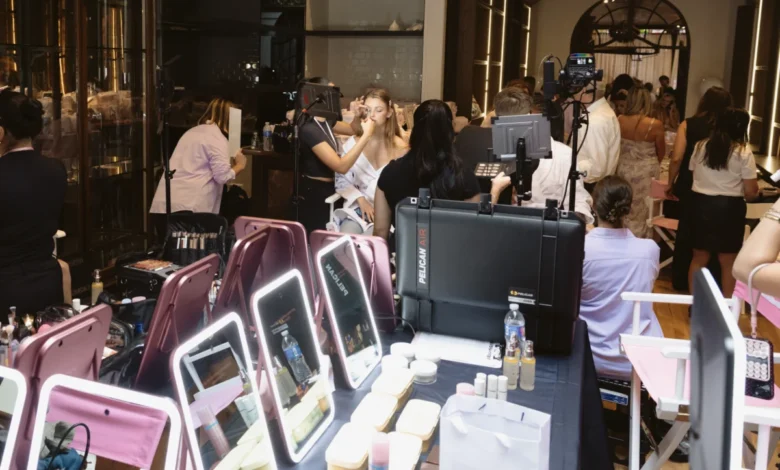
Following the success of the spring bachelorette activation, Swan Beauty sought to replicate that momentum on a larger, more public stage during New York Fashion Week (NYFW) this September. The goal was to pivot from one-off viral moments to a sustained presence, building what co-founder Colby Mitchell describes as “upper-funnel brand awareness.”
The company’s NYFW strategy was characterized by a multi-pronged approach that targeted different consumer segments:
- September 9: The activation kicked off with a “sleepover” masterclass at the Plaza Hotel, hosted in collaboration with the “Vike twins,” Alina and Inessa Vike of Vike Beauty. This event emphasized community building, featuring hairstyling masterclasses, hand-drawn portraits, and, most importantly, hands-on time with the mirrors.
- September 9–16: A week-long partnership with RPZL Rockefeller Center placed the mirrors directly into a high-traffic salon environment, allowing everyday consumers to interact with the technology outside the insular bubble of Fashion Week.
- September 10: The brand moved backstage at the LoveShackFancy presentation at Dante, providing industry professionals with the opportunity to test the mirror’s capabilities in a professional setting.
- September 11: The company participated in an invite-only “longevity suite” at the Mandarin Oriental, where the mirrors were used by Christina Skincare for professional skin assessments.
- September 15: The final major activation took place at the PatBO fashion show at Domino Park, cementing the brand’s presence in the high-fashion circuit.
This aggressive schedule yielded measurable results. The company reported a 32% week-over-week increase in site traffic during the NYFW period, while combined iOS and Android app downloads saw a 27% week-over-week lift.
Operational Excellence in Experiential Marketing
A recurring theme in Mitchell’s approach to these events is the intentional ratio of educators to hardware. For every three mirrors present at an activation, the company deploys one trained brand educator. This granular attention to detail is designed to remove the “barrier to entry” that often accompanies new technology. By ensuring that every guest—not just the high-profile influencers—receives a personalized demonstration, Swan Beauty fosters an environment of confidence. As Mitchell noted, the strategy is to engage the entire room of beauty lovers, creating a ripple effect of organic social media content as users share their own positive experiences.
Industry Implications and Future Outlook
The success of Swan Beauty’s recent activations suggests a broader trend in the beauty industry: the decline of passive media consumption and the rise of experiential, interactive brand building. By placing the mirror in the hands of creators, models, and designers, Swan Beauty is effectively leveraging social proof to validate its technology.
The partnership with LoveShackFancy provides a glimpse into the brand’s roadmap for long-term retention. By working with key makeup artist Matthew Taylor to create a “custom spring 2027 look” within the mirror’s AR software, the company is turning its hardware into a living, evolving platform. Users will soon be able to replicate professional runway looks at home, creating a feedback loop between fashion-forward content and the consumer’s daily beauty routine.
Looking ahead, Swan Beauty shows no signs of slowing its expansion. With a masterclass scheduled with dermatologist Dr. Michelle Henry, MD, in late September and plans to expand into additional B2B (business-to-business) channels, the brand is positioning itself to be more than just a passing trend.
The challenge, however, will be maintaining this growth trajectory once the initial excitement of “new-to-market” technology fades. The recurring subscription model is vital here; if the company can continue to update its AR features with high-value, trend-driven content—such as the upcoming LoveShackFancy collaboration—it will likely succeed in turning these one-time event participants into long-term, loyal subscribers.
In a market crowded with smart home devices and beauty gadgets, Swan Beauty has distinguished itself through a rare combination of high-end design, strategic influencer partnerships, and a clear understanding of the digital creator economy. By proving that technology can be both a practical tool and an aspirational accessory, the company has carved out a unique space in the beauty ecosystem. Whether they can scale this model to a mass market remains to be seen, but for now, their data-driven approach to brand awareness is setting a new standard for beauty-tech startups.