Talia Byre Embraces Soft Minimalism and Bridal Influence for Spring at London Fashion Week

London’s Hellenic Centre provided a serene backdrop for Talia Byre’s Saturday morning presentation, an event that marked a significant aesthetic pivot for the emerging British designer. Known previously for a vibrant, color-saturated palette, Byre utilized her latest runway show to introduce a softer, more contemplative approach to contemporary womenswear for the spring season. The transition toward a predominantly ivory, white, and cream color scheme signals a maturation of the brand’s identity, driven heavily by the designer’s recent foray into bespoke bridal wear and a broader industry craving for visual and psychological cleansing.
The Main Facts of the Presentation
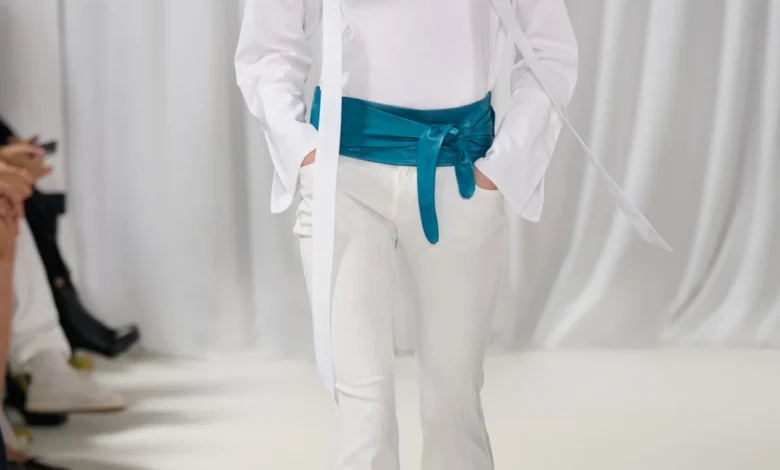
The presentation itself was anchored by a deliberate reduction in chromatic noise, allowing texture, tailoring, and silhouette to take center stage. Byre’s runway featured a masterclass in contrasts: the crisp architecture of structured jackets paired against the fluid movement of bias-cut garments. Key pieces included sharp tailoring executed in rich moiré fabrics, long boot-cut trousers that evoked a sophisticated 1970s nonchalance, and ethereal halter dresses crafted from sheer paisley and held together by delicate grosgrain ties.
Bridal codes were systematically deconstructed and translated into everyday wardrobe staples. Stiff cottons interacted dynamically with sheer fabrics, creating a tension between concealment and revelation, while strategic deployments of black leather grounded the otherwise romantic, angelic palette. Although pale tones reigned supreme, Byre punctuated the collection with judicious accents of fresh mint greens and unexpected jolts of magenta. Furthermore, practical wardrobe staples—such as the shearling vests worn habitually by Byre’s studio team—made a functional reappearance in stark black, underscoring a commitment to realistic, wearable luxury.
The Evolution and Chronology of Talia Byre
To understand the trajectory of Talia Byre’s spring collection, one must examine the brand’s steady evolution within the competitive ecosystem of London Fashion Week. Over the past several seasons, Byre has cultivated a loyal and discerning clientele by rejecting the fast-paced churn of disposable fashion trends in favor of an additive wardrobe model. Her design philosophy encourages patrons to invest in foundational pieces and add a single, high-impact item each season, allowing for an organic, sustainable evolution of personal style.
The genesis of this all-white and cream palette began months prior in the designer’s London studio. Faced with an influx of bespoke bridal commissions, Byre found herself immersed in the textures, emotions, and symbolic purity of traditional wedding attire. Rather than keeping bridal wear siloed, she chose to translate those emotional cues into ready-to-wear. This conceptual shift was documented and expanded upon through a specially produced zine—now an annual tradition for the designer’s shows—which featured contributions from 10 distinct contemporary artists.
Among these contributors was artist Dillwyn Smith, whose conceptual footprint heavily influenced the physical presentation. Two of Smith’s signature "Placebo Paintings," constructed from the superposition of colorful yet translucent fabrics, served as the principal runway backdrop inside the Hellenic Centre.
Supporting Data and Conceptual Parallels
The integration of Dillwyn Smith’s artwork was far from incidental; it served as a visual metaphor for the collection’s underlying psychological thesis. Byre has frequently spoken about garments operating as a form of armor or emotional reinforcement. In interviews following the presentation, she drew a direct parallel between Smith’s "Placebo Paintings" and her clothing line, suggesting that well-crafted garments can function as a placebo—boosting the wearer’s confidence not through overt extravagance, but through the quiet power of exceptional fit, tactile comfort, and subtle luxury.
Market data within the contemporary womenswear sector indicates a growing consumer fatigue regarding hyper-trend-driven, logo-heavy apparel. Industry analysts note a distinct pivot toward "quiet luxury," minimalism, and modular wardrobe building—metrics that align precisely with Byre’s adherence to an additive consumer model. By designing garments intended to last and integrate seamlessly with previous seasons, Byre positions her label advantageously among sustainable-minded consumers who prioritize longevity, versatility, and craftsmanship over ephemeral stylistic statements.
Official Responses and Designer Insights
Backstage at the Hellenic Centre, Byre elaborated on her creative process to members of the fashion press, shedding light on the pragmatic realities that shape her collections. The inclusion of utilitarian garments, such as the studio’s favored shearling vests, was highlighted as a testament to the symbiotic relationship between the designer’s personal life, her team’s daily uniform, and the ultimate consumer experience.
"We wanted something fresh, almost cleansing," Byre remarked, discussing the departure from her historically vibrant color palette. By scaling back the visual volume, the designer invited critics and buyers to focus intently on construction techniques, fabric weight ratios, and the subtle interplay of opacity and transparency. The deliberate introduction of black leather into an otherwise ethereal white and cream lineup was described as an intentional disruption—a narrative device designed to prevent the collection from drifting into saccharine territory and to reflect the multifaceted nature of the modern woman.
Broader Industry Impact and Strategic Implications
Talia Byre’s strategic pivot carries notable implications for independent designers operating within the current macroeconomic climate. As production costs rise and consumer spending habits undergo cautious recalibration, independent labels face immense pressure to demonstrate both commercial viability and distinct artistic vision. By leaning into modular design, bridal-adjacent ready-to-wear, and cross-disciplinary artistic collaborations, Byre has carved out a resilient niche.
The success of the presentation at the Hellenic Centre demonstrates that emerging designers can successfully scale their businesses without sacrificing intimacy or conceptual rigor. By prioritizing continuity over reinvention—offering loyal customers a reliable architectural framework to build upon year after year—Byre fosters profound brand loyalty. As the fashion industry continues its broader recalibration toward mindful consumption, the designer’s thoughtful, placebo-like approach to apparel may well serve as a blueprint for sustainable, long-term brand equity in the post-pandemic luxury market.