RECESS Thermal Station Redefines Montreal Wellness Through Social Infrastructure and Architectural Stillness

RECESS Thermal Station, a 4,500-square-foot facility located in Montreal’s Griffintown district, represents a significant evolution in the city’s wellness landscape by prioritizing social connectivity over traditional solitary spa experiences. Designed by the Montreal-based Future Simple Studio and founded by entrepreneurs Adam Simms and Marilyne Gagné, the project addresses a specific void in the urban fabric of Quebec’s largest metropolis. While Montreal possesses a high density of traditional saunas and gym facilities, RECESS is positioned as the city’s first dedicated social hot-cold circuit, emphasizing the concept of "social infrastructure"—a space where the physical environment facilitates communal interaction through shared ritual.

The facility is conceived as a contemporary "ode to stillness," moving away from the clinical or purely aesthetic focus of modern wellness centers to embrace a more ancient philosophy. By drawing inspiration from Roman thermae, the project seeks to revive the historical role of public baths as central hubs for social life, deal-making, and community engagement. At RECESS, the architecture and the prescribed 75-minute thermal cycle are engineered to produce a specific social chemistry, predicated on the idea that shared physical intensity—such as extreme heat followed by sudden cold—creates a unique bond among participants that differs from casual conversation in a standard social setting.

The Architectural Vision and Materiality of Stillness
Future Simple Studio, under the leadership of architect Christine Mallet, organized the 4,500-square-foot plan as a linear sequence of "compression and release." This spatial strategy is designed to guide the visitor through various psychological states, transitioning from the frantic energy of the city to a state of meditative presence. The materiality of the space follows a carefully calibrated gradient. In the public-facing and transitionary zones, the studio utilized cold-rolled steel and aluminum. These materials provide a sense of clinical precision and reflective depth, echoing the surface of water and the industrial heritage of the Griffintown neighborhood.

As visitors progress deeper into the bathing areas, the palette shifts toward organic warmth. Industrial metals give way to natural oak and stone, materials chosen for their tactile qualities and ability to retain heat. This transition is not merely aesthetic but functional, signaling a shift in the sensory environment. The lighting, captured in the project’s documentation by photographer Felix Michaud, plays a critical role in defining these zones. Refracted light patterns are used in the entry corridors to simulate the movement of water, providing a visual cue of the experience to come before the visitor ever encounters a pool.

The 75-Minute Thermal Circuit: A Chronological Journey
The core experience at RECESS is a structured 75-minute ritual that balances individual restoration with collective presence. This cycle is rooted in the principles of contrast therapy, a practice that has gained significant traction in the global wellness industry for its physiological and mental health benefits.

- Decompression and Entry: The journey begins in an elongated tunnel that wraps around the perimeter of the facility. This passage serves as a sensory buffer, utilizing a gentle ramp and flickering light patterns to distance the visitor from the outside world. This leads to an all-gender locker room, designed to be hushed and efficient, functioning as a "decompression chamber."
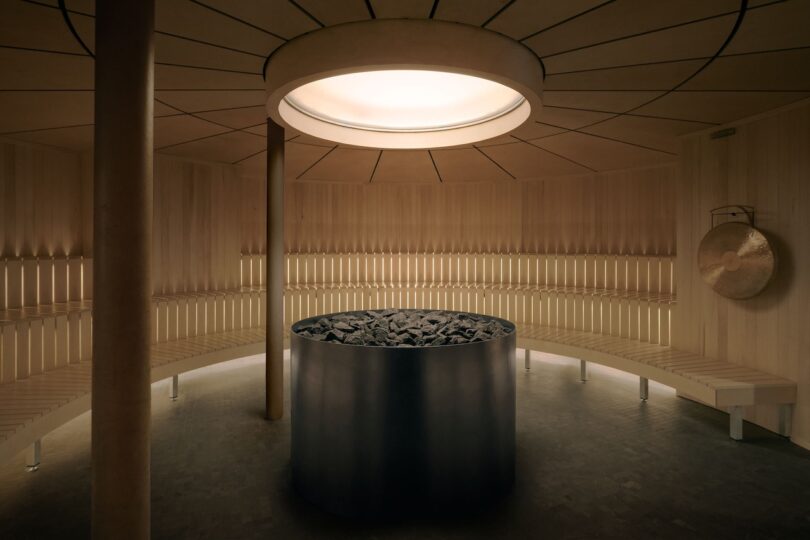
- The Heat Phase (20 Minutes): Emerging from the locker rooms, visitors enter the primary sauna environment. The centerpiece of this zone is a custom-built, freestanding circular sauna. With a monumental radius, this timber-lined enclosure can accommodate up to 50 people simultaneously. This is a radical departure from the typical four-to-eight-person saunas found in most North American facilities. The geometry is intended to facilitate guided, performative group sessions and "Aufguss" rituals, where heat and steam are managed by a practitioner to a communal rhythm.
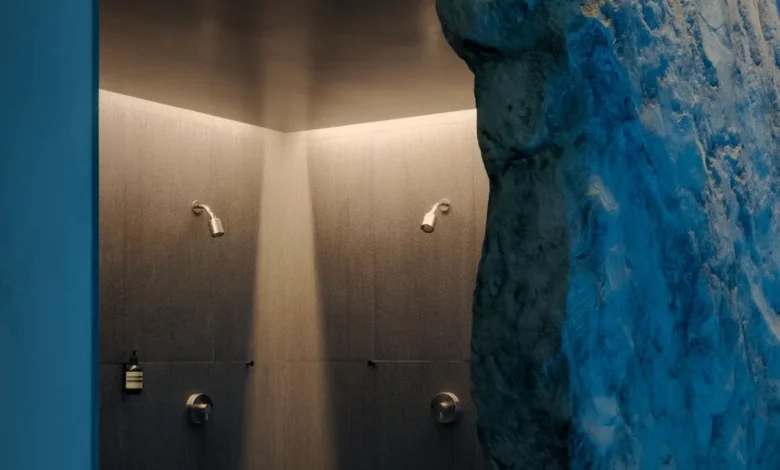
- The Cold Immersion (2 Minutes): Following the heat phase, visitors move through a sequence of sculptural showers concealed behind natural stone, designed to evoke the sensation of rainfall. This leads to the communal cold-plunge pool. Sized for 12 people, the pool is illuminated by a deep blue light, creating a stark atmospheric contrast to the golden timber of the sauna. Submerging in the cold water triggers a systemic physiological response, including vasoconstriction and the release of endorphins.
- Rest and Social Integration: The final phase of the circuit takes place in the post-plunge lounge. This area is defined by layers of diffused curtains that encircle the room. These curtains serve a dual purpose: they provide a soft, private environment for rest while also acting as projection surfaces for a rotating program of digital art.
Social Infrastructure and the "Third Space" Concept
The founders, Adam Simms and Marilyne Gagné, have explicitly stated that RECESS is intended to function as a cultural venue as much as a wellness space. By integrating art installations, live DJ sets, and guided breathwork sessions into the lounge area, the facility occupies the role of a "third space"—a social environment separate from the two usual social environments of home ("first space") and the office ("second space").

In a city like Montreal, which experiences long, dark winters, the availability of indoor social infrastructure is a matter of public health. The design of the 50-person sauna and the 12-person cold plunge is a deliberate attempt to combat urban isolation. By placing people in close proximity during moments of physical intensity, the architecture forces a level of presence that is often missing in a society increasingly dominated by digital interaction. The circular geometry of the sauna ensures that participants are facing one another, encouraging a sense of equality and shared experience.

Supporting Data and Wellness Market Context
The opening of RECESS coincides with a global surge in the popularity of "contrast therapy" and communal wellness. According to industry reports from the Global Wellness Institute, the thermal springs and spa economy has seen a steady annual growth rate of approximately 5% to 7% as consumers pivot from passive treatments (like massages) to active, ritual-based experiences.

Key data points regarding the RECESS facility include:

- Total Area: 4,500 square feet, optimized for flow and sequence.
- Sauna Capacity: 50 persons, making it one of the largest communal saunas in Quebec.
- Plunge Capacity: 12 persons, designed to prevent the bottlenecks common in smaller wellness boutique settings.
- Cycle Duration: 75 minutes, a timeframe calibrated to allow for three full cycles of heat, cold, and rest, which is the standard recommendation for maximum physiological benefit.
The physiological benefits of this circuit are well-documented in sports science and balneology. The "hot-to-cold" transition stimulates the lymphatic system, improves circulation, and has been shown to reduce cortisol levels. By professionalizing this experience in an architecturally significant environment, RECESS caters to a demographic that values both health outcomes and high-design aesthetics.

Broader Implications for Urban Design and Wellness
The significance of RECESS extends beyond the borders of Griffintown. It serves as a case study for how "dead" or underutilized urban spaces can be transformed into high-density social hubs. Future Simple Studio’s intervention demonstrates that wellness facilities do not need to be sprawling, outdoor resorts to be effective; rather, through smart interior architecture and a clear understanding of human ritual, a deep sense of place can be created within a standard rectilinear urban shell.
Furthermore, the project challenges the traditional "quiet" spa model. By allowing for conversation and communal activity, RECESS acknowledges that for many urban residents, wellness is inextricably linked to social belonging. The inclusion of all-gender facilities and large-scale communal pools reflects a broader cultural shift toward inclusivity and the breaking down of traditional barriers in wellness spaces.

As Montreal continues to densify, particularly in neighborhoods like Griffintown which have seen a massive influx of residential high-rises, the need for spaces like RECESS will likely grow. The project suggests that the future of urban wellness lies in the intersection of health, art, and community—repositioning the act of bathing not as a luxury service, but as an essential social ritual for the modern age. Through the lens of Future Simple Studio’s minimalist yet monumental design, RECESS offers a framework for connection in a city that, like many others, has largely outsourced its togetherness to screens.