Jonathan Anderson Officially Enshrined at La Galerie Dior, Marking a New Chapter in the House’s Illustrious History

PARIS – Jonathan Anderson, the acclaimed Irish designer, has officially cemented his place within the hallowed halls of Dior’s permanent exhibition space, La Galerie Dior, in Paris. This significant inclusion, occurring less than a year after his appointment as Creative Director, signals a profound recognition of his immediate impact and his nuanced reinterpretation of the venerable French fashion house’s codes. The move integrates Anderson into a lineage of visionary couturiers, from the founder Christian Dior himself to his most influential successors, underscoring the brand’s enduring commitment to innovation within its rich heritage.
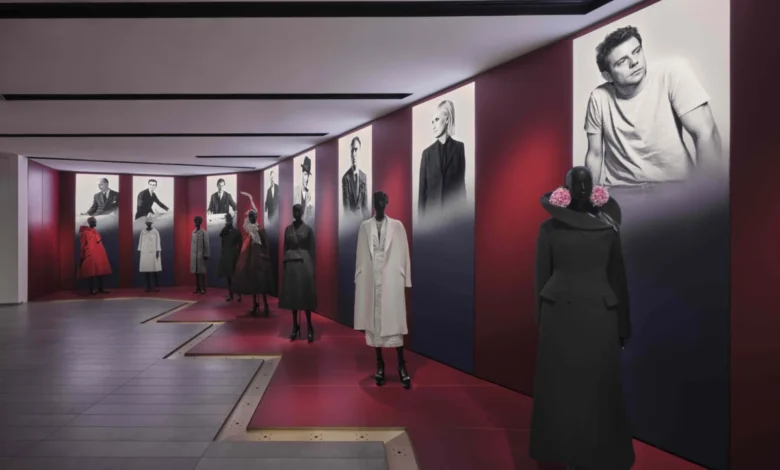
Upon entering room three of La Galerie Dior, visitors are now greeted by a striking large portrait of Anderson, casually clad in a gray marl T-shirt, a subtle nod to his contemporary sensibility. This image stands alongside those of the seven previous creative directors who have steered the Maison since its inception in 1946, offering a visual chronology of Dior’s artistic evolution. Each designer’s portrait is thoughtfully paired with a seminal creation that encapsulates their unique contribution to the house. For Anderson, this emblematic piece is the black Rêve coat, distinguished by its dramatically swooping collar, a highlight from his critically acclaimed debut haute couture collection, which captivated audiences when it was unveiled in January.
A New Vision Woven into Dior’s Tapestry
Anderson’s ascension to this prestigious position within the exhibition space is not merely a ceremonial gesture but a profound acknowledgment of his inaugural year at the helm of Dior. Appointed to oversee women’s, men’s, and haute couture collections, his arrival in 2025 was met with considerable anticipation. His initial collections have quickly established a distinctive aesthetic that, while undeniably modern and often radical, remains deeply rooted in Dior’s foundational principles of refinement, femininity, and architectural silhouette. Approximately 15 of Anderson’s designs, meticulously chosen from his first year’s output, are now interspersed throughout the historic flagship at 30 Avenue Montaigne, enriching the existing narrative of Dior’s legacy. La Galerie Dior, known for its periodic updates and annual temporary shows, continually refreshes its presentation to reflect the ongoing dialogue between past and present.

The thematic rooms within the gallery have been thoughtfully reconfigured to illuminate the historic brand codes that Anderson has masterfully homed in on and reinterpreted. Key among these are the enduring motif of the bow, a symbol of elegance and femininity deeply cherished by Christian Dior, and the opulent ornamentation characteristic of 18th-century French aesthetics, which Anderson has infused with a contemporary edge.
Olivier Flaviano, the esteemed head of La Galerie Dior, articulated the curatorial philosophy behind this update, noting that the exhibition’s redesign was directly inspired by the powerful resonance of Anderson’s debut couture show. Flaviano observed, “There’s a real radicality in the form, which is super interesting, yet it’s infused with a sense of refinement and femininity, which is equally compelling. Jonathan Anderson’s pieces help us see more clearly this tension that is at the root of the Dior style.” This tension—the interplay between audacious modernity and timeless elegance—is precisely what defines Anderson’s nascent tenure at Dior and what makes his inclusion in the gallery so pertinent.
Showcasing Anderson’s Haute Couture Masterpieces
Several standout looks from Anderson’s spring 2026 haute couture collection are prominently featured, each chosen for its ability to convey his distinctive vision and its resonance with Dior’s heritage. Among these, the off-the-shoulder draped Ombre dress, famously worn by global superstar Rihanna on the cover of EE72 magazine, takes pride of place in the enchanting “Enchanted Gardens” room. This garment, with its fluid lines and evocative silhouette, speaks to Dior’s historical connection with nature and floral motifs, reinterpreted through Anderson’s contemporary lens.
Another striking creation, the bulbous pleated Clémentine dress, commands attention in the spectacular “Le Bal Dior” room. This gown, known for its sculptural volume and rich texture, is inspired by the profound work of renowned ceramic artist Magdalene Odundo, whose pottery is celebrated for its organic forms and exquisite craftsmanship. The “Le Bal Dior” room itself has been transformed, now drenched in vibrant shades of orange and red, creating an immersive backdrop that amplifies the drama and artistry of Anderson’s creation. Odundo’s influence underscores Anderson’s commitment to integrating diverse artistic disciplines into his haute couture, demonstrating a dialogue between fashion and fine art that enriches the narrative of the collection.

The Art of the Bow: A Timeless Emblem Reimagined
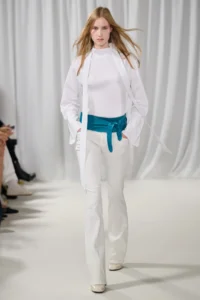
Room five, aptly christened “The Art of the Bow,” serves as a poignant testament to one of Dior’s most cherished and enduring brand codes. Here, Anderson’s cream Noeud pantsuit, with its elegant and distinctive bow detailing, is displayed alongside iconic designs by Christian Dior, Yves Saint Laurent, Marc Bohan, and John Galliano. This juxtaposition highlights the bow’s continuous evolution and its symbolic power across different eras and creative interpretations.
Christian Dior himself articulated his affection for this motif in his seminal “Little Dictionary of Fashion,” published in 1954: “I love bows to close a décolleté, trim a hat or to fasten a belt. I like them big, small or enormous, in any way and in any material.” This quote, prominently featured in the room, provides historical context to Anderson’s modern interpretation. The exhibition further enriches this narrative with original documents, including sketches and rare photographs. Notably, a Henry Clarke portrait of model Victoire Doutreleau wearing the 1954 Curaçao dress is displayed. The Curaçao dress is significant for its draped detail at the waist, a motif that Anderson heavily reprised and modernized in his debut women’s ready-to-wear collection, demonstrating his deep dives into the archives for inspiration.
Eighteenth-Century Grandeur and a Cabinet of Curiosities
Anderson’s reverence for historical details extends to his reprisal of the brand’s signature medallions, adorned by the elegant “fontange” bow. This particular bow, named after Mademoiselle de Fontanges, a mistress of King Louis XIV, is a direct link to the opulence and stylistic intricacies of the French court. These medallions feature prominently in an 18th-century-themed cabinet of curiosities within the gallery. This meticulously curated space also houses a couture evening clutch, exquisitely covered in French fabrics from the period of Queen Marie Antoinette, further immersing visitors in the grandeur and artisanal mastery of that era. Anderson’s ability to seamlessly integrate such historical elements into his contemporary vision for Dior speaks volumes about his profound understanding of the house’s heritage and his innovative approach to its future.

Diorling: A Glimpse into the Swinging Sixties
For the first time in its history, La Galerie Dior is presenting a selection of looks from its Diorling ready-to-wear line. Launched in the U.K. in 1968, Diorling was designed by Jorn Langberg, the artistic director of the Christian Dior London subsidiary. This inclusion marks a significant expansion of the gallery’s historical scope, offering visitors a glimpse into a distinct chapter of Dior’s past. With its vibrant geometric and floral patterns, the Diorling line captured the exuberant spirit of Carnaby Street and the broader cultural revolution of the Swinging Sixties. It represents Dior’s strategic diversification into ready-to-wear, making high fashion more accessible while retaining the brand’s quintessential elegance, albeit with a youthful, mod sensibility. This facet of Dior’s history, often overshadowed by its haute couture legacy, highlights the brand’s continuous adaptation to evolving fashion landscapes.
Official Commentary and the Philosophy of Renewal
Olivier Bialobos, Dior’s deputy managing director in charge of global communication and image, underscored the comprehensive nature of the updated exhibition in a recent statement. He remarked, “The essence of the Dior spirit is unveiled through the 150 models on display: from the modernity of the Diorling ready-to-wear, created in London in 1968, to the tradition of balls featuring haute couture gowns that will make visitors dream more than ever.” His words emphasize the exhibition’s dual focus: to celebrate both the brand’s historical breadth and its unwavering commitment to the aspirational dream of haute couture.
Above all, Bialobos noted, the exhibition serves as a powerful illustration of Christian Dior’s enduring adage: “The Parisian tradition of couture is renewal.” This philosophy is central to Anderson’s work at Dior, where he is tasked with both honoring the past and boldly forging the future. His inclusion in La Galerie Dior, alongside the house’s previous luminaries, is a testament to this continuous process of renewal, demonstrating how each creative director, while bringing their unique vision, ultimately contributes to the timeless and evolving narrative of Dior.

Implications for Dior’s Future and Anderson’s Legacy
Jonathan Anderson’s formal recognition at La Galerie Dior less than a year into his tenure carries significant implications for both the designer and the iconic fashion house. For Anderson, it solidifies his position not just as a contemporary force in fashion but as a legitimate heir to Christian Dior’s foundational vision. It acknowledges his ability to infuse radical, avant-garde ideas with the inherent refinement and historical gravitas expected of Dior. This early induction suggests strong internal confidence in his direction, signaling that his initial collections have not merely been successful but have resonated deeply with the core identity of the brand.
For Dior, this update to its permanent exhibition reinforces its dynamic nature. It showcases the house’s willingness to embrace change and new interpretations while simultaneously grounding them in a rich historical context. By presenting Anderson’s work alongside that of his predecessors, Dior demonstrates its continuous evolution and its capacity to remain at the forefront of luxury fashion across generations. This strategic move is likely to further enhance Dior’s appeal to a new generation of luxury consumers who value both heritage and contemporary relevance. It positions La Galerie Dior not just as a static museum of the past, but as a living testament to an ongoing creative journey, reflecting Christian Dior’s own philosophy that couture, at its heart, is a perpetual state of renewal and reinvention. This milestone marks a pivotal moment, affirming Anderson’s transformative impact and setting a promising trajectory for Dior’s creative future.