Saul Nash Reimagines Masculinity: From Pin-Up Discipline to Athletic Empowerment in Spring Collection

The enduring debate surrounding corsetry—was it ever truly empowering, or merely a tool of constriction—finds a surprising contemporary echo in the latest collection from British Guyanese designer Saul Nash. This polarizing topic, even for the 1950s pin-up icons who famously embraced and subverted the trend, turning bodily discipline into a performance of confidence, forms a crucial philosophical underpinning for Nash’s spring offering. He meticulously scrutinizes these historical figures and their penchant for body-conscious dressing, transposing their aesthetic and ethos into a groundbreaking vision for modern men’s athletic-inspired gear and tailoring. Nash’s collection provocatively asks what constitutes the "pin-up" of today, ultimately proposing that the confident display of a sculpted physique, achieved through dedication to fitness, is a direct heir to the legacy of those mid-century icons.
The Enduring Corsetry Debate: A Historical and Cultural Examination
To fully appreciate Nash’s inspiration, it is essential to delve into the complex history of corsetry. Originating as a foundational garment in the 16th century, the corset evolved dramatically, reaching its most iconic—and often maligned—form during the Victorian and Edwardian eras. In these periods, corsets were synonymous with the "wasp waist" ideal, a rigid silhouette achieved through tight lacing that was widely criticized by health reformers for its potential to restrict breathing, displace organs, and cause fainting. Yet, its narrative is not solely one of oppression. For many women, the corset provided crucial back support, particularly for those engaged in physically demanding domestic labor, or for adhering to prevailing social standards of propriety and elegance. Adopting the fashionable silhouette could, for some, be an act of empowerment within the confines of societal expectations, allowing them to participate in social rituals and project an image of refinement.
By the early 20th century, as women’s roles began to shift and fashion trends favored looser, more active silhouettes, the corset gradually receded, giving way to less restrictive girdles and, eventually, the modern brassiere. However, the 1950s witnessed a fascinating resurgence of structured undergarments, particularly within the burgeoning pin-up culture. Icons like Marilyn Monroe and Bettie Page, alongside countless calendar girls, embraced shapewear and form-fitting attire not as instruments of rigid constraint, but as tools to enhance and celebrate their natural curves. This era saw corsetry, or its more modern iterations, reappropriated as an element of playful allure and overt, yet controlled, sexuality. These women transformed the very idea of bodily discipline from a societal imposition into a deliberate performance of confidence, asserting agency and challenging puritanical norms through a sculpted, celebrated form. This nuanced historical perspective underscores the dual nature of such garments—their capacity for both restriction and liberation, depending on context and individual intent—a duality that Nash keenly observes and translates into a contemporary masculine context.
The 1950s Pin-Up Phenomenon and Its Enduring Legacy
The 1950s pin-up was more than just a pretty face on a calendar; she was a significant cultural phenomenon that captured the zeitgeist of post-World War II America. These images, often playful and suggestive rather than overtly sexual, represented a confident, aspirational femininity that resonated deeply with a public emerging from austerity and seeking a return to normalcy, albeit with a new edge. The pin-up aesthetic emphasized an hourglass figure, often achieved with the aid of foundational garments, and a general approach to dressing that was highly "body-conscious." Unlike the restrictive corsets of earlier eras, the 1950s approach to body-con dressing was about artfully displaying and celebrating the female form in a way that projected self-assurance and an undeniable charm.
This performative confidence, where clothing became a vehicle for self-expression and a subtle challenge to societal norms, deeply influenced generations. The pin-up demonstrated that even garments traditionally associated with shaping or conforming the body could be reappropriated to convey personal power and allure. It is precisely this spirit—the intentional shaping and display of the body as a performance of confidence—that Saul Nash identifies as a pivotal bridge to his contemporary vision for menswear. He observes that while the garments and the gender have shifted, the underlying psychological impulse to present a refined, confident self through physical appearance remains remarkably consistent.
Saul Nash: Blurring Boundaries in Modern Menswear
Saul Nash, a British-Guyanese designer renowned for his innovative approach to menswear, stands at the forefront of a movement that redefines contemporary masculinity. His design philosophy is deeply rooted in his background as a dancer and choreographer, an influence that manifests in his unwavering commitment to freedom of movement, ergonomic design, and the seamless integration of performance wear into everyday luxury. Nash’s work consistently explores the intersection of athleticism, identity, and the male form, challenging traditional sartorial boundaries and proposing a new lexicon for men’s fashion. His critical acclaim, including being a recipient of prestigious awards like the International Woolmark Prize, solidifies his position as a visionary designer capable of both conceptual depth and practical innovation.
Nash’s unique perspective allows him to draw compelling parallels between the historical discipline embodied by 1950s pin-up dressing and the contemporary emphasis on physique within sports and fitness culture. He posits that both phenomena involve a conscious shaping, honing, and confident display of the body. While one was historically driven by aesthetic allure and societal expectations, and the other by performance optimization and health, Nash argues that in the modern era, these motivations frequently converge. The meticulous attention paid to physical form, whether through structured underpinnings or rigorous training, ultimately serves a similar purpose: to project an image of strength, discipline, and self-assuredness. It is this nuanced understanding that underpins his collection, aiming to articulate what a "pin-up" figure might represent for men in the 21st century.
The Contemporary Pin-Up: Fitness Culture and the Male Physique
The 21st century has witnessed an unprecedented global obsession with fitness, health, and the sculpted physique. The rise of athleisure, initially a niche trend, has permeated mainstream fashion, transforming how people dress for both active pursuits and everyday life. This cultural shift has been fueled by factors such as increased health consciousness, the proliferation of gym culture, and the pervasive influence of social media, where fitness influencers regularly showcase idealized body types. Consequently, the display of a "fit" body has become increasingly normalized, often equated with discipline, success, and attractiveness.
In this context, modern sport uniforms and athletic gear play a dual role. While primarily designed for ergonomic performance, enhancing movement and minimizing resistance, they also inherently accentuate the physique. The compression fabrics, strategic paneling, and streamlined silhouettes of contemporary sportswear often highlight musculature and body contours, effectively turning the athletic form into a visual statement. Nash argues that this accentuation, whether intentional for aesthetic purposes or a byproduct of performance-driven design, functions as a modern equivalent of the pin-up’s bodily display. For men, the dedication to physical conditioning and the confident presentation of a toned physique become a powerful form of self-expression, projecting strength and an inherent self-confidence that resonates with the bold self-presentation of historical pin-ups.
The Spring Collection: An Homage to Movement and Form
Saul Nash’s Spring collection is a masterful articulation of these themes, a cohesive exploration of the male form in motion, designed for both comfort and confident display. Each garment is meticulously crafted to blend the functional demands of sportswear with the refined aesthetics of traditional tailoring, creating a new vernacular for masculine attire.
Silhouettes and Staples
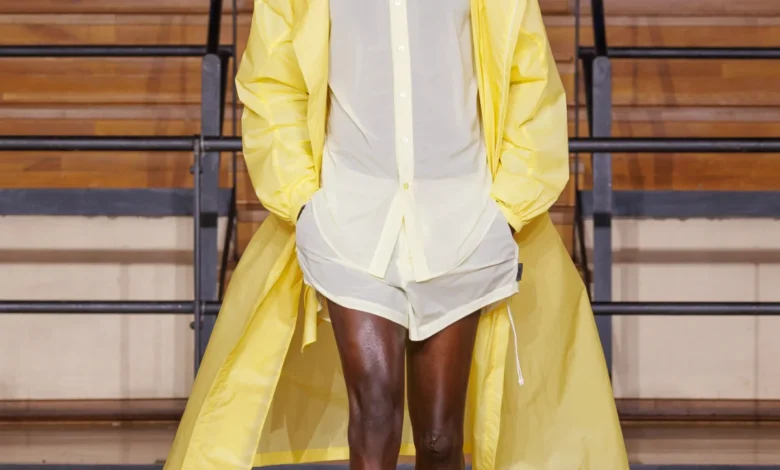
The collection’s "leggy looks" are particularly striking, featuring athletic short shorts often layered over form-fitting leggings. This modular combination speaks directly to dynamic movement, offering versatility for varying activity levels and environments. These are frequently paired with hooded windbreakers, further emphasizing a practical, performance-oriented aesthetic that doesn’t sacrifice style.
A significant influence from "gorpcore"—a style trend emphasizing outdoor utility wear—is evident in the collection’s vests and parachute pants. Crafted from paper-thin nylon, these pieces are incredibly lightweight and functional, yet their cut and drape are designed to expose and flatter the models’ "statuesque bodies" beneath. This use of ultra-lightweight technical fabrics, notably echoed on the Prada runway just an hour earlier, underscores a broader industry trend towards sophisticated material innovation that prioritizes comfort and performance without compromising on luxury.
Singlets emerge as ubiquitous underpinnings throughout the collection, worn beneath bomber jackets and anoraks. More than just a base layer, the singlet’s characteristic shape and body-hugging lines are cleverly recreated via intricate stitching on sweatshirts, base layers, and tracksuits. This subtle yet impactful design detail allows Nash to highlight the body’s contours and musculature, celebrating the male form in a sophisticated manner that avoids overt ostentation.
Tailoring Reimagined
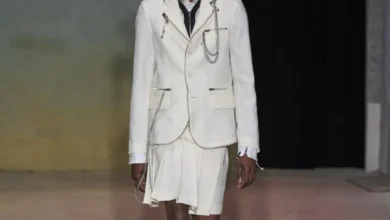
Nash’s inventive tailoring is a cornerstone of the collection, offering a fresh perspective on formalwear. High-waisted shorts and trousers strike an appreciable balance between tailored sophistication and functional utility. Their refined cut, often featuring a slightly wider leg, nods subtly to equestrian gear, referencing the clean lines and practical elegance of rider’s attire. This fusion of formal and functional elements suggests a future for tailoring that is less about rigid structure and more about dynamic form.
Further exemplifying this inventive approach are the competition jacket-like designs. These pieces are not merely inspired by athletic wear; they actively incorporate its principles. Gathered at the back, they enhance freedom of movement and create a dynamic silhouette that celebrates the wearer’s posture. Crafted from pinstriped technical wools and denim, these jackets embody a modern duality, blending the heritage of formal fabrics with the performance characteristics of contemporary textiles. They are often paired with Bermuda shorts, a choice that further blurs the lines between traditional formalwear and casual, comfort-driven attire, making a bold statement about contemporary sartorial codes.
The Pinnacle: The Sheer Unitard
The collection culminates in a truly audacious closing look: a sheer, long-sleeved mesh unitard. This singular garment encapsulates the collection’s overarching theme of confident bodily display and the blurring of traditional garment functions. It is a piece that demands immense self-assurance, challenging societal perceptions of vulnerability and strength. The unitard, by its very nature, reveals the body without apology, transforming it into a canvas for unapologetic self-expression. It is a bold statement, pushing the boundaries of what is considered acceptable or desirable in menswear, and asking its wearer to embrace a powerful form of self-acceptance.
Designer’s Vision: The Modern Masculine Pin-Up
Saul Nash articulates his vision with clarity and conviction: “I was really looking at this idea of what our pin-up of today is, and to tell that story by blurring the lines between sportswear and tailoring. I think they’re confident, open-minded, strong individuals.” This statement is the ideological core of the collection. Nash is not merely recreating a historical aesthetic; he is redefining masculinity itself, moving away from rigid, traditional archetypes towards a more fluid, expressive, and confident ideal.
His "modern pin-up" is not gender-specific but embodies an attitude—an individual who is comfortable in their own skin, proud of their physical form, and unafraid to express themselves through their chosen attire. This ethos champions open-mindedness and strength, suggesting that true power lies in authenticity and self-acceptance, regardless of conventional sartorial boundaries. By merging sportswear and tailoring, Nash creates a wardrobe that empowers this modern individual, allowing them to navigate diverse social landscapes with ease and unwavering self-possession.
Broader Implications and Industry Context
Saul Nash’s Spring collection is more than a seasonal fashion statement; it is a profound cultural commentary with significant implications for the wider fashion industry and societal discourse.
Menswear Evolution
Nash’s work contributes significantly to the ongoing evolution of menswear, which has been steadily moving away from rigid definitions towards greater fluidity, comfort, and personal expression. The collection exemplifies how athleisure, once considered a casual subgenre, has achieved an elevated status, demonstrating its potential for high fashion and conceptual depth. It underscores the continued erosion of traditional dress codes, where the lines between formal and informal, performance and luxury, are increasingly blurred. This shift reflects a broader societal desire for clothing that is versatile, adaptable, and truly reflective of individual lifestyles rather than restrictive social mandates.
Body Positivity and Confidence
By presenting pieces that highlight the body with unapologetic confidence, Nash encourages a vital dialogue about self-perception and the courage required to wear what one chooses. In an era where body image remains a complex issue for all genders, his collection implicitly advocates for body positivity, framing the display of the male physique not as an act of vanity, but as an assertion of self-worth and discipline. The sheer unitard, in particular, pushes the boundaries of vulnerability in menswear, transforming it into an act of profound strength and self-acceptance. This challenges men to embrace their bodies, fostering a sense of comfort and pride that extends beyond mere physical appearance.
The Future of Formalwear
The collection also offers a compelling glimpse into the future of formalwear. By integrating technical fabrics, ergonomic design principles, and sportswear aesthetics into tailored garments, Nash suggests a paradigm shift. Future tailoring, he implies, will be less about rigid construction and more about dynamic form, enhanced movement, and material innovation. This approach ensures that formal attire remains relevant and desirable in an increasingly active and comfort-driven world, providing sophisticated options that do not compromise on practicality or freedom. The use of technical wools and advanced nylon speaks to a future where high-performance materials are seamlessly integrated into luxury fashion, offering durability, breathability, and enhanced comfort.
Conclusion
Saul Nash’s Spring collection stands as a powerful testament to the designer’s ability to weave together disparate historical threads and contemporary trends into a compelling narrative for menswear. By skillfully drawing parallels between the nuanced history of bodily discipline, from the contentious legacy of corsetry to the confident allure of 1950s pin-ups, and contemporary expressions of physical confidence in an era of fitness obsession, Nash invites a profound re-evaluation of what it means to be a "pin-up" in the modern age. His designs not only celebrate movement and form but also champion an ethos of individuality, strength, and unapologetic self-expression. In doing so, Nash crafts a compelling vision for the future of menswear that is both intellectually stimulating and fearlessly expressive, pushing boundaries and challenging conventional notions of masculine attire with elegance and audacious innovation.