How SOA Architekti Crafted the Visual Identity of Prague’s Newest Korean Eatery, The Kimchi

Nestled in the bustling historic core of the Czech capital, right beside the architectural landmark of the Masaryk Railway Station, a new culinary destination has redefined how cultural fusion is expressed through interior design. Spanning a modest 1,453 square feet inside a former pastry shop, The Kimchi represents a sophisticated departure from traditional ethnic restaurant design. Conceived by the Prague-based studio SOA architekti and completed in 2026, the restaurant is the physical manifestation of a Korean husband-and-wife team’s vision to bring authentic street food culture to Central Europe. Rather than relying on clichéd artifacts, predictable iconography, or literal cultural souvenirs, the design team chose to distill the pulsating, modern visual energy of Seoul into a tightly integrated masterclass of architecture and graphic branding.

The Genesis and Spatial Evolution of the Project
The transformation of the former pastry shop into a contemporary dining hub began with a clear brief from the owners: create an inviting, unpretentious space for Korean street food that feels genuinely connected to Seoul without descending into pastiche. Architects Štěpán Šulek and Matěj Štrecha of SOA architekti undertook the commission with a philosophy centered on restraint and conceptual clarity. Retaining elements of the original spatial layout, the design team faced the inherent challenges of a relatively compact footprint.

Instead of cluttering the narrow interior with multiple disparate design elements, the architects decided to establish a singular, powerful gesture that could bridge the physical architecture with a cohesive graphic identity. Collaborating closely with graphic designer Tomáš Eisner from the earliest conceptual phases, the team ensured that the restaurant’s branding was not treated as a superficial afterthought. Instead, materials, color schemes, signage, and physical spatial boundaries were developed concurrently, resulting in an environment where two-dimensional graphics and three-dimensional space seamlessly converse.
Decoding the Visual Language: The Wave and the Palette

At the heart of the design lexicon is a fluid, dynamic wave motif. This form made its debut as a loose, abstract interpretation of the iconic taegeuk symbol—the central emblem found on the South Korean national flag—before evolving into a broader, continuous visual wave that travels organically from the building’s exterior signage, across the primary serving counter, and finally ripples along the interior walls.
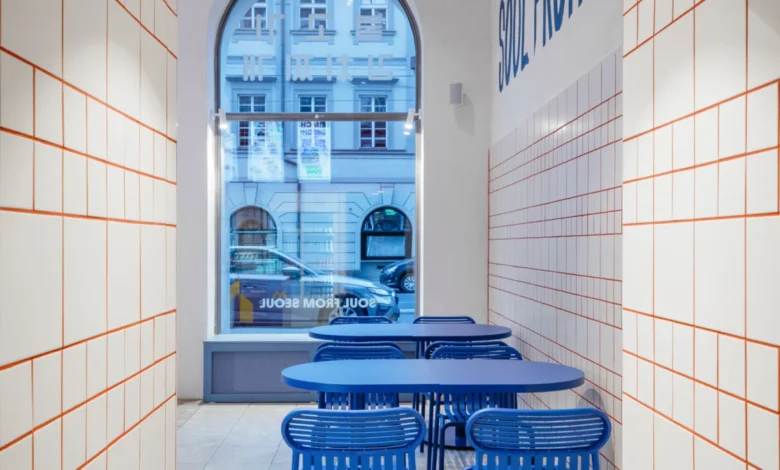
According to Štěpán Šulek, utilizing a single, commanding gesture within such a confined floor plan proved far more effective than introducing an array of competing motifs. This spatial narrative is heavily amplified by a rigorous and daring application of color. Bold blue tones stretch deliberately across custom tables, built-in bench seating, specific wall finishes, and deliberate lighting fixtures, introducing a cool, urban contrast.

Perhaps one of the most striking yet surprisingly economical interventions involves the tiling. Ordinary white ceramic wall tiles—a utilitarian material found in countless commercial kitchens—are radically transformed through the application of vibrant red grout. This seemingly minor detail completely alters how the tiled surfaces are perceived by patrons. The resulting crisp grid suddenly functions as an expansive graphic mural, drawing a visual line to other red accents deployed throughout the restaurant. Above the main service counter, textured orange mesh adds yet another layer of tactile depth, casting warm glows and breaking up the vertical planes.
Operational Transparency and Spatial Choreography

Because the footprint of The Kimchi is tightly constrained, the layout demanded that the functional operations of the restaurant become an integral part of the overarching architectural experience. Traditional restaurant designs often seek to hide food preparation behind swinging doors; here, the workflow is thoughtfully curated. The bulk of heavy food preparation takes place away from the primary dining zone, while final cooking stages, assembly, and plating occur right at the service counter. This open setup allows guests to observe the culinary craftsmanship firsthand, bridging the gap between kitchen staff and diners.
Despite the limited square footage, the seating arrangement avoids a monotonous layout. SOA architekti curated a diverse array of dining experiences tailored to different types of visitors. Patrons can choose to sit at window perches that gaze out onto the lively streetscape near Masaryk Railway Station, settle into a long, continuous wall bench, claim an individual table for an intimate meal, or gather around a communal concrete table that anchors the center of the room. This variety ensures that the space remains dynamic, flexible, and capable of accommodating solo diners and large groups alike.

Broader Architectural Implications and Urban Context
The completion of The Kimchi arrives at a time when Prague’s culinary scene is undergoing a rapid, cosmopolitan evolution. As historic neighborhoods like the surroundings of Masaryk Railway Station experience commercial revitalization—driven by major urban renewal projects and increased foot traffic—design studios are increasingly tasked with inserting contemporary concepts into historic urban fabrics.

The success of SOA architekti’s approach lies in its refusal to treat cultural translation as a literal translation. By focusing on sensory intensity, color theory, and graphic cohesion rather than folkloric props, the project establishes a modern benchmark for hospitality design in Central Europe. It proves that small-scale commercial spaces do not need to rely on excessive ornamentation to tell a compelling story. Instead, through the calculated interplay of architecture, branding, and the authentic rituals of food preparation, The Kimchi stands as a testament to the power of design restraint, offering a slice of contemporary Seoul right in the heart of Prague.