Emirates Brings First-Class Skies to Arthur Ashe Stadium with Immersive A380-Inspired US Open Suite


High above the bustling grounds of the USTA Billie Jean King National Tennis Center, luxury aviation and elite sport have converged in a striking new architectural collaboration. For its 15th consecutive year as the official airline partner of the U.S. Open, Emirates has unveiled a nearly 1,600-square-foot hospitality suite inside Arthur Ashe Stadium that completely reimagines the boundaries of corporate event design. By translating the signature aesthetic of its Airbus A380 front cabins directly into a courtside environment, the airline has created a seamless dialogue between the world of high-altitude commercial flight and Grand Slam tennis.
The newly debuted space serves as a tangible manifestation of experiential branding, utilizing leather-clad seating, rich lacquered woodgrain surfaces, and a sophisticated color palette anchored strictly between ivory and champagne. But the centerpiece of the installation—making its inaugural appearance at the Flushing Meadows tournament—is an exact replica of the iconic horseshoe-shaped bar found on the upper deck of the Emirates A380.
The Evolution of an Aviation Icon
The geometry of the famous onboard bar dates back to 2004, a period when Emirates commissioned the Paris-based design firm Pierrejean Vision to conceptualize a revolutionary social space for its upcoming flagship superjumbo fleet. The design team arrived at a distinctive central horseshoe counter accompanied by curved, intimate seating arrangements. When the concept officially entered commercial service in 2008, it immediately transformed the passenger experience for first and business-class travelers on long-haul routes.
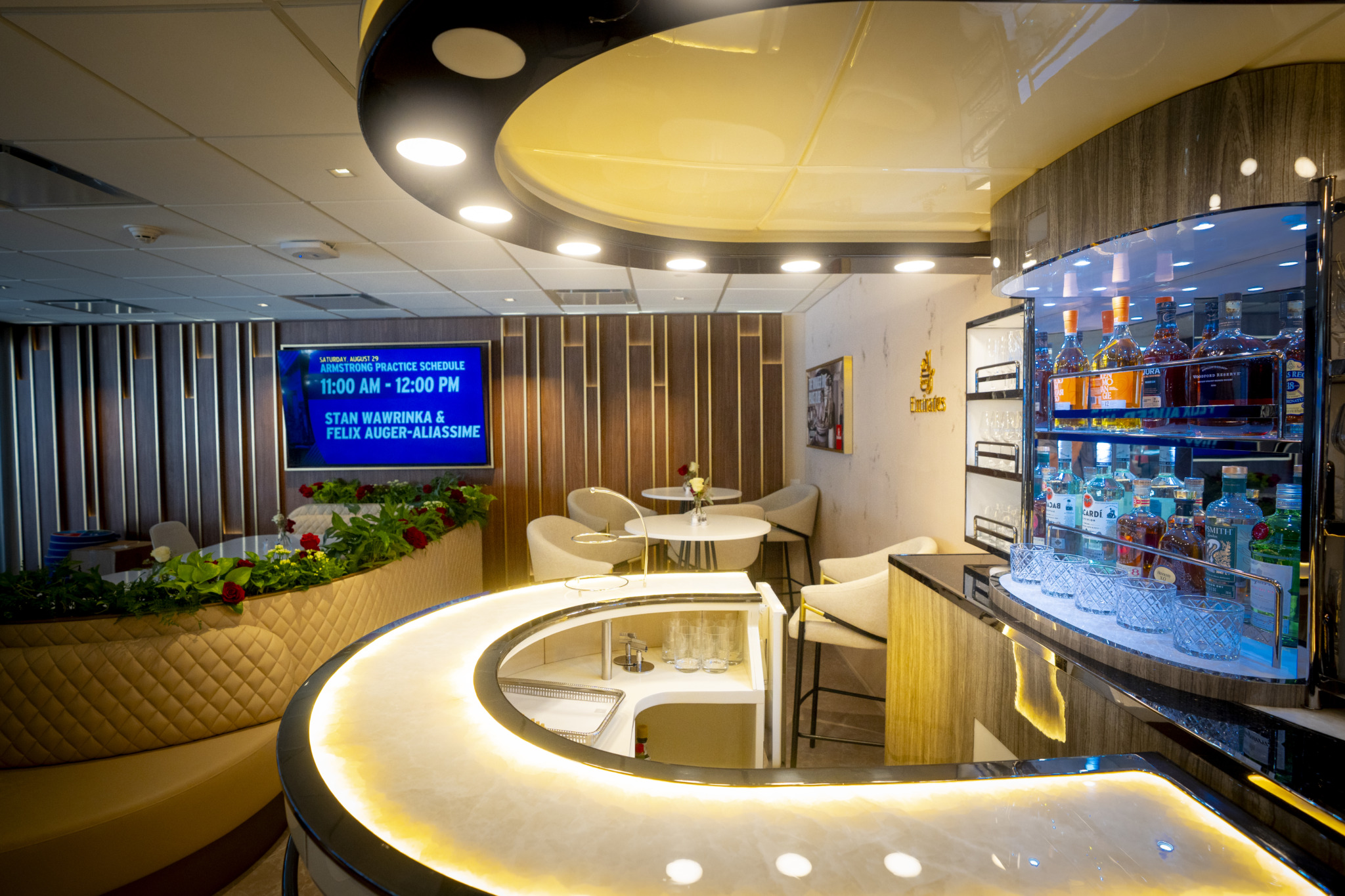
Transporting this exact architectural footprint into a sports stadium presented a unique engineering and design challenge. The reproduction inside Arthur Ashe Stadium not only replicates the physical dimensions and tactile finishes of the aircraft lounge, but it also anchors the entire suite’s spatial layout. Surrounded by cream-toned surfaces and bespoke lighting, the bar acts as a physical portal, offering guests the distinct sensation of stepping into an airborne lounge while remaining firmly grounded in the heart of Queens.
Transforming Flushing Meadows: The Broader Architectural Masterplan
The unveiling of the Emirates suite coincides with a massive, multi-year transformation of the USTA Billie Jean King National Tennis Center. Originally constructed in 1997, Arthur Ashe Stadium now stands as the crown jewel of an ambitious $800 million redevelopment masterplan spearheaded by the renowned architectural firms HOK and ROSSETTI.
The comprehensive overhaul, scheduled for complete finalization ahead of the 2027 tournament, is designed to modernize the sprawling complex and enhance the visitor experience for the more than one million spectators who stream through the gates every August and September. To manage this immense seasonal volume without disrupting the flow of the tournament, the United States Tennis Association (USTA) structured the redevelopment into three distinct chronological phases.
The recently completed second phase delivered pivotal infrastructure upgrades just in time for the current championship cycle, most notably an expanded courtside seating bowl and two entirely new tiers of luxury hospitality suites. It is within this newly minted architectural footprint that Emirates secured its prime mid-court vantage point, merging interior architecture with sweeping, unobstructed views of the action below.

Rather than sealing guests off behind traditional glass partitions, the suite extends outward through terraced seating aligned directly with the central axis of the court. This design philosophy deliberately prioritizes proximity to the athletic performance over passive enclosure, allowing patrons to absorb the dynamic sounds and energy of the match while enjoying first-class amenities.
A Two-Way Design Exchange
The partnership between Emirates and the U.S. Open extends far beyond a static real estate installation in New York. During the grueling two-week tournament, the design exchange flows in reverse, carrying the spirit of the U.S. Open thousands of feet into the air aboard transatlantic Emirates flights.
Passengers flying with the airline during the fortnight are treated to an immersive thematic takeover. Cabins are outfitted with custom headrest covers, while menus feature specially curated themed dishes and beverages inspired by the culinary culture of New York and the tournament itself. Even minor details, such as commemorative coasters, are deployed to reinforce the connection. This reciprocal branding effort effectively creates a floating embassy for the U.S. Open, bridging the gap between a ground-based sporting spectacle and global commercial aviation.
Industry Implications and Experiential Hospitality
From a strategic perspective, the installation reflects a broader evolution in sports marketing and high-end hospitality. Modern corporate sponsors are increasingly moving away from simple logo placement and traditional signage, opting instead for fully immersive, design-forward environments that communicate brand values through tactile architecture and spatial storytelling.

By investing heavily in permanent and semi-permanent architectural spaces like the new Arthur Ashe Stadium suite, brands are able to cultivate deeper, more memorable engagements with high-net-worth clients, celebrities, and stakeholders. The collaboration demonstrates how luxury service providers can leverage their proprietary design languages—honed in entirely different industries, such as aerospace—to create bespoke physical experiences that resonate within the intensely competitive landscape of global sports entertainment.
As the Billie Jean King National Tennis Center continues toward the final phase of its historic $800 million modernization project ahead of 2027, installations like the Emirates suite set a new benchmark for stadium architecture. They prove that modern sports venues are no longer just arenas for athletic competition, but sophisticated cultural hubs where design, hospitality, and commerce intersect on a grand scale.