When Kitchenware Giants Collide With Direct-to-Consumer Upstarts: The High-Stakes Battle Over Caraway and Forever Chemicals

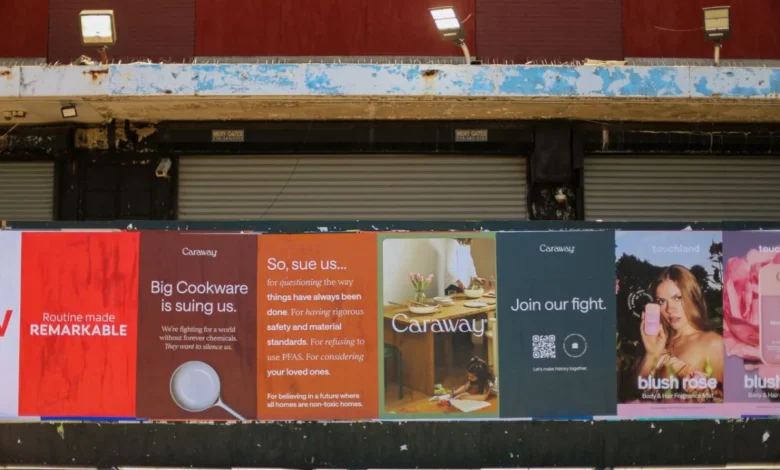
The modern direct-to-consumer kitchenware industry has long thrived on a narrative of disruption, challenging legacy conglomerates with sleek aesthetics, digital-first marketing, and direct appeals to consumer health consciousness. However, this commercial friction has recently crossed from digital advertising feeds into the federal court system. Jordan Nathan, the founder and chief executive officer of cookware startup Caraway, entered the year with a straightforward strategic directive for his team: make the brand impossible to ignore through aggressive, splashy out-of-home marketing initiatives. Yet, the manner in which that visibility has manifested represents a dramatic escalation in corporate legal conflict that neither Nathan nor his executive team initially anticipated.
The roots of this legal standoff trace back to February, when two of the most dominant manufacturing heavyweights in the global housewares sector—Groupe SEB and Meyer—jointly filed a federal lawsuit against Caraway. The plaintiffs are formidable industry conglomerates that own and operate dozens of legacy household brands familiar to consumers across the globe. Groupe SEB’s extensive portfolio features household staples such as T-fall and All-Clad, while Meyer oversees prominent names including KitchenAid cookware and Rachael Ray products. The core allegation levied by these industry giants accuses Caraway of a sustained history of false and deceptive advertising, which the plaintiffs argue has inflicted continuous commercial and reputational harm on competitors and misled the purchasing public.
At the epicenter of this litigation is the contentious debate over how kitchenware brands communicate the presence and risks of per- and polyfluoroalkyl substances, commonly known as PFAS, alongside related synthetic polymers like polytetrafluoroethylene (PTFE). As defined by the United States Environmental Protection Agency, PFAS comprise a vast, highly durable class of man-made chemicals that break down exceptionally slowly in the environment and human bodies. Because of their longevity, these substances have earned the colloquial designation of "forever chemicals."
Over the past decade, accumulating scientific research documenting the widespread detection of PFAS in environmental ecosystems and human bloodstreams has heightened public scrutiny regarding potential health impacts. Direct-to-consumer startups frequently identify this cultural anxiety as a primary market opportunity. Nathan has frequently recounted the origin story of Caraway, which he founded in 2019 following an incident where he inadvertently overheated a traditional non-stick pan, leading to a personal medical scare commonly referred to in consumer lore as the "Teflon flu." This foundational narrative became a cornerstone of Caraway’s marketing strategy, emphasizing ceramic-coated cookware explicitly marketed as free from PTFE, PFOA, PFAS, lead, and cadmium.
Chronology of a Corporate Escalation
The friction between legacy manufacturers and the upstart brand did not materialize overnight, following a well-documented trajectory of regulatory challenges and industry pushback:
- 2019: Jordan Nathan launches Caraway with a line of ceramic cookware, introducing a direct-to-consumer model centered on non-toxic kitchenware alternatives.
- Prior to 2024: The Cookware Sustainability Alliance, a non-profit organization featuring Groupe SEB and Meyer as members, challenges Caraway’s advertising practices before the National Advertising Division (NAD) of the Better Business Bureau.
- Late 2023: The NAD issues a formal recommendation advising Caraway to cease utilizing the "Teflon flu" narrative in a context that implies competing traditional cookware is inherently toxic or likely to induce illness under normal use conditions. The self-regulatory body notes Caraway possesses a reasonable basis for its own chemical-free claims, but lacks sufficient comparative evidence to designate competitor products as unsafe.
- February 2024: Groupe SEB and Meyer file a joint federal lawsuit against Caraway, accusing the startup of false advertising, deceptive trade practices, and utilizing fear-based marketing tactics.
- May–June 2024: Caraway launches a prominent out-of-home advertising campaign across major metropolitan areas, including billboard placements near Groupe SEB’s New Jersey corporate offices, urging consumers to support its public petition.
- July 27, 2024: Legal representatives for Groupe SEB and Meyer issue a formal cease-and-desist letter demanding Caraway immediately halt the unauthorized use of registered trademarks and brand logos in promotional materials.
- Summer 2024: An independent consumer files a separate class-action lawsuit in California federal court against Caraway, alleging similar misleading advertising claims.
- September 2024: Caraway expands its product ecosystem beyond cookware and bakeware, introducing a plastic-free coffee maker that immediately generates over seven million dollars in initial sales, applying the brand’s non-toxic marketing playbook to a new consumer category.
The Legal Battleground and Competing Arguments
The central legal argument presented by Groupe SEB and Meyer targets Caraway’s broad brush-stroke characterization of traditional non-stick products. Carmine Zarlenga, legal counsel representing the manufacturing conglomerates, asserted in public statements that the litigation centers fundamentally on truthful advertising. According to the plaintiffs, Caraway’s aggressive promotional campaigns have advanced unsubstantiated claims against an entire category of regulated products that federal oversight bodies—including the Food and Drug Administration and the Consumer Product Safety Commission—have consistently deemed safe for consumer use under normal conditions. Furthermore, the lawsuit emphasizes that while Caraway partially complied with the aforementioned NAD recommendations regarding its advertising copy, the company allegedly persisted in a broader pattern of misleading communications.
Legal filings cite specific digital advertisements featuring phrasing such as "5 things in your kitchen you didn’t know were toxic" and promotional messaging warning consumers to stay safe from forever chemicals by trusting Caraway products, which are explicitly framed as free from harmful acronyms. The plaintiffs argue these materials deliberately prey on consumer apprehensions, causing measurable financial and reputational injury to companies that manufacture traditional PTFE-coated cookware.
Conversely, Caraway has defended its public positioning vigorously, moving to dismiss the federal complaint while turning the litigation itself into a central component of its corporate marketing engine. In legal motions and public commentary, Nathan has pointed out that major conglomerates like Groupe SEB and Meyer also manufacture and market their own lines of ceramic cookware, frequently utilizing parallel promotional vocabulary such as "toxin-free" and "made without PFAS." Regarding the scientific debate, Nathan acknowledges that toxicologists often differentiate among the thousands of distinct chemical structures within the broader PFAS family. However, he maintains that numerous international regulatory bodies, independent scientists, and human rights experts increasingly classify the entire class of substances as a matter of significant environmental and public health concern.
The Broader Industry Trend: The Rise of Non-Toxic Positioning
The ideological clash between Caraway and legacy manufacturers reflects a broader, systemic shift across multiple consumer packaged goods categories. For years, direct-to-consumer disruptors have successfully captured market share by championing ingredient transparency and eliminating specific compounds from formulations—often ahead of regulatory mandates.
This phenomenon extends far beyond the kitchenware sector. In the personal care industry, the proliferation of aluminum-free deodorants occurred despite scientific consensus indicating no definitive causal link between aluminum compounds in antiperspirants and long-term health complications. Similarly, athletic apparel brands increasingly market their textiles as non-toxic and free from specific chemical treatments, responding directly to surging consumer demand for cleaner household and lifestyle products.
Academic research underscores the commercial efficacy of this consumer sentiment. A peer-reviewed study published in the Journal of Marketing Research by Georgetown University associate professor Anita Rao and her co-authors examined consumer response mechanisms to debunking claims across product categories laden with toxicity debates, including aluminum in deodorants, fluoride in toothpaste, and genetically modified organisms in nutritional supplements. The empirical findings demonstrated that while corrective messaging from regulatory bodies carries significant statistical weight in altering consumer purchase intentions, attempts by competing commercial entities to debunk rival claims often yield mixed results. Consequently, industry analysts observe that major incumbent brands frequently choose to launch complementary competing product lines—such as traditional brands releasing aluminum-free deodorants or fluoride-free toothpastes—rather than attempting to reverse consumer demand through direct counter-messaging alone.
Implications and Future Outlook for Direct-to-Consumer Brands
Caraway’s tactical decision to embrace the litigation publicly—establishing dedicated webpage tabs detailing the lawsuit, encouraging digital petition signatures, and deploying provocative out-of-home advertising—presents a calculated high-risk, high-reward corporate strategy. Marketing analysts note that framing the legal battle as an David-versus-Goliath struggle against "Big Cookware" effectively galvanizes the startup’s core demographic of health-conscious, digitally native consumers, reinforcing brand loyalty and driving immediate top-of-funnel awareness.
However, this aggressive public relations stance carries distinct operational and legal vulnerabilities. Industry observers point out that if the federal court ultimately rules in favor of Groupe SEB and Meyer, or if subsequent private litigation yields unfavorable judgments, the reputational blowback could severely undermine Caraway’s consumer trust and brand equity. Additionally, the emergence of a secondary class-action lawsuit filed by a California consumer over the summer signals that the company must navigate mounting legal exposure on multiple fronts simultaneously.
Despite these legal headwinds, Caraway continues to scale its commercial operations using its established playbook. The successful late-September rollout of its plastic-free coffee maker—which rapidly exhausted initial inventory and generated seven-figure sales volumes within days—demonstrates that the brand’s underlying product demand remains robust. By pivoting its messaging focus from traditional non-stick chemical coatings to microplastics within household appliances, Caraway illustrates that the broader cultural movement toward material transparency will continue to shape product development and competitive dynamics across the consumer goods landscape for the foreseeable future.