The AI Report 2026: Navigating the Intersection of Artificial Intelligence and Fashion Education


For as long as the fashion industry has existed, the sanctity of human creativity has served as its bedrock. From the initial sketch on a designer’s pad to the final marketing campaign, the process was historically defined by human intellect, intuition, and lived experience. However, the rapid integration of artificial intelligence into the fashion ecosystem is fundamentally altering this landscape, forcing a generation of emerging professionals to reconcile their academic training with a workplace increasingly dominated by algorithmic outputs. As detailed in The Interline’s AI Report 2026, this shift represents more than a mere technological update; it is a structural transformation of what it means to be a creative professional.
The transition from a human-led industry to one augmented—or in some cases, driven—by machine learning has been swift. Initially, AI’s footprint in fashion was largely utilitarian, focused on behind-the-scenes optimization: predictive analytics for trend forecasting, inventory management, and the refinement of cutting-room efficiency to reduce fabric waste. These applications were welcomed as logical extensions of existing digital tools. Yet, the current trajectory has shifted toward the creative core. AI is now frequently tasked with generating moodboards, drafting marketing copy, and producing high-fidelity imagery for both internal brand use and external consumer-facing content.
A Chronology of Technological Integration
The timeline of AI in fashion reveals a clear progression of influence. In the early 2020s, AI served as a supporting actor in the supply chain, primarily utilized by data scientists and logistics managers to streamline production. By 2024, the advent of sophisticated generative models—capable of interpreting natural language prompts to create visual assets—brought AI directly into the design studio. By 2026, the technology had moved into the curriculum of major fashion institutions. This rapid adoption has left current students in a precarious position: they are being trained for a career path that is evolving faster than the pedagogical frameworks designed to support them.
Data-Driven Sentiment Among Emerging Creatives
The Westminster Fashion agency, through a recent survey of students and recent graduates, captured the prevailing anxiety of this transition. The data paints a picture of a generation divided by necessity and fear. Approximately 59% of respondents identified AI as a threat to their future career opportunities, while only 12% viewed it as a primary opportunity. The qualitative feedback further highlighted a deep-seated unease, with nearly 50% of participants expressing worry regarding the erosion of human-centric roles.

Despite this apprehension, the usage patterns suggest a pragmatic, albeit cautious, engagement with the technology. While 70% of students report using AI, the majority do so sparingly. The primary use cases remain anchored in administrative and research tasks—copywriting, scheduling, and data synthesis—rather than the "sacred" territory of artistic design and ideation. This creates a clear dichotomy: students are willing to outsource the mundane, but they remain fiercely protective of the creative processes that defined their university education.
Pedagogical Disconnect and Workforce Readiness
A critical finding from recent studies is the significant gap between industry reality and academic preparation. Only 25% of students feel their current education adequately prepares them for an AI-integrated workplace. A staggering 41% report uncertainty regarding the applicability of their skills to modern employment, signaling a crisis in fashion education.
The challenge for educators is whether to treat generative AI as a technical skill—much like Adobe Illustrator or Excel—or as a disruptive force that necessitates a complete overhaul of how "creativity" is taught. Critics argue that teaching AI as a standard software tool ignores the profound ethical and philosophical implications of its use. If fashion schools prioritize speed and output efficiency, they risk losing the slow, iterative experimentation that historically fostered original design. There is a growing concern that algorithmic reliance will lead to a homogenization of style, where "originality" is sacrificed for the sake of basic capability and rapid trend cycles.
Ethical Implications and Environmental Concerns
The resistance expressed by emerging professionals is not limited to job security; it is deeply rooted in the ethics of the industry. Many students are entering the field with a mandate for sustainability, aiming to dismantle the legacy of overproduction and environmental waste. There is a prevailing fear that AI, marketed as a tool for efficiency, may inadvertently accelerate the fashion cycle, leading to more frequent drops and higher waste volumes.
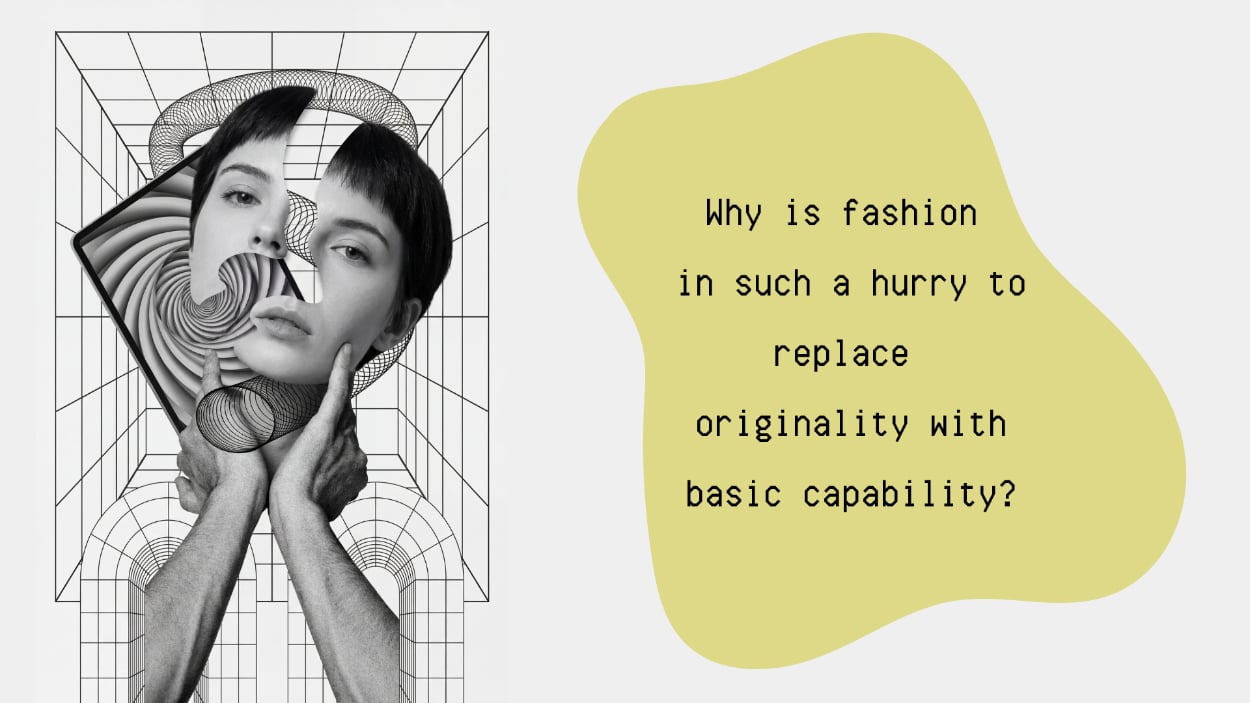
Furthermore, issues regarding data provenance, intellectual property, and the lack of consent in training large language models remain at the forefront of student concerns. The ethical dimension of using existing creative works—often produced by the very people the AI might replace—to train proprietary models has sparked a debate about the future of authorship in fashion. For this generation, the industry’s "hurry to replace originality with basic capability" is viewed as an existential threat to the integrity of the craft.
Industry Implications and Future Outlook
The broader implication of this shift is the potential narrowing of the "possibility horizon" for new entrants. While many students remain optimistic about their ability to adapt, there is a pervasive cynicism regarding the industry’s direction. The common sentiment among the cohort is that while AI is an unavoidable part of the future, the manner of its implementation lacks a cohesive human-centric strategy.
The industry currently faces a critical juncture. Brands and supply chain partners are utilizing AI to maintain competitive advantages, but they are doing so at the risk of alienating their future workforce. For students, the objective is not necessarily to banish AI, but to define the guardrails of its integration. They seek a professional environment where AI supports, rather than supplants, the human element—a culture where technology is used to enhance the designer’s vision rather than dictate the brand’s output.
As the industry continues to integrate these systems, the role of the next generation will be to act as the moral and creative compass. They will be the ones to determine the balance between the efficiency of the machine and the nuance of human expression. Whether this generation can successfully shape the guardrails of AI, or whether they will be forced to adapt to a system that prioritizes output over artistry, remains the defining question for the next decade of fashion. The integration of AI is not merely a technical challenge; it is a cultural negotiation that will redefine the identity of the global fashion industry for years to come.
Related posts: