Shattering the Bubble: Inside Los Angeles Design Week/end and the City’s Decentralized Creative Renaissance

When newcomers arrive in Los Angeles from denser metropolitan hubs like New York City, they are often struck by a disquieting stillness. Where Manhattan pulses with continuous sidewalk foot traffic and spontaneous urban friction, Los Angeles operates as an archipelago of insular neighborhoods. Residents construct curated bubbles of localized haunts, navigating the urban expanse from the enclosed interior of an automobile—or, increasingly among younger generations, autonomous vehicles. This deeply fragmented topography presents a distinct challenge for community-building, particularly for an interconnected creative sector that relies on cross-pollination and public engagement.

To counter this geographical isolation, co-founders Holland Denvir and creative director Meghan McNeer launched LA Design Week/end (LAD/W) in 2024. Now in its third consecutive year, the festival has evolved into a major fixture on the international design calendar. During the first week of October, the 2026 edition brought together more than 130 independent designers, multidisciplinary studios, experimental galleries, and prominent brands spread across over 15 distinct Los Angeles neighborhoods. By deliberately bypassing traditional, centralized convention centers, the festival drew thousands of locals and international visitors away from typical tourist corridors and deep into the city’s vibrant Eastside creative hubs.
A Decentralized Model Fostering Urban Discovery
The structural philosophy underpinning LA Design Week/end is intentionally decentralized. Rather than anchoring events to a single exhibition hall or designated commercial design district, LAD/W unfolds organically across the urban fabric. Each day of the festival focuses on a cluster of neighborhoods, encouraging attendees to ditch their cars in favor of walking, biking, scootering, or utilizing the Metro system.

According to festival organizers, this mobility-focused approach is designed to shift the participant’s mindset from passive transit to active urban exploration. By eliminating hours spent navigating notoriously congested traffic arteries, attendees are invited to experience the city at a human scale. This neighborhood-by-neighborhood format transforms the event into a choose-your-own-adventure experience, where no two visitors navigate the exact same itinerary, yet all are funneled into communal spaces that highlight the city’s grassroots creative ecosystem.
From Boyle Heights to Silver Lake: Key Stops on the 2026 Itinerary
The 2026 iteration offered an overwhelming array of programming, reflecting the diverse material practices thriving across Southern California. Among the standout stops was Small Green Door (SGD), a creative studio nestled within an unassuming cluster of industrial warehouses on a tree-lined street in Boyle Heights. Co-founded by Leo Estévez, the complex houses artist workspaces, an advanced R&D kitchen, multiple galleries, and even a subterranean bunker.

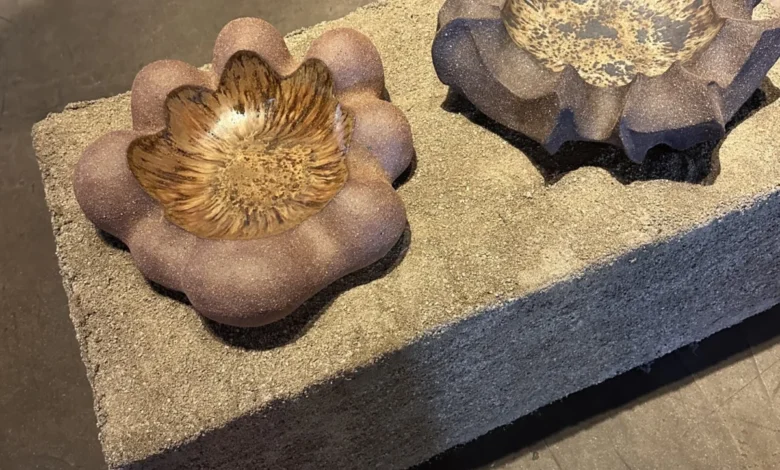
SGD served as the venue for After the Tide, an open-call group exhibition curated by Nadia Khagani and Rose Zhang. The showcase featured 19 artists and designers whose material explorations are deeply informed by natural forces, heavily emphasizing gothic-leaning ceramics. A sonic water installation by Edge Sound Research anchored the gallery space, complemented by custom sand pedestals fabricated on-site. Works like Kimberly Meyer’s shallow clay bowls demonstrated the intersection of functional craft and sculptural form, prompting viewers to reconsider the tactile qualities of everyday objects. Upon exiting, visitors were handed retro cassette cases containing mini zines and a hidden green key—a playful nod to historic underground subcultures.
Further west in Echo Park, the neighborhood bistro Henrietta provided a culinary anchor for festival attendees. Helmed by owner Mark Lesser, the establishment operates as a market-driven sandwich shop by day and a sophisticated California bistro by night. Beyond its gourmet bodega offerings, the restaurant exemplifies the hyper-local integration of design and community life, featuring custom-ordered facade tiles and an interior that serves as a casual salon for visiting creatives.

In Silver Lake, historical architecture and contemporary preservation intersected at the Living Paul McCobb Museum. Run by British transplant and skateboarding enthusiast Yogi Proctor alongside his wife, documentary filmmaker Carol Martori, the private home serves as a living archive dedicated to the midcentury designs of Paul McCobb. Over two decades, Proctor has amassed a staggering collection of McCobb’s 1950s Planner Group furniture, Contempri tableware, and associated accessories. Housed within a 1949 Silver Lake residence, the museum challenges the traditional, sterile museum format by integrating historical design objects into daily domestic life, prompting reflections on the durability and enduring relevance of midcentury American craftsmanship.
Exploring Materiality and Sound at Neutra VDL
Another architectural anchor of the 2026 festival was the Neutra VDL Studio and Residences near the Silver Lake Reservoir, a National Historic Landmark designed by Richard Neutra. The historic site hosted Companionship, an exhibition presented by the Yamaha Design Laboratory—the in-house design division established by the multinational music corporation in 1963.

Guest-curated by multimedia artist and photographer Johnny Le, the exhibition explored musical instruments not merely as functional tools, but as lifelong companions. Le’s photographic documentation of Yamaha’s Japanese headquarters and piano factories offered viewers a rare look at the complex internal anatomy of acoustic instruments. The exhibition also featured innovative furniture prototypes, including specialized guitar stand-stools and TransAcoustic guitars capable of Bluetooth playback.
Of particular note was the first public exhibition of Dreaming of the Sea, a collaborative low chair prototype developed with Karimoku Case. Designed to generate soothing, wave-like acoustic and tactile sensations through internal rolling metal balls, the piece exemplifies contemporary cross-industry experimentation. The exhibition concluded on the roof with Manabu Kawada’s The Backrest for Sky Viewers, inviting visitors to contemplate the open sky while leaning against a minimalist wooden plank.

Sculptural Gastronomy and the Power of Real-Life Gathering
Evening programming throughout LAD/W frequently blurred the lines between high design, performance art, and culinary hospitality. At the Haas Brothers studio, visitors were welcomed into a bustling fabrication shop interspersed with whimsical, organic sculptures. Food designer Zehra Ahmed contributed theatrical culinary installations, featuring a ten-foot-long serpentine sandwich crafted from braided brioche that functioned as a decorative table runner alongside long-stemmed roses.
Similarly, Ravenhill Studio hosted Los Angeles Sets a Table, a critically acclaimed exhibition curated by Chelito Villaflor and Chris Albanese of Thought Forms Studio, based on an initial concept by Cathy Callahan. The showcase utilized two distinct tablescapes representing dawn and dusk to highlight the resurgence of hand-crafted tableware and the cultural importance of gathering in real life around shared meals.

Broader Economic and Cultural Implications
The sustained success of LA Design Week/end highlights a broader structural shift within Los Angeles’s creative economy. For decades, the city’s creative output—spanning entertainment, fashion, fine art, and industrial design—has frequently suffered from a lack of centralized cohesion, often overshadowed by legacy creative capitals like New York or Milan.
By utilizing a decentralized, neighborhood-driven framework, LAD/W has successfully cultivated a unified identity for the Southern California design community without sacrificing its localized autonomy. Economically, the festival provides vital visibility for independent studios, fabricators, and galleries, connecting local artisans directly with international collectors, press, and curators. Furthermore, by intentionally routing foot traffic through historically marginalized or industrial corridors such as Boyle Heights, the event stimulates localized commerce and fosters civic pride.

As LA Design Week/end looks toward future iterations, its model offers a blueprint for how sprawling, automobile-centric metropolises can utilize design festivals to break down physical and social barriers. By prioritizing human connection, active mobility, and tactile engagement over conventional exhibition formats, LAD/W has cemented its status as an essential catalyst for the city’s ongoing cultural renaissance.
Related posts: