Fibroline dry powder impregnation technology reaches full-scale operational status in automotive headliner production at Howa Europe

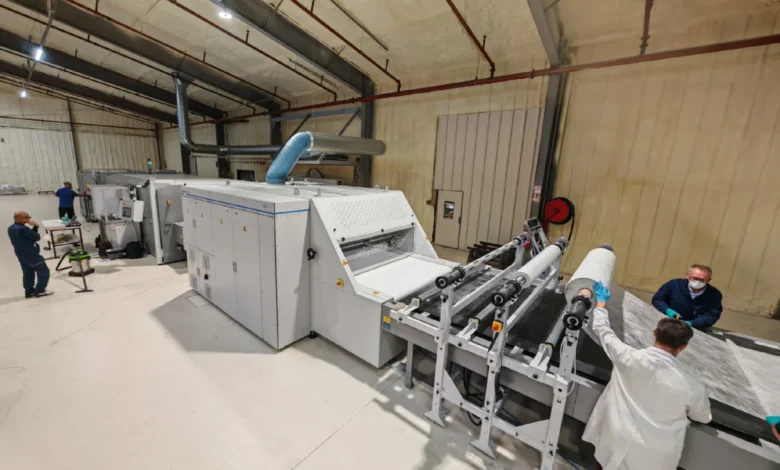
The landscape of automotive interior manufacturing is undergoing a significant transformation as Fibroline, a French technology innovator, announces that its proprietary dry powder impregnation process is now fully operational at the Howa Europe production facility. This milestone marks the culmination of years of collaborative research and development between the two companies, signaling a shift away from traditional liquid-based chemical processes in the production of automotive headliners. By utilizing high-intensity alternating electric fields, the system enables the precise distribution of powders throughout complex, porous materials without the need for volatile organic compounds (VOCs) or energy-intensive drying stages.
A Technological Shift in Automotive Manufacturing
Historically, the automotive textile industry has relied heavily on liquid impregnation—a process that involves soaking materials in chemical baths to add structural integrity, acoustic damping, or fire-retardant properties. While effective, this methodology presents significant environmental and logistical challenges. Conventional liquid systems require vast amounts of water and solvent, necessitate heavy machinery for the subsequent drying of textiles, and produce hazardous liquid effluent that must be treated or disposed of.
Fibroline’s patented dry impregnation technology bypasses these drawbacks entirely. By creating a high-intensity alternating electric field, the process forces fine, dry powders into the interstitial spaces of porous fabrics, foams, and nonwovens. Because the material remains dry throughout the process, the energy-draining evaporation step—traditionally the most resource-intensive phase of headliner manufacturing—is eliminated. This transition is not merely a process improvement; it is a fundamental redesign of the production flow, allowing manufacturers to reduce their carbon footprint while simultaneously simplifying their supply chain.
Chronology of Development
The partnership between Fibroline and Howa Europe is the result of a multi-year industrialization roadmap. Fibroline, based near Lyon, France, has been pioneering powder-based technologies since the early 2000s, accumulating a portfolio of over 50 patents. The collaboration with Howa was specifically initiated to address the unique performance requirements of automotive headliners, which must balance stringent weight constraints with durability, acoustic performance, and aesthetic standards.

- Early 2000s: Fibroline begins foundational research into dry impregnation techniques for technical textiles and composites.
- 2010s: The company pivots toward specialized applications, including medical and high-performance industrial fabrics, refining the alternating electric field technology.
- Early 2020s: Fibroline and Howa Europe enter a strategic partnership to apply this technology to the automotive interior market. Extensive pilot testing is conducted to ensure the dry-powder method meets automotive standards for mechanical stress and structural integrity.
- 2024-2025: Installation and calibration of the industrial-scale machinery, supported by engineering firms Ingecal and Reliant, take place at the Howa Europe facility.
- September 2026: The production line is officially declared fully operational, marking the transition from experimental pilot to high-volume commercial manufacturing.
Implications for Automotive Sustainability
The adoption of solvent-free manufacturing is a direct response to the global automotive industry’s "Green Transition." As original equipment manufacturers (OEMs) face increasing pressure to lower their Scope 3 emissions and improve the recyclability of vehicle components, technologies that enable mono-material construction have become highly valuable.
Automotive headliners are traditionally complex, multi-layer assemblies of varying materials that are difficult to separate once bonded. This makes end-of-life recycling nearly impossible, often resulting in these components being sent to landfills. Fibroline’s dry powder technology allows for the precise application of bonding agents and functional powders that can be tailored to the specific material composition of the headliner. By moving toward mono-material or more compatible multi-layer structures, Howa is positioning itself to lead in the development of vehicle interiors that are easier to disassemble and recycle at the end of their service life.
Furthermore, the elimination of liquid solvents drastically reduces the Volatile Organic Compound (VOC) emissions associated with factory operations. This is a critical factor in meeting tightening European environmental regulations and improving indoor air quality for factory personnel.
Data and Performance Metrics
While specific output figures for the Howa Europe plant remain proprietary, the technical advantages of dry impregnation are well-documented in industrial studies. When compared to wet impregnation, the dry powder process has demonstrated the following potential efficiencies:
- Energy Consumption: By removing the heat-intensive drying and evaporation tunnels, energy usage in the impregnation stage can be reduced by as much as 40–60%.
- Water Usage: The system is essentially water-free, eliminating the need for water treatment facilities for process waste.
- Production Footprint: The compact nature of the electric field impregnation system allows for a smaller factory floor footprint, as the space previously reserved for long drying ovens can be repurposed for other production activities.
- Operational Speed: The process allows for the simultaneous treatment of multiple layers in a single pass, increasing throughput without sacrificing precision.
The Role of Engineering Partners
The successful deployment of this technology at the industrial scale would not have been possible without the integration expertise of Ingecal and Reliant. These engineering firms were instrumental in bridging the gap between Fibroline’s laboratory-scale prototypes and the high-speed, high-reliability requirements of an automotive production line. Their involvement ensured that the alternating electric field technology could operate continuously, maintaining uniform powder distribution even at the high line speeds required by modern automotive manufacturing.

Industry Reactions and Market Outlook
While an official statement from the board of Howa Europe is pending, industry analysts suggest that this move is a calculated strategic advantage. By adopting this technology early, Howa is likely to secure a competitive edge in bidding for future vehicle platforms from major automotive manufacturers who are actively seeking suppliers with lower-carbon production capabilities.
"The industrialization of dry powder impregnation is a watershed moment for the technical textiles sector," says an industry consultant familiar with the project. "It proves that we can maintain, or even improve, the performance of complex automotive components while stripping away the legacy chemical processes that have hindered the industry’s environmental performance for decades."
As Fibroline continues to leverage its 50+ patents, the success at Howa Europe serves as a proof-of-concept that is likely to attract interest from other sectors, including the aerospace and medical industries. In aerospace, where every gram of weight reduction is vital, the ability to impregnate lightweight structures with precise amounts of functional powders without the "dead weight" of residual liquid chemical carriers offers immense potential.
Conclusion
The operational status of the Fibroline technology at Howa Europe represents a critical shift toward cleaner, more efficient, and more sustainable automotive manufacturing. By harmonizing advanced physics with industrial textile engineering, the companies have successfully removed the reliance on solvents and drying stages that have long defined the industry. As the automotive sector accelerates its transition to greener manufacturing, the successful implementation of this dry powder process provides a blueprint for how legacy industries can integrate high-tech solutions to meet the sustainability mandates of the future. The project stands as a testament to the power of cross-industry collaboration and the long-term potential of fundamental material science innovations.