Rare 1945 Patek Philippe Leads Phillips Geneva Watch Auction XXIV With $4.9 Million Upper Estimate

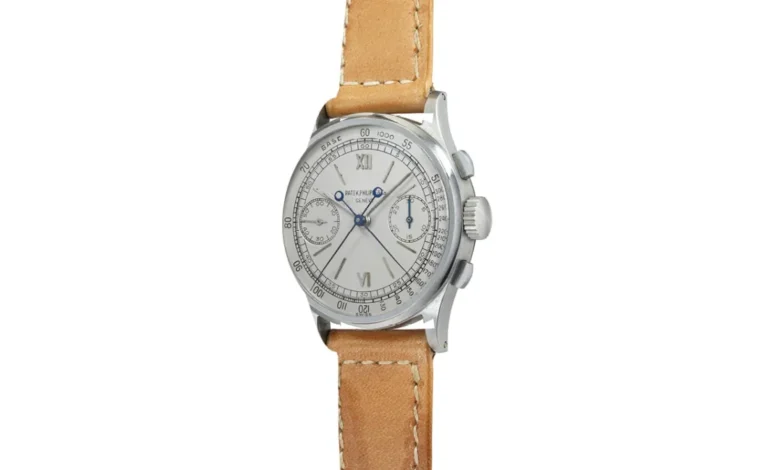
The upcoming autumn live auction season for vintage and contemporary timepieces is set to open with extraordinary momentum as auction house Phillips, in association with Bacs & Russo, unveils the premier highlights for the upcoming Geneva Watch Auction: XXIV. Scheduled to take place on November 7 and 8, the two-day event will present more than 200 meticulously curated lots to global collectors, investors, and horological enthusiasts. Leading the catalogue is a historically significant, exceptionally rare Patek Philippe split-second chronograph dating back to 1945, which commands an upper pre-sale estimate of CHF 4 million, equivalent to approximately $4.9 million.
This flagship timepiece encapsulates the pinnacle of mid-20th-century watchmaking craftsmanship. Featuring a sophisticated silver-toned dial complemented by polished steel hour markers and a precise tachymeter scale, the vintage Patek Philippe represents a golden era of mechanical engineering. Split-second chronographs, known in the industry as rattrapantes, are among the most complex mechanisms to produce, requiring master watchmakers to spend countless hours hand-finishing gears, springs, and levers. The presence of this museum-quality artifact is expected to draw intense bidding competition from institutional buyers and high-net-worth private collectors when it crosses the auction block in Geneva.
The announcement of this marquee lot marks the official commencement of the autumn 2026 luxury watch auction circuit. As elite auction houses converge on the Swiss watchmaking capital, the performance of the Geneva Watch Auction: XXIV will serve as a crucial barometer for the health of the secondary luxury watch market, which has experienced both unprecedented booms and subsequent stabilization phases over recent years.
Exceptional Masterpieces and Star-Studded Catalogue Highlights
While the 1945 Patek Philippe anchors the sale in terms of valuation and historical prestige, the rest of the 200-piece catalogue features an array of rare complications, highly sought-after vintage references, and modern independent masterpieces. Among the most anticipated lots is an exclusive creation by independent watchmaking luminary F.P. Journe. This wristwatch showcases a striking, shiny pink-gold dial adorned with a meticulously hand-engraved geometric pattern, blending traditional artisanal decoration with modern horological innovation. Auction specialists have assigned the piece a pre-sale estimate ranging between CHF 1 million and CHF 2 million, translating to roughly $1.2 million to $2.4 million, reflecting the surging demand for independent master watchmakers in the contemporary collecting sphere.
Rolex is also heavily represented in the sale, led by an extraordinary Daytona reference carrying an upper estimate of CHF 1.6 million, or about $2 million. This vintage chronograph pairs a warm yellow-gold case with a contrasting, highly collectible black Paul Newman dial. Adding an exceptional layer of provenance and rarity, the bracelet carries a V.C.A. stamp, which horological researchers have attributed to the legendary high jewelry maison Van Cleef & Arpels, signaling a bespoke retail partnership from the mid-century era.
Another stellar Rolex lot originating from circa 1952 features the coveted Stelline dial—a moniker derived from the Italian word for stars, honoring the eight distinct star-shaped hour markers that punctuate the face of the watch. Beyond its captivating aesthetic, the timepiece incorporates a triple calendar complication alongside a moon-phase display, marrying utility with celestial tracking. This sophisticated vintage Rolex carries a high estimate of CHF 1.2 million, or approximately $1.5 million.
Rounding out the major highlights is a rare 2007 F.P. Journe creation manufactured to commemorate the second anniversary of the independent watchmaker’s exclusive boutique in Tokyo. This limited-production timepiece boasts a distinct ruthenium-coated dial set in stark contrast against warm pink-gold crowns and hands. Inside the case beats a sophisticated hand-wound pink-gold caliber engineered to power two independent time displays. It carries an upper estimate of CHF 800,000, equivalent to roughly $976,715.
Chronology of the Geneva Watch Auctions and Market Evolution
The unfolding narrative of the Geneva Watch Auction: XXIV is rooted in decades of evolution within the Swiss horological market. Geneva has long served as the undisputed global epicenter for fine watch auctions, acting as the neutral ground where international wealth, historical preservation, and elite craftsmanship intersect. Over the past twenty-four editions, the Phillips watch department, heavily shaped by the stewardship of industry veterans such as Aurel Bacs and Livia Russo, has consistently redefined the ceiling for vintage watch valuations.
The trajectory of the secondary watch market over the last decade has transformed timepieces from niche collector hobbies into recognized alternative asset classes. Throughout the late 2010s and early 2020s, rare sports models from brands like Rolex and Patek Philippe saw exponential price growth driven by broad macroeconomic factors, low interest rates, and an influx of younger, digital-native investors. Although the market underwent a necessary price correction beginning in late 2022 and extending through 2024, top-tier, museum-grade rarities with uncompromised provenance have continued to defy broader economic headwinds.
The November 2026 auction falls precisely into a cyclical rhythm that dictates the luxury calendar. Preparations for this flagship sale began months in advance, involving rigorous authentication, historical archiving, and international exhibition tours. Before the hammers fall in Geneva, select highlights from the catalogue will travel to major global financial and cultural hubs—including cities in Asia, the Middle East, and North America—allowing elite clientele to inspect the physical condition and mechanical integrity of the timepieces firsthand.
Supporting Market Data and Economic Context
An analysis of the pre-sale estimates for the Geneva Watch Auction: XXIV reveals a market deeply bifurcated between accessible luxury and ultra-rare investment-grade masterworks. While the catalogue encompasses more than 200 lots catering to varied collecting budgets, the concentration of value in the top five lots—totaling tens of millions of francs—demonstrates the resilience of the ultra-high-end collector segment.
Market research data from major luxury watch indices indicates that while mass-produced steel sports watches experienced valuation normalization following the speculative peaks of 2022, unique historical complications, vintage independent pieces, and signed retailer dials have retained, and in many cases grown, their intrinsic value. The inclusion of the 1945 Patek Philippe split-second chronograph at a $4.9 million upper estimate underscores the market’s enduring appetite for pre-quartz mechanical achievements that cannot be replicated by modern industrial manufacturing methods.
Furthermore, the growing prominence of independent watchmakers like F.P. Journe in major auction catalogues reflects a structural shift in collector tastes. Over the past five years, secondary market indices for independent brands have outpaced several legacy conglomerates, driven by limited production numbers—often numbering only in the hundreds per year—and the personal artistic vision of master watchmakers. The presence of two major F.P. Journe lots in the upcoming Phillips sale highlights how contemporary independent horology has successfully established itself alongside historical giants like Patek Philippe and Rolex.
Official Responses and Industry Perspectives
Representatives for Phillips, in association with Bacs & Russo, expressed profound optimism regarding the quality and depth of the upcoming catalogue. While formal statements accompanying the Tuesday release emphasized the historical significance of the individual lots, industry experts and auction specialists have underscored the meticulous curation process required to assemble such a high-caliber lineup.
"The curation of the Geneva Watch Auction: XXIV represents a careful balancing act between honoring the golden age of mid-century Swiss watchmaking and acknowledging the vibrant, rapidly evolving landscape of contemporary independent creators," noted a senior horological consultant not directly affiliated with the auction house. "When you place a 1945 Patek Philippe split-second chronograph alongside a modern F.P. Journe with a ruthenium-coated dial, you are telling a comprehensive story of human ingenuity across nearly a century."
Collector communities and luxury market analysts have similarly weighed in on the implications of the forthcoming sale. Many anticipate that the performance of the auction will provide definitive proof of whether institutional and private capital is returning to the physical asset market with renewed confidence following periods of macroeconomic uncertainty. The collaboration between Phillips and Bacs & Russo remains a gold standard in the auction ecosystem, offering buyers a layer of trust, transparency, and scholarly authentication that is paramount when transacting at the multi-million-dollar level.
Broader Impact and Implications for the Luxury Ecosystem
The consequences of the Geneva Watch Auction: XXIV extend far beyond the salesroom floor of the Hôtel La Réserve in Geneva. As the first major live auction of the fall 2026 season, the event will establish psychological and financial benchmarks that will influence private dealers, retail boutiques, and insurance valuations worldwide.
For primary manufacturers, the skyrocketing values achieved by vintage models at auction validate the enduring equity of their historical archives. When a 1945 Patek Philippe commands millions of dollars, it reinforces the narrative of timeless durability and generational wealth transfer that brands use to market their contemporary portfolios. Conversely, the high demand for vintage Rolex models with rare configurations—such as the Stelline triple calendar or the Paul Newman Daytona with a Van Cleef & Arpels retail stamp—demonstrates that historical provenance and unique factory anomalies remain the ultimate drivers of collector desire.
As November 7 and 8 approach, all eyes in the global financial and luxury sectors will turn toward Geneva. The results of the auction will not only crown new custodians for these mechanical treasures but will also write the next chapter in the ongoing history of horological collecting, proving once again that fine mechanical timepieces transcend mere instruments of time measurement to become enduring symbols of human art and engineering.