Luxury Jewelry E-commerce Faces Sophisticated Cyber Threat Through Typosquatting and Negative SEO Tactics

The digital landscape for luxury jewelry e-commerce has shifted as a sophisticated and highly coordinated form of cyberattack begins to target high-end retailers. Unlike traditional phishing or credit card fraud, this emerging threat utilizes a combination of typosquatting and negative Search Engine Optimization (SEO) to undermine the brand authority and search rankings of established jewelers. The pattern, which was first identified by industry experts at Opulent Jewelers, indicates a strategic attempt to manipulate search engine algorithms, causing legitimate businesses to lose visibility on high-value keywords.
The initial indicators of these attacks often manifest within technical diagnostic tools rather than customer complaints or immediate sales drops. Retailers have reported sudden, unexplained surges in referring domains within their Google Search Console reports. In several documented cases, the number of referring domains jumped by several hundred within a single week. These domains typically bear no relation to the jewelry industry and follow a coordinated pattern of linking to luxury brands through misspelled variations of their official domain names.
The Mechanics of the Modern Typosquatting Threat
Historically, typosquatting involved registering domain names that were minor misspellings of popular websites to trick users into visiting fake storefronts or entering sensitive information. However, this new iteration is significantly more subtle. The attacker does not necessarily host a functional website or a phishing page on the typosquatted domain. Instead, the domain often sits "parked" or empty, with no outbound links or visible content.
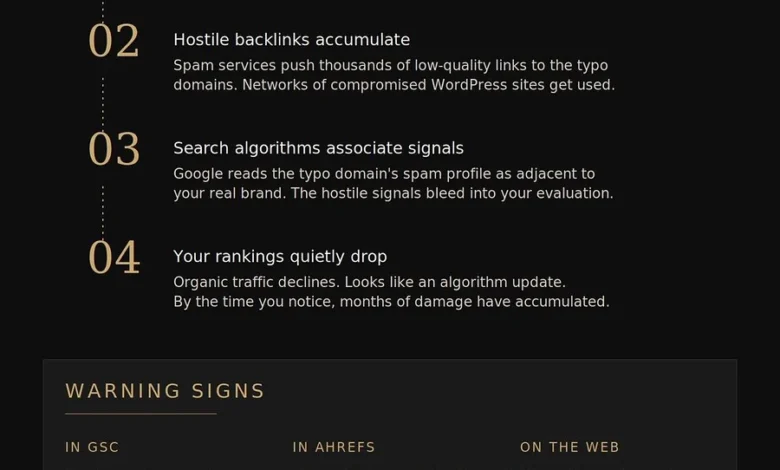
The malicious intent lies in the inbound link profile of these typosquat domains. Attackers use automated link-building services to point thousands of spam-flagged backlinks toward the misspelled domain. By doing so, they create a "hostile backlink profile" that search engine algorithms, such as Google’s, may inadvertently associate with the legitimate brand. Because modern search engines evaluate a brand’s identity based on a broad landscape of digital signals, the toxicity of a typosquatted domain can "bleed" into the evaluation of the actual brand, leading to a decline in organic search rankings.
As search engines attempt to determine the authority and trustworthiness of a website, they look for patterns. When a domain that is nearly identical to a reputable brand is suddenly surrounded by thousands of links from compromised WordPress sites, gambling portals, or low-quality directories, the algorithm may flag the entire brand cluster as suspicious. This results in a "negative SEO" effect where the legitimate site is penalized for the "neighborhood" in which its brand name is appearing.
Why the Luxury Jewelry Sector is a Prime Target
The targeting of the luxury jewelry industry is calculated and driven by the high economic stakes associated with high-end retail. Several factors make this sector particularly attractive to cyber-attackers:
- High Average Order Values (AOV): In the world of pre-owned luxury jewelry, individual transactions often range from $5,000 to over $50,000. A marginal drop in organic search traffic—even as small as 5%—can result in a significant loss of revenue. For a retailer specialized in authenticated Cartier or Van Cleef & Arpels pieces, losing the top spot on a search engine results page (SERP) can mean the loss of six-figure monthly sales.
- Competitive Keyword Landscape: The industry relies on specific, high-intent keywords such as "pre-owned Cartier Love bracelet" or "authenticated Van Cleef Alhambra." Because the inventory of authoritative retailers for these specific items is limited, pushing a competitor down just one or two positions allows other players (or the attacker’s own assets) to capture that high-value traffic.
- The Importance of Trust and Authentication: Luxury jewelers invest heavily in content that builds trust, including provenance documentation and authentication guides. This rich, high-quality content is what helps them rank well in search engines. Attackers seek to undermine this built-in authority by associating the brand with low-quality, automated spam networks.
Chronology of the 2024 Cyber Campaign
While typosquatting has existed for decades, the specific coordination with negative SEO against jewelers began to intensify in late 2024.
- Early 2024: Sporadic reports of "parked" typosquat domains began appearing in industry forums, though they were largely dismissed as traditional cybersquatting.
- Mid-2024: The volume of backlink injections increased. Monitoring tools began picking up networks of compromised WordPress sites injecting commercial anchor text related to luxury brands.
- Late 2024: The attack infrastructure became more visible. Analysts identified the use of aged-domain marketplaces where domains with pre-existing (and often toxic) backlink profiles were being repurposed to mimic luxury jewelry retailers.
- Present: The campaign has reached a level of automation where multiple variants of a single brand’s name are registered simultaneously, each accumulating thousands of spam links within a 14-day window.
The owner of Opulent Jewelers noted that the attacker’s infrastructure appears to include link-spam services that openly advertise their ability to manipulate search signals. This suggests that the attackers are not just hackers, but individuals with a deep understanding of SEO mechanics and search engine vulnerabilities.
Identifying the Indicators of Compromise
For jewelry retailers, early detection is critical to preventing long-term ranking damage. Security analysts recommend monitoring several key areas:
Google Search Console Monitoring
Retailers should watch for spikes in disavowed referring domains that do not align with any active marketing campaigns. Another warning sign is the appearance of new URLs in the "Links to your site" report from unknown domains using anchor text like "buy [brand]" or "discount [product]." Furthermore, a sudden surge in traffic or links from geographic regions where the retailer does not operate—such as specific Eastern European or Southeast Asian clusters—can indicate a coordinated bot-driven campaign.
Backlink Analysis Tools
Using tools like Ahrefs, Semrush, or Moz, jewelers can identify new referring domains classified as "spam" by automated detection. Hostile profiles often feature referring URL paths containing randomized hash strings or auto-generated patterns. A tell-tale sign of a compromised site linking to a typosquat is a domain with an unnaturally high outbound link count, often linking to hundreds of unrelated industries.
Typosquat Detection
Proactive monitoring involves searching for domains registered with single-letter variations of the brand name (e.g., adding an extra ‘s’, missing a vowel, or swapping adjacent letters). If these domains show rapid backlink growth despite having no content, it is a definitive signal of an impending negative SEO attack.
Defensive Strategies and Legal Recourse
The defense against these attacks is multi-layered, involving technical, administrative, and legal actions.
Technical Defense: The Disavow File
The primary technical defense is the maintenance of a Google Search Console disavow file. This tool allows webmasters to tell Google which inbound links should be ignored when evaluating the site’s ranking. For brands under active attack, this file must be updated weekly. While it does not remove the links from the internet, it effectively "insulates" the legitimate domain from the toxic signals of the typosquat domains.
Administrative Action: Spam Reporting
Submitting formal spam reports to search engines is a secondary but necessary step. Google’s spam reporting tools allow brands to flag "paid links" and "quality issues." While these reports rarely result in an immediate takedown, they contribute to the algorithm’s ability to recognize the attack pattern across the broader jewelry industry.
Legal Recourse: UDRP and ACPA
When the damage to a brand is substantial, legal action may be required. The Uniform Domain-Name Dispute-Resolution Policy (UDRP) is a process managed by the World Intellectual Property Organization (WIPO). It is designed to resolve cases of "bad faith" domain registration. A UDRP proceeding typically takes two to three months and costs approximately $1,500 in filing fees, plus legal fees. If successful, the typosquatted domain is transferred to the legitimate brand owner or cancelled.
In the United States, the Anticybersquatting Consumer Protection Act (ACPA) provides a more aggressive path. Under 15 U.S.C. § 1125(d), trademark owners can sue for statutory damages ranging from $1,000 to $100,000 per domain. While ACPA litigation is more expensive than UDRP, the potential for high damage awards serves as a significant deterrent against professional attackers. Both legal paths require the brand to have established trademark rights, underscoring the importance of federal trademark registration for even small e-commerce retailers.
Broader Industry Implications and Analysis
The rise of typosquatting paired with negative SEO represents a form of "asymmetric warfare" in the e-commerce space. The attacker requires relatively few resources—automated scripts and low-cost spam networks—while the defender must invest in expensive monitoring, legal counsel, and technical maintenance.
This trend highlights a potential flaw in how search engines process brand authority. As long as "brand signals" are used as a ranking factor, attackers will find ways to spoof or poison those signals. For the jewelry industry, which relies heavily on digital prestige and organic search visibility, this necessitates a shift in how business is conducted. Cybersecurity is no longer just about protecting credit card data; it is about protecting the digital "reputation" that search engines see.
Industry experts suggest that the most effective long-term protection is collective awareness. When jewelers share data regarding the attack patterns and the specific domains involved, it becomes easier for search engines to identify and neutralize the botnets responsible. For now, the burden remains on individual retailers to maintain a vigilant watch over their digital footprint. As one industry veteran noted, the defense is not necessarily complex, but it requires a level of technical oversight that many traditional jewelers are not yet accustomed to providing. In the high-stakes world of luxury e-commerce, the cost of "not noticing" has never been higher.