Baked by Melissa Expands Beyond Bakeries With National Target Launch of At-Home Baking Kits

For nearly two decades, Baked by Melissa has occupied a distinct niche in the American confectionery landscape, serving up more than 500 million bite-sized cupcakes to dessert enthusiasts. Founded on the premise that people want to enjoy a variety of treats without the guilt associated with oversized pastries, the brand built a fiercely loyal cult following. However, enjoying these diminutive delicacies historically required a trip to one of the company’s nine brick-and-mortar bakeries in the New York City metropolitan area or an online delivery order.
That geographic limitation officially ended on November 1, when Baked by Melissa made its long-awaited retail debut. In a strategic partnership with Target, the brand launched a new line of non-perishable at-home baking kits available nationwide in physical Target stores and on Target.com. This milestone represents a monumental operational shift for a company that has spent 18 years strictly managing its own vertically integrated perishable supply chain. By introducing shelf-stable products to big-box retail shelves, Baked by Melissa is positioning itself for a new era of national accessibility, brand scaling, and mainstream market penetration.
A Historic Evolution: From NYC Bakeries to National Retail
The journey to retail shelves has been a deliberate, meticulously paced process. Since its inception, Baked by Melissa maintained strict control over its product lifecycle, operating primarily as a localized direct-to-consumer and experiential brand. Co-founder and president Melissa Ben-Ishay has long acknowledged the internal debate surrounding retail expansion. For years, the executive team discussed scaling the brand into national mass-market channels, but the timing never felt right.
Ben-Ishay admits that her reluctance to rush the process sometimes made her unpopular among business partners eager for rapid growth. She maintained that she lacked the necessary conviction to expand the brand’s product lines into an entirely new category and distribution channel until all the foundational pieces were securely in place. Comparing the decision to the life-altering certainty of starting a family, Ben-Ishay noted that the readiness to make this leap had to be felt in every ounce of her bones.
That gut feeling was backed by rigorous corporate preparation. In March of this year, the company executed a strategic leadership transition, promoting chief financial officer Sanjay Khetan to the position of chief executive officer. According to corporate announcements, Khetan’s promotion followed a full year of intensive operational and financial groundwork specifically designed to ready the enterprise for its next major growth phase. With a strengthened executive structure and a reinforced financial foundation, the company finally greenlit its first non-perishable product line.
The Target Partnership: Products and Launch Strategy
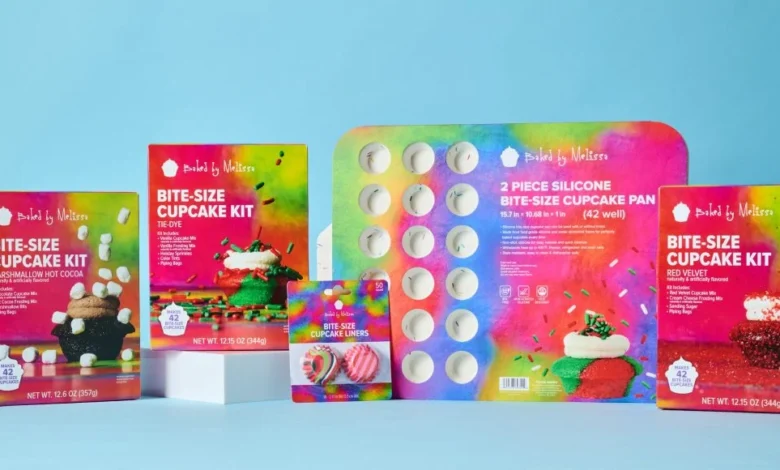
The initial retail rollout focuses on the core DNA of the Baked by Melissa brand: vibrant, bite-sized treats designed for sharing and enjoyment. Target is currently stocking at-home baking kits in three seasonal and signature flavors: Christmas Tie-Dye, Marshmallow Hot Cocoa, and Red Velvet.
In addition to the baking mixes, the Target collection features specialized culinary tools designed to replicate the brand’s signature aesthetic at home. Shoppers can purchase bite-sized cupcake liners alongside silicone bite-sized cupcake pans available in both one-piece and two-piece configurations. By offering the necessary hardware alongside the consumables, Baked by Melissa ensures that consumers have all the tools required to successfully recreate the bakery experience in their own kitchens.
To maximize awareness for the launch, the brand utilized a multi-channel promotional strategy. Ben-Ishay took directly to her robust social media platforms over the launch weekend, treating the rollout with the enthusiasm of someone who had waited nearly two decades to share a secret with the world. Alongside digital campaigns and targeted newsletter dispatches, the brand leaned heavily on its digital community to spread the word.
The Power of Digital Communities and Co-Branding
The ability to successfully launch a national retail line does not happen in a vacuum. Over the past six years, Baked by Melissa has enjoyed an exponential amplification of its brand awareness, largely driven by Ben-Ishay’s organic and engaging social media presence. During the COVID-19 pandemic, Ben-Ishay went viral on TikTok, captivating millions of viewers with videos detailing her everyday meals, salads, and culinary philosophy.
Today, that digital footprint has translated into massive consumer reach, boasting 2.8 million followers on TikTok and 1.9 million on Instagram. This digital equity provides the company with an enviable direct-to-consumer marketing engine capable of driving foot traffic to retail partners without relying solely on traditional advertising expenditure.
Beyond social media, Baked by Melissa has strategically leveraged business-to-business gifting and high-profile co-branded partnerships to expand its cultural footprint. Over the past year alone, the company has secured lucrative collaborations with major consumer packaged goods (CPG) giants such as Ferrero and Tabasco, as well as globally recognized entertainment franchises including "Paw Patrol" and "Emily in Paris." According to corporate statements, these collaborative ventures have meaningfully expanded the brand’s market reach, cultural relevance, and revenue streams, proving that the tiny cupcake company possesses mainstream crossover appeal.
Operational Adjustments and Mastering New Muscles
Transitioning from a localized, vertically integrated bakery model to a national retail supplier required the company to adapt to entirely new operational dynamics. Ben-Ishay highlighted that the most significant learning curve involved adjusting to the extended lead times necessitated by big-box retail distribution.
Because Baked by Melissa traditionally operated its own production and distribution ecosystem, the company prided itself on extreme agility. Ben-Ishay noted that the internal team was accustomed to turning a product around in as little as 24 hours if circumstances demanded it. Partnering with a retail giant like Target, however, requires long-range planning, months of forecasting, and strict adherence to rigid supply chain timelines.
Rather than viewing these structural differences as friction, leadership has embraced the challenges as vital learning experiences. Ben-Ishay expressed genuine excitement over the opportunity to acquire new business skills, noting that stretching the organization’s capabilities breathes fresh energy into the enterprise.
Broader Implications and Market Impact
The entry of Baked by Melissa into the mass-market retail space reflects a broader industry trend where digitally native food brands leverage their online communities to secure coveted shelf space in national brick-and-mortar chains. As consumer habits continue to evolve post-pandemic, shoppers increasingly seek moments of comfort, nostalgia, and interactive experiences in the home.
By introducing at-home baking kits, Baked by Melissa is tapping into the booming experiential food category, allowing consumers to participate directly in the creation of the product. This strategy not only broadens the brand’s demographic reach but also insulates the company against the geographic and economic limitations of maintaining purely perishable retail storefronts.
Furthermore, the timing of the Target launch aligns with the critical fourth-quarter holiday shopping season, positioning the colorful baking kits as ideal gifts, stocking stuffers, and family-oriented holiday activities. Flavors like Marshmallow Hot Cocoa and Christmas Tie-Dye are deliberately curated to capture seasonal consumer spending habits, maximizing the immediate financial and visibility impact of the retail debut.
Looking Ahead: Spreading Joy on a National Scale
As Baked by Melissa embarks on this new chapter under the leadership of CEO Sanjay Khetan and the continued creative direction of Melissa Ben-Ishay, the core mission of the brand remains remarkably grounded. While the business infrastructure has evolved to accommodate national distribution and complex retail partnerships, the ultimate objective is simple and human-centric.
Reflecting on the deeper purpose behind the new product category, Ben-Ishay emphasized the company’s enduring commitment to emotional connection. In a climate where consumers face constant daily stressors, the brand views its offerings as catalysts for positivity.
The goal, according to Ben-Ishay, is to get the product into the hands of as many people as possible, creating moments of joy, love, and human connection. With its products now lining Target aisles and sitting in virtual carts across the nation, Baked by Melissa is well-equipped to share those moments on a scale it has never before achieved.
Related posts: