The Invisible Threat to Luxury Jewelry E-commerce: How Typosquatting and Negative SEO are Reshaping Cyber Defense in 2025

The first indication of a sophisticated cyberattack against the luxury jewelry sector often does not arrive via a compromised server or a fraudulent transaction, but rather through a subtle anomaly in Google Search Console. For Opulent Jewelers, a prominent retailer in the luxury pre-owned market, the warning sign was a quiet entry in a disavow report indicating that referring domains had spiked by several hundred within a single week. These domains, which had no prior history with the brand and no relevance to the jewelry industry, were found to be part of a coordinated pattern targeting high-end retailers. This phenomenon represents a significant shift in the digital threat landscape, moving away from traditional phishing and toward a more patient, technical form of sabotage known as typosquatting paired with negative Search Engine Optimization (SEO).
The Mechanics of Signal Poisoning
Typosquatting has traditionally been understood as a form of "cybersquatting" where an actor registers a domain name that is a minor misspelling of a popular brand—such as "gogle.com" instead of "google.com." Historically, these sites were used for "brandjacking" to capture accidental traffic, or for phishing to steal credit card data and login credentials. However, the current wave of attacks targeting the jewelry industry employs a much more insidious strategy.
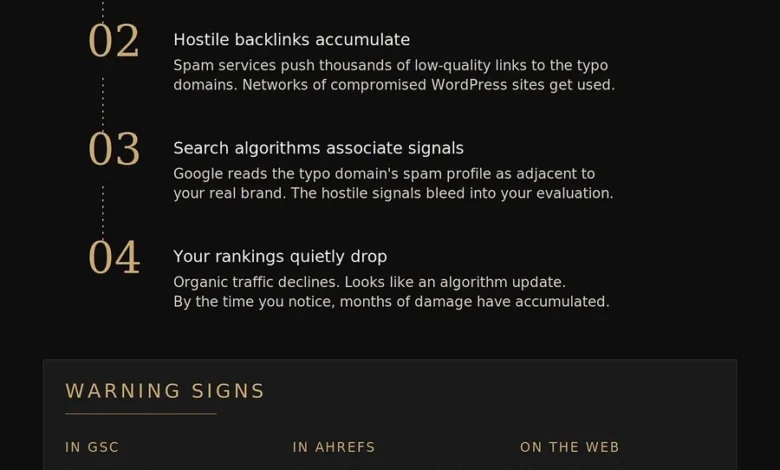
Instead of hosting a fake storefront to deceive consumers, these new typosquat domains often host no content at all. They sit as "parked" pages with zero outbound links. The malice lies in their inbound link profile. Attackers use automated infrastructure to point thousands of spam-flagged, low-quality links toward these misspelled domains. By doing so, they exploit the way modern search engines understand brand identity. Google’s algorithms do not merely evaluate a single domain; they assess the broader "signal landscape" surrounding a brand name. When a domain that is nearly identical to a legitimate brand becomes associated with a massive volume of "toxic" backlinks, that negative signal can bleed into the evaluation of the real brand, leading to a precipitous drop in search engine results page (SERP) rankings.
Chronology of the 2024-2025 Attack Wave
The intensification of these coordinated attacks began to surface in late 2024. While "black hat" SEO techniques have existed for decades, the specific combination of typosquatting and negative SEO targeting the luxury jewelry niche represents a specialized evolution.
- Phase I: Infrastructure Acquisition (Early 2024): Attackers began acquiring "aged domains"—existing domain names with established histories—and repurposed them to serve as the foundation for link-spam networks.
- Phase II: Trademark Mimicry (Mid-2024): A surge in registrations of minor misspellings of established luxury jewelry retailers was observed. These registrations were often distributed across various international registrars to complicate legal takedown efforts.
- Phase III: The Link-Spam Surge (Late 2024): Automated scripts began injecting links into compromised third-party websites, primarily those running outdated versions of WordPress. These links used "anchor text" that combined the target brand’s name with commercial keywords.
- Phase IV: Ranking Volatility (Early 2025): Legitimate jewelry retailers began reporting unexplained declines in organic traffic. What was initially dismissed as routine algorithm updates by Google was later identified as the result of "signal bleeding" from the typosquat networks.
Why the Luxury Jewelry Industry is the Primary Target
The selection of the luxury jewelry market is a calculated economic decision by attackers. The industry possesses several characteristics that make it uniquely vulnerable to SEO-based sabotage.
High Average Order Value (AOV)
In the world of pre-owned luxury jewelry, individual transactions frequently range from $5,000 to $50,000. Because the margins and price points are so high, even a minor fluctuation in search visibility can result in six-figure revenue losses. A 5% drop in organic traffic for a jeweler selling authenticated Van Cleef & Arpels or Cartier pieces is significantly more damaging than a similar drop for a high-volume, low-cost commodity retailer.
Competitive Keyword Specificity
The keyword landscape for luxury jewelry is highly specific and lucrative. Terms such as "pre-owned Cartier Love bracelet" or "authenticated Van Cleef Alhambra" carry immense commercial intent. There is a limited "inventory" of top-tier search positions for these queries. By pushing a legitimate competitor down just one or two spots on the SERP, an attacker can effectively redirect millions of dollars in potential annual search traffic to other players or simply cause systemic damage to a rival’s digital footprint.
The Trust and Authentication Paradox
Legitimate retailers invest heavily in content that builds trust, such as provenance documentation and authentication guides. This high-quality content is what allows them to rank well in the first place. Ironically, this wealth of "indexable" data provides the very hooks that attackers use to associate their spammy typosquat domains with the legitimate brand’s "entity" in the eyes of search algorithms.
Identifying the Signs of a Negative SEO Attack
For most jewelry e-commerce operators, the symptoms of an attack are often misdiagnosed as poor website performance or a change in consumer behavior. However, specific technical indicators can confirm the presence of a coordinated typosquatting campaign.
Google Search Console Anomalies
The most reliable data source is the "Links to your site" report within Google Search Console. Operators should look for sudden spikes in referring domains that have no logical connection to their marketing activities. A surge of links from foreign-language sites or regions where the jeweler does not operate is a primary red flag. Furthermore, if new URLs appear in the index that the jeweler did not create—often containing "brand + discount" or "brand + buy" anchor text—it suggests an external attempt to manipulate the brand’s search profile.
Backlink Monitoring Metrics
Using professional tools like Ahrefs or Semrush, jewelers can monitor their "Toxic Link" score. A sudden increase in links from domains with extremely high outbound link counts—a hallmark of compromised "link farms"—indicates an active campaign. Attackers often use randomized hash strings in the URL paths of these referring domains to bypass simple pattern-matching filters.
Typosquat Registration Clusters
The discovery of a single misspelled domain is concerning, but the discovery of a "cluster" of four or five variations (e.g., adding an extra ‘s’, swapping an ‘i’ for an ‘l’) suggests a sophisticated infrastructure. When these domains show rapid backlink growth despite having no content, it is a definitive sign of a negative SEO attack.
Strategic Defense and Remediation
Defending against this form of cyber-sabotage requires a multi-layered approach that combines technical SEO maintenance with traditional intellectual property (IP) law.
1. The Disavow Protocol
The primary technical defense is the maintenance of a Google Search Console disavow file. This tool allows a site owner to tell Google which inbound links should be ignored for ranking purposes. In an active attack scenario, this file must be treated as "living documentation," updated weekly or even daily as new spam domains are identified. While it does not remove the links from the web, it prevents them from poisoning the brand’s algorithmic reputation.
2. Legal Recourse: UDRP and ACPA
When the damage to a brand’s reputation and revenue becomes significant, legal action is often the only way to permanently remove the offending domains.
- Uniform Domain-Name Dispute-Resolution Policy (UDRP): This is an administrative process through the World Intellectual Property Organization (WIPO). It is designed to resolve cases of "bad faith" domain registration. It is relatively fast (60–75 days) and cost-effective, typically resulting in the transfer of the domain to the rightful trademark owner.
- Anticybersquatting Consumer Protection Act (ACPA): For brands with US-based operations and federal trademark registrations, the ACPA allows for litigation in federal court. Unlike UDRP, the ACPA provides for statutory damages ranging from $1,000 to $100,000 per domain, which can serve as a powerful deterrent against well-funded attackers.
3. Rigorous Documentation
The success of both SEO recovery and legal action depends on the quality of the evidence. Jewelers must maintain detailed records, including screenshots of WHOIS data, exports of backlink profiles, and a timeline of when each typosquat variant appeared. This documentation is essential if a retailer ever needs to file a manual reconsideration request with Google’s webspam team.
Common Pitfalls in Cyber Defense
In the face of an attack, many business owners react with instincts that can inadvertently worsen the situation. One common mistake is the "defensive purchase" of the typosquat domains. While it may seem logical to buy the misspelled domains to keep them out of the hands of attackers, buying a domain that has already been blasted with spam links means the jeweler is now the owner of a "poisoned asset." The toxic backlink profile remains attached to the domain even after the ownership transfer.
Another mistake is attempting to use phishing report forms (such as those provided by Cloudflare or Google Safe Browsing) for sites that do not host content. These services define phishing narrowly as "credential or data theft." Reporting a "parked" domain for phishing will often result in a rejected report, wasting valuable time and potentially flagging the reporter for "false reporting."
The Future of Search Integrity in Luxury Markets
As search engine algorithms become more reliant on "entity-based" associations—where Google tries to understand the relationship between brands, products, and reputations—the vulnerability to "signal poisoning" is likely to increase. For small and mid-sized jewelers, the resource asymmetry is the greatest challenge. An attacker can deploy automated scripts for a few hundred dollars, while a defender may need to spend thousands on SEO consultants and legal counsel.
The long-term solution lies in industry-wide awareness and the evolution of search engine detection. Until then, the burden of vigilance remains with the individual retailer. The ability to distinguish between a routine algorithm shift and a coordinated negative SEO attack is becoming a core competency for any luxury brand operating in the digital age. As the owner of Opulent Jewelers noted, the defense is straightforward once the pattern is recognized, but the true work lies in the constant, disciplined monitoring of the digital horizon. In 2025, protecting a jewelry brand requires more than just a secure safe and an alarm system; it requires a sophisticated understanding of the invisible links that define a brand’s reputation in the eyes of the world’s most powerful algorithms.