Photographer Nikhil Devasar Hoses Down His Cameras After Grueling Safari Shoots, Sparking Debate Among the Photography Community

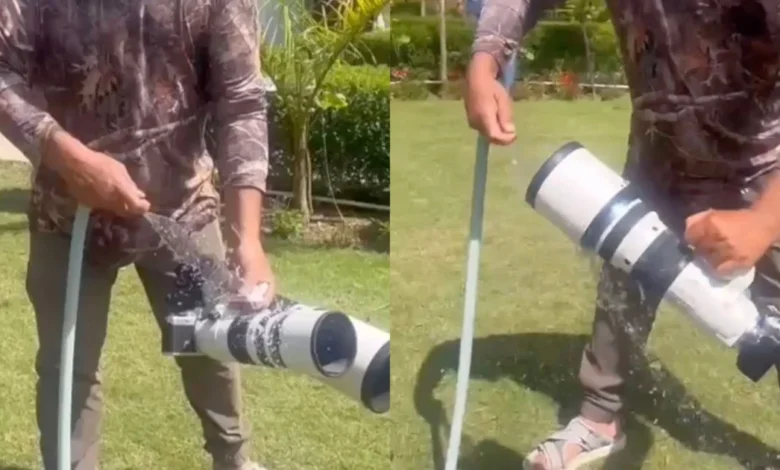
Indian wildlife photographer Nikhil Devasar has ignited a firestorm of discussion within the photography community after a video surfaced showcasing his unconventional yet effective method of cleaning his high-end camera equipment: a powerful garden hose. While most photographers treat their gear with extreme caution, Devasar’s direct approach involves rinsing his OM System cameras and lenses with water, a practice that has drawn both admiration for its audacity and apprehension from those accustomed to more delicate cleaning protocols.
The striking imagery, captured during Devasar’s safari expeditions in India, depicts him systematically dousing his professional camera bodies and lenses with a stream of water, washing away the relentless dust, grit, and sand that plague outdoor photography. This unorthodox ritual, shared on social media, quickly went viral, prompting a flurry of reactions ranging from shock and disbelief to wry amusement and outright horror.
The Relentless Onslaught of the Indian Scrub
Devasar, whose work focuses on capturing the elusive wildlife of India, including the majestic tiger, detailed the extreme conditions that necessitate his unique cleaning regimen. "The dust of the Indian scrub is relentless," he explained in a social media post accompanying the viral video. "After a day on the tracks trailing a tiger, every crevice of the gear – from the tactile dials to the lens barrel – is coated in a fine layer of grit."
The pervasive dust and fine particulate matter encountered in environments like the Indian scrublands pose a significant challenge for camera equipment. This abrasive material can infiltrate seals, scratch lens elements, clog internal mechanisms, and degrade the overall performance and longevity of sophisticated imaging devices. Traditional methods for dealing with such contamination typically involve a combination of air blowers, specialized brushes, and microfiber cloths.
A Departure from Conventional Wisdom
While his peers often opt for meticulous, albeit time-consuming, manual cleaning, Devasar confessed to preferring a more decisive and thorough approach. "While other photographers will grab a gentle brush and an air blower, I prefer a more direct approach," he stated. "The ritual of washing away the day’s grime under a running pipe is the only way to truly get it clean." This statement underscores a fundamental difference in philosophy regarding gear maintenance, prioritizing a deep clean over the perceived risks associated with water exposure.
The visual of a photographer intentionally submerging, or at least extensively spraying, expensive camera equipment with water is understandably jarring for many. Photography, by its nature, often involves operating in challenging environments, but the common understanding is that cameras, especially professional-grade ones, require careful protection from the elements, particularly moisture.
Reactions from the Photography World: A Mix of Horror and Humor
The immediate aftermath of the video’s dissemination saw a torrent of comments from fellow photographers, many of whom expressed their astonishment and concern. The prevailing sentiment was one of disbelief, with many questioning the sanity of such an act.
"Don’t forget the sensors," quipped photographer Michael Hickey in a comment that captured the collective anxiety. "You may have to use soap and a stiff brush." This sarcastic suggestion highlights the extreme measures some might imagine are required for such a "deep clean," while simultaneously pointing out the highly sensitive nature of camera sensors, which are notoriously delicate and require specialized cleaning.
Another photographer, Zach Tarrant, offered a humorous, albeit equally alarming, suggestion: "Don’t forget to put everything in the microwave to dry it all off. You don’t want any water spots!" This response, while clearly a joke, underscores the perceived danger of water remaining on or within the camera body and the potential for damage. The underlying concern in these humorous jabs is the very real threat of short circuits, corrosion, and permanent damage that water can inflict on electronic devices.
The Secret Weapon: OM System’s Robust Weather Sealing
The key to understanding Devasar’s seemingly reckless behavior lies in the specific equipment he employs: OM System OM-1 Mark II cameras and M.Zuiko Pro lenses. These professional-grade tools are engineered with an exceptional level of weather sealing, boasting an IP53 rating.
The International Protection (IP) rating system is a global standard that classifies the degree of protection provided by enclosures against intrusion from solid objects (like dust) and liquids (like water). An IP53 rating signifies that the equipment offers:
- Protection from limited dust ingress (5): While not entirely dust-proof, the enclosure prevents a harmful amount of dust from entering. This is crucial for photographers working in dusty or sandy environments.
- Protection from water spray less than 60 degrees from vertical (3): This means the device can withstand water sprayed at an angle of up to 60 degrees from the vertical at a specified rate. This offers significant protection against rain, light splashes, and, as Devasar demonstrates, a controlled stream from a hose at a moderate angle.
Devasar’s M.Zuiko Pro lenses also carry the same IP53 rating, ensuring that the entire imaging system is built to withstand challenging environmental conditions. This robust construction is not merely a marketing claim; OM Digital Solutions, the company behind OM System, is renowned for its rigorous testing procedures.
A History of Extreme Durability Testing
PetaPixel has previously reported on the intense torture tests that OM Digital Solutions subjects its cameras to, demonstrating the company’s commitment to building durable and reliable equipment. These tests have included everything from submersion in mud and sand to exposure to extreme temperatures and impact resistance. The OM-1 Mark II, in particular, has been lauded for its ruggedness and its ability to perform under duress.
Devasar himself likens his treatment of the OM-1 Mark II to that of a pair of field boots, emphasizing that he trusts his tools implicitly. "When you trust your tools," he asserts, "the focus remains where it should be: on the stripes in the tall grass, not on the dust on the camera gear." This perspective highlights the importance of reliable equipment in allowing photographers to concentrate on their craft rather than worrying about the integrity of their gear.
It is crucial to note, however, that even with an IP53 rating, these cameras are not designed for underwater photography. The rating specifically addresses protection against dust and water spray, not immersion. Devasar’s method, while bold, is clearly within the operational parameters for which these cameras are designed.
The Broader Implications: Trust in Technology and the Photographer’s Mindset
Nikhil Devasar’s controversial cleaning technique raises several interesting points about the evolution of camera technology and the mindset of modern photographers.
Firstly, it underscores the significant advancements made in weather sealing and ruggedization of professional camera equipment. Brands like OM System are pushing the boundaries of what was once considered acceptable exposure for sensitive electronics, enabling photographers to pursue their passion in environments previously deemed too hostile.
Secondly, it highlights the critical importance of understanding one’s equipment. Devasar’s confidence stems from a deep knowledge of his OM System gear’s capabilities and limitations. This is a crucial lesson for all photographers: invest in tools that meet your needs and learn to use them to their full potential, even if it means challenging conventional wisdom.
The debate sparked by Devasar’s video also serves as a valuable reminder of the inherent risks involved in outdoor photography. While technology has advanced, photographers must still exercise judgment and care. The line between robust and indestructible is fine, and a misplaced hose or an unexpected downpour could still spell disaster for even the most weather-sealed equipment.
Ultimately, Devasar’s method, while shocking to some, is a testament to the resilience of modern camera technology and the photographer’s willingness to adapt and innovate to overcome environmental challenges. It’s a bold statement about trusting one’s tools and prioritizing the capture of the shot over the pristine condition of the gear, at least until the day’s work is done. The viral nature of the video suggests that while many might not adopt his exact technique, it has certainly opened a dialogue about what is possible and what it truly means to be prepared for the wild.