DSM Kei Ninomiya Redefines Punk as an Attitude of Creation in Thrilling Florence Show

Florence, Italy – In a bold reinterpretation of its founding ethos, the DSM Kei Ninomiya brand, a distinctive house label from the avant-garde retail powerhouse Dover Street Market, unveiled its third collection in Florence, Italy, serving a visceral explanation of its initial tagline: "Untitled, Untethered, Undefined." The presentation, held on Wednesday night, unequivocally declared that at its core, DSM Kei Ninomiya is also punk, not merely as an aesthetic, but as a profound attitude toward creation and community. This latest offering marks a pivotal moment for the brand, which first launched in 2025, solidifying its identity beyond initial perceptions and aligning it firmly with the disruptive spirit championed by its parent entity.
The Genesis of a Maverick Brand: DSM Kei Ninomiya’s Inception
The launch of DSM Kei Ninomiya in 2025 was met with considerable anticipation within the fashion industry. As an in-house brand for Dover Street Market, a global retail concept founded by Rei Kawakubo of Comme des Garçons and her husband Adrian Joffe, its very existence signaled a strategic expansion for the influential retailer. Dover Street Market (DSM) has long been celebrated for its radical approach to retail, curating an eclectic mix of established luxury houses, emerging designers, and avant-garde labels within architecturally distinct spaces that are as much art installations as they are stores. The introduction of its own private label, under the creative direction of Comme des Garçons protégé Kei Ninomiya, therefore, was a significant development, allowing DSM to further embed its unique philosophy directly into product.
Kei Ninomiya himself is a designer of considerable repute. Known for his eponymous label, Noir Kei Ninomiya, he is celebrated for his intricate, often monochromatic, and structurally complex designs that eschew traditional sewing in favor of innovative construction techniques like linking, weaving, and riveting. His work for Noir is characterized by a meticulous, almost scientific approach to garment making, resulting in sculptural pieces that challenge conventional notions of form and silhouette. The appointment of Ninomiya to lead DSM’s house brand suggested a different trajectory, one that would marry his precise design sensibility with Dover Street Market’s inherent rebellious spirit. The initial tagline – "Untitled, Untethered, Undefined" – hinted at a brand free from rigid categorization, capable of evolving and embracing diverse influences, a promise that this third collection emphatically delivered upon.
Florence as the Stage: A Sanctuary Transformed
The choice of Florence, a city synonymous with classical art and Renaissance beauty, for a punk-inspired collection was in itself a provocative statement. The presentation unfolded within the historic Sant’Orsola convent-turned-museum, a venue that provided a striking juxtaposition to the raw energy of the collection. The ancient stone walls and scaffolded courtyard of the former convent, with its layers of history and quiet reverence, became an unlikely yet potent backdrop for a fashion show designed to channel rebellion and self-expression. This deliberate contrast amplified the collection’s message, suggesting that punk’s spirit can thrive even amidst traditional beauty, challenging established norms and aesthetics.
The show was conceived not merely as a runway presentation but as an immersive performance. Models, described as "young and younger types," wandered disarranged throughout the scaffolded courtyard, bumping into each other, sitting among audience members, and climbing bleachers. Their movements were designed to appear "unhinged," embodying a sense of spontaneous rebellion, angst, and unfettered self-expression. While some observers noted that the choreographed nature of these interactions occasionally felt too staged to be entirely authentic, the designer, Kei Ninomiya, clarified its intent during a preview with WWD: the performance was meant to represent punk as "an attitude to creation," rather than a literal reenactment of a subculture. This distinction is crucial to understanding the brand’s approach – it is less about replicating an era and more about channeling its underlying ethos of defiance and individualism into contemporary design.
The Punk Lexicon Reimagined: Collection Details
The collection itself was a comprehensive and thoughtful celebration of punk’s visual insignias, meticulously translated through Ninomiya’s distinctive lens. Each garment spoke to the subculture’s rebellious spirit while maintaining a sophisticated, almost couture-like attention to detail that elevates it beyond mere replication.
- Tartan Kilts: A hallmark of punk fashion, tartan kilts were reimagined and shortened to mid-thigh, expertly balancing overt rebellion with a subtle sensuality. The choice of tartan, historically linked to Scottish clans and later appropriated by punk as a symbol of anti-establishment sentiment, was given a contemporary edge through its cut and styling.
- Parachute Pants and Shorts: These utilitarian garments were infused with punk’s bondage aesthetic through strategically placed fasteners that bounded both legs, creating a sense of restriction and liberation simultaneously. The functional origins of parachute fabric met the provocative elements of punk.
- Safety Pins: Elevating a ubiquitous punk accessory, safety pins were employed galore, often tone-on-tone, arrayed in neat rows on bomber jackets and shirts. This meticulous arrangement transformed a raw, DIY element into a refined, almost couture-like embellishment, showcasing Ninomiya’s ability to blend high craft with street aesthetics.
- Leather Jackets: A cornerstone of punk attire, leather jackets were presented in a collaboration with Schott N.Y.C., a brand with a storied history dating back to 1913, renowned for manufacturing the first motorcycle jacket. These jackets were expertly tooled and sprayed with defiant words like "chaos," further cementing the collection’s authentic connection to punk heritage. Schott’s iconic Perfecto jacket, in particular, has been a symbol of rebellion for generations, from Marlon Brando to The Ramones.
- Open Weave Knits: These pieces were bedecked with an array of punk pins and badges, reminiscent of personalized band jackets and DIY adornments. The open weave offered a textural contrast, adding depth to the punk narrative.
- Trousers: Blurring the lines between tailored sophistication and utilitarian functionality, trousers featured zips running throughout, allowing for versatile styling and an adjustable silhouette. This detail spoke to the deconstructionist aspect of punk, where garments could be altered and personalized.
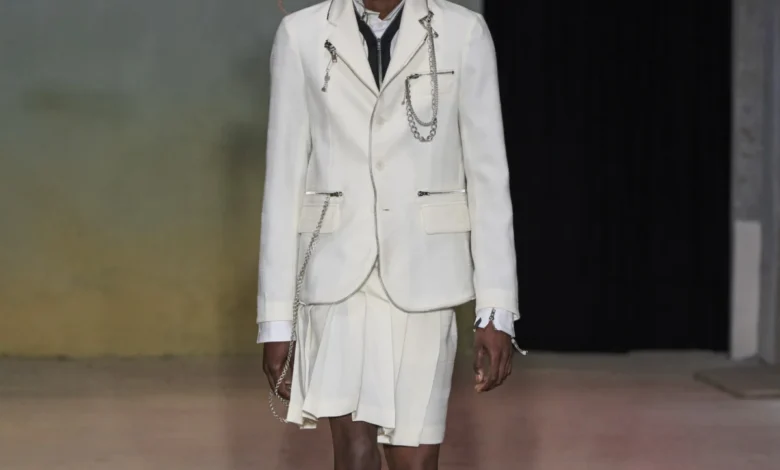
- Edgy Black Tailoring: Ninomiya’s signature black tailoring was present, but imbued with a punk edge, featuring dangling chains that added a kinetic, almost menacing element, echoing the hardware often seen in punk accessories.
Footwear and Artistic Collaborations: Deepening the Narrative
The footwear choices further cemented the collection’s authentic punk credentials. Black leather slip-ons, a collaboration with Vans, brought in the skate and street culture elements that often intersect with punk. Vans, founded in 1966, has been synonymous with counter-culture movements for decades. Complementing these were creepers developed with George Cox, the original punk footwear supplier. George Cox, a British shoemaker established in 1908, became iconic in the 1950s with its ‘Dandy’ and ‘Pop Boy’ styles, later becoming the definitive footwear for the Teddy Boys, Rockers, Punks, and Goths. This collaboration underscored a commitment to historical accuracy and genuine subculture references.
Perhaps the most significant collaboration, however, was with the estate of Jamie Reid. Reid, a legendary British visual artist, is best known for his iconic artworks for the Sex Pistols, most notably the ransom-note aesthetic for their 1977 single "God Save the Queen." Incorporating Reid’s anarchic and instantly recognizable imagery into the collection’s narrative lent an unparalleled layer of legitimacy and historical depth. Reid’s work is a direct visual representation of punk’s anti-establishment, confrontational spirit, and its inclusion served as a powerful declaration of intent, affirming that DSM Kei Ninomiya was tapping into the very heart of punk’s artistic and political rebellion.
Addressing the "Merch" Perception: A Strategic Defense
The brand’s status as a house label for a major retailer had, until this point, led some observers to categorize it primarily as "merch." This perception often carries connotations of commerciality over genuine creative endeavor. However, Adrian Joffe, president of Comme des Garçons International and chief executive officer of Dover Street Market, offered a direct and unapologetic counterpoint. "I don’t think merch is a dirty word. I think it’s cool," Joffe stated.
This declaration is highly significant within the context of Dover Street Market’s broader philosophy. DSM has consistently championed a democratic approach to fashion, blending high fashion with accessible pieces, and fostering a sense of community around creativity rather than exclusivity. Joffe’s statement reclaims the term "merch," stripping it of its pejorative undertones and aligning it with DSM’s ethos of making creative output accessible and desirable. It suggests that even items that might be considered "merchandise" can carry artistic weight and contribute to a broader cultural conversation, especially when imbued with the thoughtful design and narrative presented by Kei Ninomiya. For a brand rooted in the anti-establishment sentiment of punk, dismissing the idea of "merch" as inherently uncool would itself be counter-intuitive; punk often blurred the lines between high art and everyday objects, subverting expectations.
The Art of Styling: Hair as a Statement
Beyond the garments, the styling of the show played a crucial role in conveying the collection’s message. Kudos were particularly extended to hairstylist Pablo Kümin for his transformative work. Kümin crafted striking mohawks and intricately embellished Afro hair, adorned with unexpected elements like summer blooms and flowers. This unique fusion of aggressive punk hairstyles with delicate, natural embellishments was "showstopping," risking, at times, to upstage the collection itself.
The hair styling served as a powerful visual metaphor for the brand’s approach to punk: it was not a rigid, monochromatic rehash of the past, but a nuanced interpretation that allowed for beauty, fragility, and unexpected juxtapositions. The flowers, typically symbols of softness and life, interwoven with the defiant mohawks and Afro styles, suggested a punk spirit that is both tough and tender, rebellious and beautiful, inclusive and diverse. This detail underscored the "undefined" aspect of the brand’s initial tagline, demonstrating its willingness to explore contradictions and embrace complexity.
Community at the Core: Ninomiya’s Inclusive Vision of Punk
At the heart of this collection, and indeed the DSM Kei Ninomiya brand, lies a profound emphasis on community, as articulated by the designer himself. Kei Ninomiya, who continues to lead his Noir brand, explained that DSM Kei Ninomiya is not confined to "only one style." Instead, it operates "based on [Dover Street Market’s] philosophy or aesthetic, but we focus on a different community for each collection." For this third collection, punk was chosen because it "has many meanings."
Ninomiya’s interpretation of punk extends far beyond its stylistic trappings. He emphasized its inherent care "about minorities, about people, it’s not only about money… It’s really more open to the people. I really like [that]." This statement positions the brand within a contemporary discourse of inclusivity and social consciousness. It reframes punk not just as youthful rebellion, but as a movement deeply concerned with social justice, solidarity with marginalized groups, and a rejection of pure commercialism. By aligning DSM Kei Ninomiya with these values, the brand asserts a moral and ethical dimension that resonates with modern consumers who increasingly seek authenticity and purpose from the brands they engage with. This commitment to community aligns perfectly with Dover Street Market’s long-standing tradition of fostering creative talent and building a global network of designers, artists, and consumers who share a common appreciation for the unconventional.
Broader Impact and Future Implications
The DSM Kei Ninomiya brand’s definitive embrace of punk as an "attitude to creation" has several significant implications. For Dover Street Market, it further cements its reputation as a vanguard in retail, not just by curating cutting-edge fashion but by actively shaping it through its own creative ventures. The brand serves as a powerful testament to DSM’s ability to identify and nurture exceptional talent, offering Kei Ninomiya a platform to explore a different facet of his design philosophy beyond the highly conceptual work of Noir.
This collection also contributes to the ongoing evolution of punk within fashion. While punk’s aesthetic elements have been widely appropriated and commercialized since its eruption in the 1970s, Ninomiya’s approach attempts to reclaim its deeper philosophical underpinnings. By emphasizing punk as an attitude, a community, and a force for inclusivity, the brand offers a fresh perspective that transcends mere nostalgia. It suggests that the spirit of punk remains relevant, capable of inspiring new forms of rebellion and self-expression in a contemporary context, particularly within discussions of social justice and identity.
Looking forward, the success of this collection is likely to reinforce DSM Kei Ninomiya’s trajectory as a significant player within the designer landscape. It challenges the notion that private labels are inherently less creative or authentic, proving that with the right vision and talent, they can push boundaries and make profound statements. The brand’s commitment to exploring diverse communities for future collections, as hinted by Ninomiya, promises a dynamic and ever-evolving narrative, keeping it "Untitled, Untethered, Undefined" in the most compelling way possible. The Florence show was not just a presentation of clothes; it was a powerful declaration of identity, purpose, and a vibrant, inclusive vision for the future of fashion.