The Ultimate Guide to Streamlining Your Wedding Finances and Planning Process Through Digital Templates

Planning a modern wedding has increasingly evolved from a romantic exercise into a complex logistical and financial project. As couples navigate the economic realities of organizing large-scale events in 2024, 2025, and beyond, the administrative burden often overshadows the celebratory nature of the milestone. Financial transparency and meticulous organization have become paramount for engaged couples seeking to avoid spiraling debt and vendor miscommunication. Addressing this growing demand for structured guidance, digital wedding planning resources have emerged as essential instruments, offering dual solutions ranging from straightforward budget trackers to comprehensive, multi-faceted planning suites compatible with industry-standard spreadsheet software.

The evolution of wedding administration reflects broader consumer trends favoring DIY digital organization over traditional, costly consultancy services. Historically, couples relied heavily on physical planners, scattered notebooks, or generic software that failed to account for the nuanced expenses associated with modern nuptials. Today, digital templates designed for platforms such as Google Sheets and Microsoft Excel bridge the gap between professional event management and accessibility. Industry experts note that early financial tracking significantly reduces stress, mitigates interpersonal conflict between families, and ensures that resources are allocated efficiently across high-priority categories such as venues, catering, and entertainment.

To accommodate varying degrees of planning complexity, digital resource developers have structured their offerings into tiered options. The foundation of these tools is typically a dedicated budget spreadsheet. Conceptualized from firsthand experience by industry founders Elizabeth and Zee, a standard free wedding budget spreadsheet provides a centralized hub for cost estimation, actual expense monitoring, and payment tracking. This tool accompanies couples from the initial brainstorming phase through to final vendor settlements and payment reminders. By incorporating dedicated sections for confirmed vendor records alongside line-item cost projections, these complimentary templates eliminate much of the heavy lifting associated with financial oversight, allowing participants to input custom figures directly into a pre-formatted framework available for both Google Sheets and Excel.

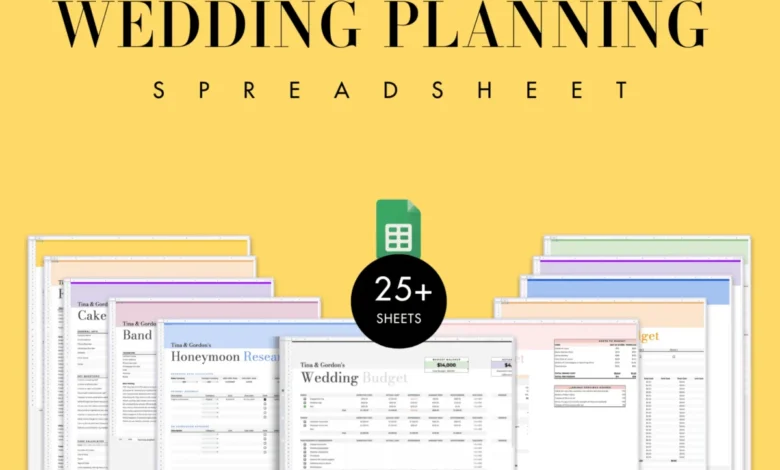
For couples requiring a more robust infrastructural approach, premium all-in-one wedding planning suites offer an expanded ecosystem of over 25 custom-designed sheets. Developed in collaboration with specialized platforms like The Creations, these comprehensive packages address every conceivable logistical requirement of event coordination. Priced at a discounted rate of $69—reduced from its standard $105 threshold—the premium suite targets the intricacies of large-scale event production. The architecture of the comprehensive planner extends far beyond basic financial balancing, incorporating specialized calculators for niche expenditures such as alcohol consumption and custom cake production, alongside exhaustive research frameworks for high-ticket vendor categories including florists, caterers, and premier venues.

A detailed examination of the premium planning suite reveals a modular design tailored to distinct phases of the engagement lifecycle. Planning-related sheets include comprehensive guest list managers, sophisticated seating plan architects, and chronological wedding planning checklists that establish a step-by-step roadmap for the months leading up to the ceremony. These modules are complemented by wedding-day-specific sheets, which feature meticulous timelines and emergency kit inventories designed to preemptively address unforeseen logistical hurdles on the wedding day itself. By mapping out the sequence of events down to the minute, couples can coordinate seamlessly with photographers, videographers, and venue coordinators.

Vendor management represents another critical pillar integrated into advanced digital planners. Given that venue acquisition, catering, and entertainment typically consume the vast majority of a wedding budget, specialized research and budget spreadsheets for photographers, videographers, wedding bands, and florists provide structured frameworks for comparative analysis. Couples can systematically evaluate multiple vendor proposals, tracking package inclusions, payment schedules, and contractual obligations side-by-side. This rigorous comparative approach empowers consumers to negotiate effectively and select service providers that align with both their aesthetic vision and financial constraints.

Beyond the immediate ceremony, modern wedding logistics increasingly encompass auxiliary events and extended travel planning. The comprehensive digital suites integrate dedicated gift and registry tracking sheets to monitor incoming presents and facilitate timely acknowledgment correspondence. Furthermore, travel-related modules address the complexities of honeymoon budgeting, destination research, and specialized packing lists tailored separately for brides and grooms, encompassing both wedding weekend essentials and extended vacation requirements. This holistic inclusion of pre- and post-wedding logistics underscores a shift toward end-to-end event lifecycle management.

The introduction of tiered digital planning tools arrives at a critical juncture for the wedding industry. Economic analysts observe that couples are facing persistent inflationary pressures affecting the hospitality, floral, and catering sectors. Consequently, precision budgeting is no longer merely a matter of preference but a financial necessity. Tools that offer real-time expenditure updates and variance analysis between estimated and actual costs provide an analytical safeguard against budget overruns. By democratizing access to professional-grade organizational frameworks, digital spreadsheets enable couples to exercise greater financial autonomy over their celebrations.

Industry feedback regarding comprehensive spreadsheet templates highlights their adaptability as a primary advantage. Unlike static mobile applications or rigid proprietary software, Google Sheets and Excel allow for infinite customization, enabling users to adapt formulas, currency formats, and categories to suit regional economic variations and personal preferences. The promotional pricing strategy employed for premium suites through the end of September further incentivizes early adoption, capturing the vital autumn and winter engagement planning window. As digital literacy continues to intersect with traditional milestone events, the reliance on sophisticated, transparent, and user-friendly planning architecture is expected to remain a cornerstone of successful modern event execution.