Bvlgari Brings Monumental Serpenti Public Art Installation to New York City High Line

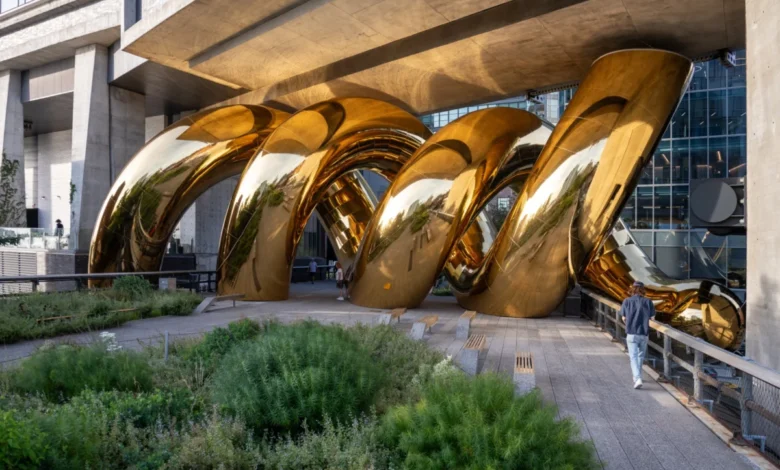
For decades, Bvlgari’s iconic serpent motif has draped itself across the wrists, fingers, and necks of global connoisseurs of high jewelry, serving as a symbol of rebirth, wisdom, and transformation. This September, the Italian luxury house has translated that intimate, wearable iconography into a monumental architectural scale, winding its way through the urban landscape of New York City. Opening on September 10, auruBOROS – Urban Memory and Collective Dream marks Bvlgari’s inaugural public art installation in the United States. Commissioned as part of the brand’s ongoing Serpenti Infinito project, the temporary exhibition brings avant-garde European design into dialogue with Manhattan’s industrial infrastructure, transforming a familiar public walkway into a surreal, reflective dreamscape.
Conceived and executed by Berlin-based artists Marco Canevacci and Yena Young of the interdisciplinary studio Plastique Fantastique, the installation reimagines the classic ouroboros symbol—an ancient motif depicting a serpent eating its own tail. Rather than preserving the creature in a closed, self-contained loop, the artists have broken the circle, allowing the symbolic beast to slither freely through the city’s concrete canyons. The result is a striking juxtaposition of high-end conceptual art, pneumatic engineering, and urban architecture, capturing the attention of commuters, tourists, and design enthusiasts alike during its brief eleven-day run on the High Line.
The Architectural Mechanics of Pneumatic Sculpture
Plastique Fantastique is globally recognized for its mastery of pneumatic installations, utilizing air as a primary structural medium to generate immersive, ephemeral additions to existing architectural environments. For auruBOROS, this technique manifested as a series of enormous, golden coils. The installation appears to emerge organically from beneath The Standard hotel before undulating its way into the elevated green space of the High Line near Little West 12th Street.
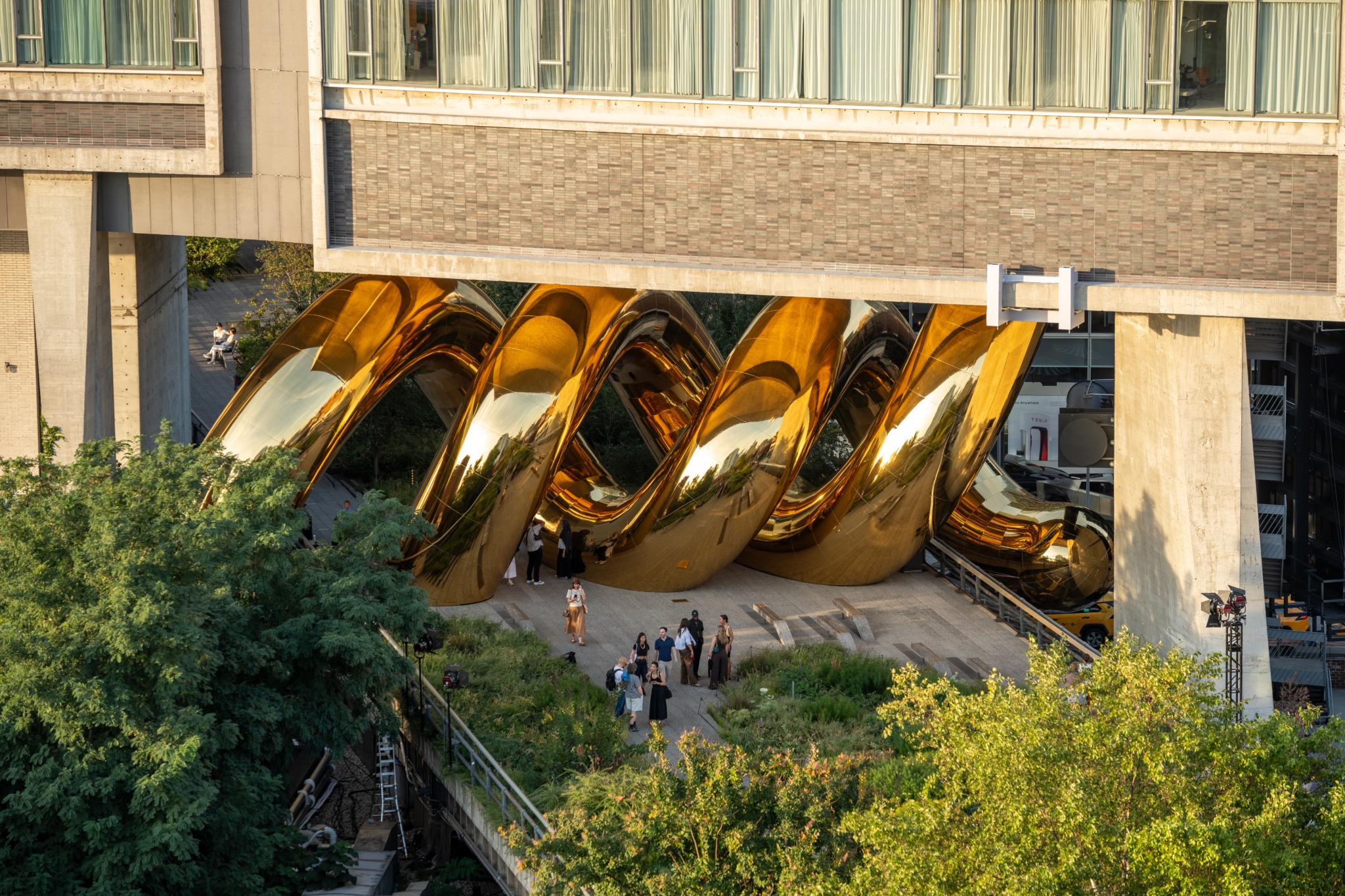
The engineering behind auruBOROS relies on lightweight, flexible membranes that are inflated to create massive, rigid-looking forms without the heavy steel or concrete typically required for monumental public sculptures. This clever use of materials creates an intentional contradiction that defines the core of the artwork. Despite appearing solid, heavy, and precious—resembling molten gold winding through the city—the entire structure is fundamentally hollow, lightweight, and temporary.
“Although it appears monumental, the entire structure exists through air and is temporary,” Canevacci and Young explained regarding the conceptual framework of their design. “We were interested in that contradiction: something that looks precious and permanent but is actually light, fragile, and transient.”
This ephemeral nature heightens the public engagement with the piece. Visitors walking beneath or alongside the golden coils are forced to confront the duality of urban permanence versus artistic transience. The installation acts as a foreign yet harmonious object injected into the daily rhythm of Manhattan, challenging pedestrians to view their routine pathways through a defamiliarized, artistic lens.
A Mirror to the Metropolis: Materiality and Environment
One of the most compelling features of auruBOROS is its hyper-reflective golden skin. Rather than imposing a static color or texture onto the High Line, the sculpture’s surface acts as a dynamic mirror, continuously absorbing and distorting its surroundings.

As daylight shifts from the morning glow to the harsh afternoon sun and eventually into the amber tones of dusk, the appearance of the serpent shifts synchronously. The golden body reflects the surrounding historic and modern architecture, the dense urban vegetation of the elevated park, the unpredictable New York weather, and the endless stream of passing pedestrians.
“auruBOROS began with the ancient image of the ouroboros, but instead of keeping the serpent as a closed circle, we opened it and allowed it to enter the city,” Canevacci and Young noted. “Its gold, reflective body moves through the High Line, absorbing buildings, vegetation, people, weather, light, and sky into its surface.”
This symbiotic relationship between the sculpture and its environment ensures that no two visitors experience the artwork in the exact same way. The installation essentially captures a living portrait of New York City, blending the human element with the natural flora of the High Line and the rigid geometry of the surrounding cityscape into a single, cohesive visual tapestry.
Chronology and the Serpenti Infinito Project
The launch of auruBOROS on September 10 represents a major milestone in Bvlgari’s broader cultural strategy, specifically falling under the umbrella of the Serpenti Infinito initiative. This global cultural project has seen the luxury house collaborate with various contemporary artists, architects, and designers to reinterpret its most famous signature motif across different mediums and geographies.

The timeline of the New York installation is strictly time-bound, remaining open to the public from September 10 through September 20. By limiting the exhibition to just eleven days, Bvlgari and Plastique Fantastique lean further into the conceptual theme of transience. The fleeting nature of the installation mirrors the ephemeral qualities of modern urban life, where massive infrastructural shifts and temporary cultural interventions continuously reshape the identity of the metropolis.
In conjunction with the public art installation, Bvlgari has synchronized its commercial and artistic messaging by debuting a series of complementary high-jewelry pieces and accessories. Alongside the physical exhibition on the High Line, the house is launching three new Serpenti Tubogas high-jewelry creations, as well as an exclusive minaudière directly inspired by New York City’s rich artistic and architectural history. These limited-release items are made available at select Bvlgari boutiques throughout the month of September, bridging the gap between museum-scale public art and the tangible, wearable heritage of the brand.
Broader Impact and Implications for Luxury Brand Urbanism
The debut of auruBOROS on the High Line highlights a growing trend within the luxury sector: the convergence of high fashion, fine jewelry, and large-scale public art. Rather than relying solely on traditional retail environments, luxury houses are increasingly investing in experiential, site-specific cultural activations that engage local communities and international travelers alike in open, democratic spaces.
By selecting the High Line—one of New York City’s most celebrated examples of adaptive reuse architecture—Bvlgari positions its brand values alongside contemporary conversations regarding urban renewal, public space accessibility, and sustainable design. The High Line, which transformed an abandoned elevated railway freight line into a public park, shares a conceptual philosophy with the Serpenti motif: taking historical structures or symbols and breathing new life into them for contemporary society.

Furthermore, the collaboration with Plastique Fantastique underscores a shift toward material innovation in temporary architecture. As cities become increasingly saturated with commercial advertising, brands are finding that subtle, highly conceptual, and interactive art installations yield deeper emotional connections with consumers. By offering a moment of wonder, reflection, and surrealism in the middle of a bustling workday, auruBOROS transcends traditional marketing to become a legitimate contribution to New York’s vibrant public art landscape.
As the installation concludes its eleven-day run on September 20, the golden serpent will vanish from the High Line just as quickly and mysteriously as it arrived, leaving behind only the collective memories of the thousands of visitors who walked beneath its shimmering coils. Through this fleeting yet impactful intervention, Bvlgari has successfully rewritten the parameters of how a century-old jewelry icon can inhabit the modern metropolis, proving that the spirit of transformation inherent in the serpent is as limitless as the imagination of contemporary urban design.