From Bricklayer Aspirations to Architectural Design: The Multi-Disciplinary Journey of Bram Vanderbeke

The trajectory of contemporary design often bridges disparate disciplines, but few practitioners navigate the intersections of raw construction, sculpture, and fine art quite like Belgian designer Bram Vanderbeke. Long before his works found a home in high-profile international collections and museums, a young Vanderbeke nurtured a simple ambition: to become a bricklayer. This foundational fascination with masonry, structural integrity, and building materials ultimately steered him toward formal studies in woodwork and construction, setting the stage for a career that defies conventional categorization.
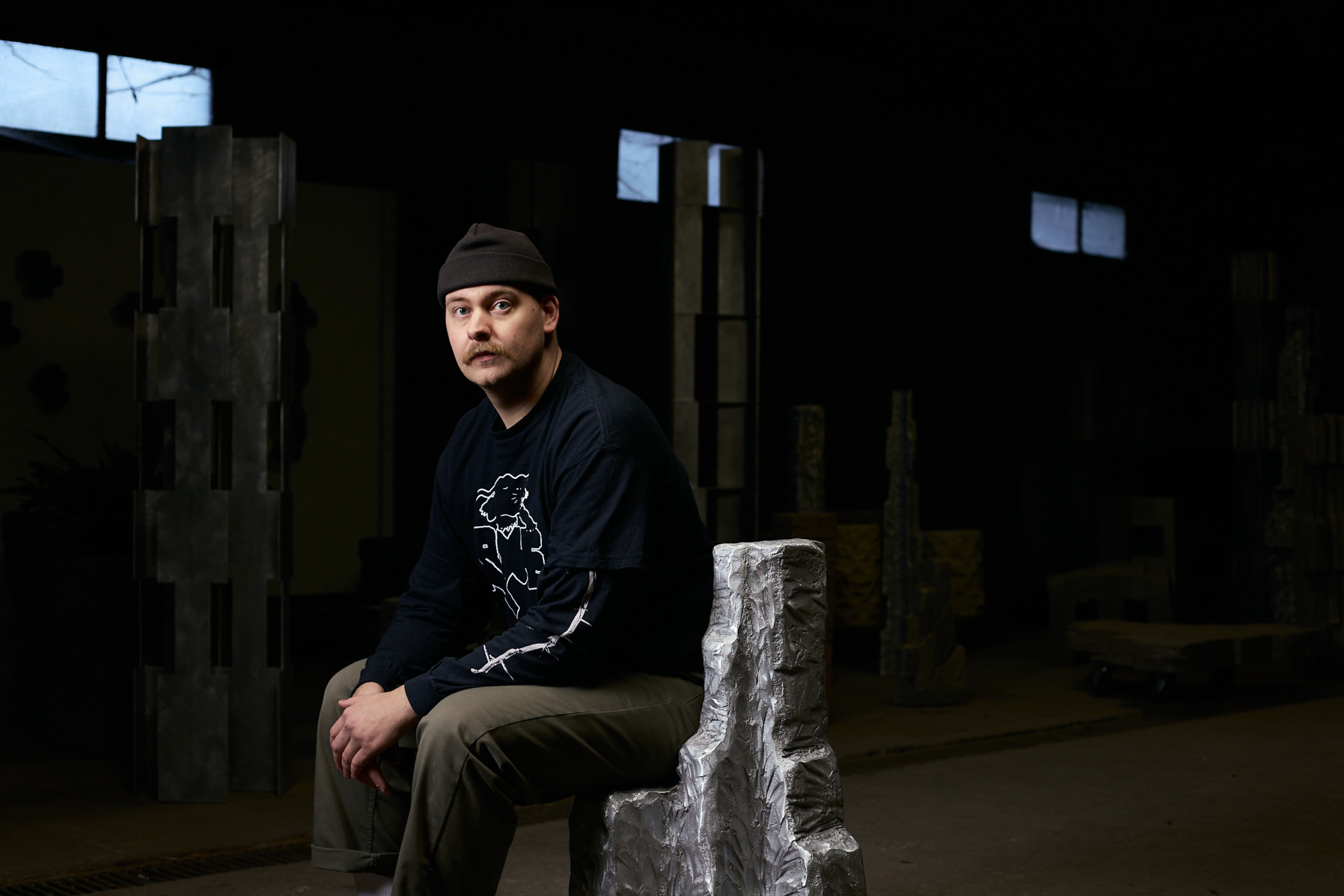
After completing his foundational training, Vanderbeke pursued higher education in design at the prestigious Royal Academy of Fine Arts in Ghent before culminating his studies at the Design Academy Eindhoven. Rather than confining his talents to traditional commercial manufacturing, he returned to his hometown to establish an independent practice as an artist and designer. Today, his portfolio reflects a deep interrogation of the relationship between physical objects, their architectural surroundings, and the human end-user. By prioritizing raw materiality, form, and structural function, Vanderbeke produces tactile, sculptural objects that persistently blur the boundaries separating fine art, industrial design, and structural architecture.
Roots of Inspiration: From Nature to the Hardcore Underground

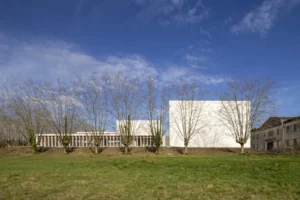
Vanderbeke’s creative philosophy is deeply anchored in how built environments harmonize with the natural world. He frequently cites Insel Hombroich—a renowned museum and sprawling sculpture park situated in Neuss, Germany—as a monumental influence on his perspective. Observing how seasonal shifts radically transform the visitor’s experience of the landscape and its architectural installations cemented his belief in fluid, context-driven design.
Perhaps more unexpectedly, Vanderbeke’s aesthetic and operational ethos is informed by the DIY culture of the hardcore punk subculture in which he was raised. Built on grassroots community organizing, self-reliance, and direct action, this background instilled in him an uncompromising urgency to make things happen independently. This hands-on ethos directly translates into his atelier practice, where material experimentation and physical fabrication take precedence over passive digital rendering.

The LVK x BV Collaboration: Bridging Jewelry and Architecture
This autumn, Vanderbeke’s collaborative spirit took center stage with the launch of Cavea, a group exhibition organized in partnership with the Brut Collective—the Belgian collectible design group he cofounded in 2018—and DesignUnDisciplined. Featuring more than 70 works by upwards of 40 designers, the exhibition further cemented Vanderbeke’s influence in the European collectible design market. Beyond group showcases, his recent output includes high-profile commissions for luxury fashion houses like Bottega Veneta, prominent interior designer Kelly Wearstler, fashion designer Pieter Mulier, and a refreshed retail interior for the newly reopened museum shop at Design Museum Gent.

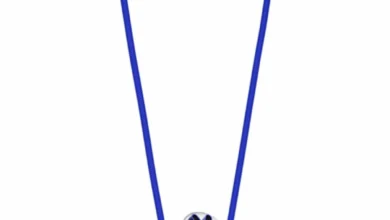
Among his most notable recent endeavors is a cross-disciplinary collaboration with Belgian jeweler Lore Van Keer, resulting in the LVK x BV collection. Comprising a limited-edition silver necklace and a sculptural side table/stool produced in an edition of just eight pieces, the collection merges micro-scale precious metal craftsmanship with macro-scale architectural furniture.
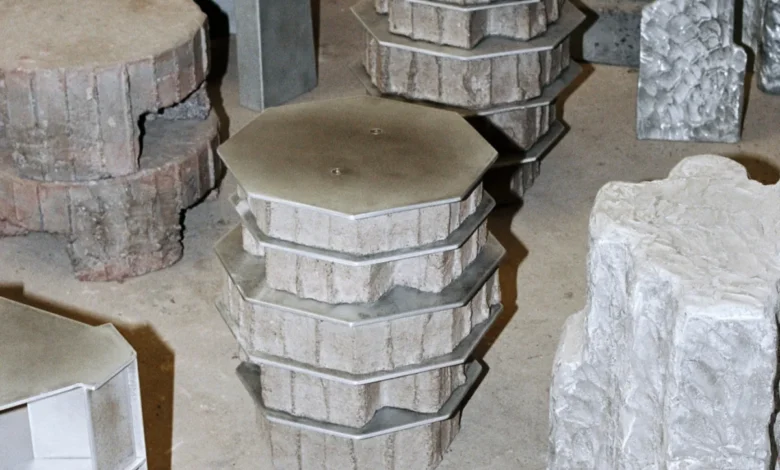
The resulting Anthology Side Table/Stool serves as a prime example of Vanderbeke’s methodology. Handcrafted entirely within his Belgian atelier, each unit is cast using a newly constructed mold, ensuring that every individual piece possesses distinct textural variations. Fabricated from alternating layers of cast concrete and structural aluminum, the hybrid furniture object is engineered for both indoor and outdoor environments and is made strictly on demand.

Anatomy of an Object: The Architectural and Historical Influences Behind Anthology
To understand the genesis of the Anthology Side Table/Stool, one must examine the diverse visual references Vanderbeke synthesizes during the design process. The collaboration originated when Lore Van Keer invited Vanderbeke to reinterpret her existing Anthology jewelry line into a functional furniture format. Drawn to the rhythmic, stacked geometry of the collection, Vanderbeke focused specifically on the Anthology 10 ring. He translated its concentric circles and distinct hexagonal geometry into a three-dimensional, load-bearing object, balancing the heavy, earthen qualities of concrete with the sleek, industrial precision of aluminum.

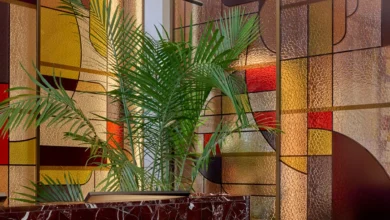
Further architectural inspiration was drawn directly from Vanderbeke’s personal library. Leafing through Isamu Noguchi’s seminal monograph A Sculptor’s World, Vanderbeke studied documentation of the dramatic ceiling installation and cascading waterfall designed by Noguchi for the lobby of 666 Fifth Avenue in New York City (a historic interior tragically lost prior to its removal in 2020). The rhythmic arrangement of metallic fins across Noguchi’s ceiling directly inspired the layered metal components integrated into the Anthology side table.
Furthermore, Vanderbeke looks to antiquity for structural cues. He frequently draws inspiration from archaeological excavations, ancient ruins, and the weathered, monumental textures of historical Roman columns. These classical motifs intersect directly with his ongoing material research, most notably his Cast Bricks collection.

In developing pieces like the Brick Chair, Vanderbeke arranges standard, industrial bricks into methodical yet intuitive spatial configurations. The intentional negative spaces left within these brick arrays serve as improvised casting molds for his architectural furniture. This straightforward, labor-intensive technique pays direct homage to the foundational methods employed by construction workers—bringing Vanderbeke’s creative journey full circle back to the childhood fascination with bricklaying that started it all.
Broader Industry Implications and the Rise of Collectible Design

The commercial and critical reception of Vanderbeke’s work highlights a broader paradigm shift within the contemporary design market. Over the past decade, collectors and cultural institutions have increasingly gravitated away from mass-produced, standardized furnishings in favor of limited-edition, highly sculptural objects that tell a compelling narrative of material and maker.
By operating fluidly across architecture, fine art, jewelry, and industrial design, practitioners like Vanderbeke challenge traditional market definitions. The commercial success of initiatives like the Brut Collective demonstrates the viability of designer-led cooperatives in Europe, offering an alternative model to traditional gallery representation and corporate manufacturing. As the boundaries separating disciplines continue to dissolve, Vanderbeke’s tactile explorations suggest that the future of design lies not in specialization, but in the synthesis of ancient construction principles, contemporary material innovation, and uncompromising craftsmanship.