The Sculptural Metamorphosis of Ordinary Paper: Jae Ko Debuts in Belgium with Striated

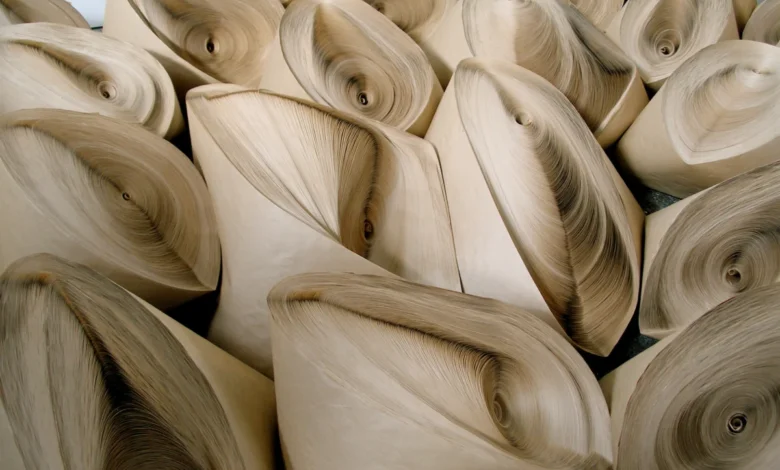
At first glance, the saturated spirals of blue, magenta, and emerald green that populate the exhibition space of the 22MUSE Gallery in Antwerp appear to be carved from ancient wood, molded from heavy clay, or hewn from solid stone. Closer inspection, however, reveals a surprising medium: ordinary paper. For more than four decades, Korean-born artist Jae Ko has dedicated her artistic practice to unlocking the hidden sculptural potential of discarded office supplies, adding machine rolls, and recycled kraft paper. Her latest milestone exhibition, titled Striated, marks her first-ever solo presentation in Belgium, offering European audiences an immersive encounter with works spanning decades of meticulous experimentation alongside a newly conceived, site-specific installation.

Main Facts and Exhibition Overview
Running through November 28, 2026, Striated brings together a carefully curated selection of sculptures that showcase Ko’s mastery over her signature medium. The exhibition title directly references the fine, parallel lines and striated grooves that characterize the topography of her works. By taking utilitarian, disposable paper products—items manufactured for fleeting administrative tasks—and subjecting them to intensive physical transformation, Ko elevates the mundane into monumental fine art.
The showcased pieces range from intimate, tightly wound wall sculptures to sweeping, floor-bound accumulations. Works like the vibrant Ultramarine Blue (JK338) demonstrate how thousands of individual layers can be compressed, shaped, and bound to create objects of profound density and visual weight. Through this process, Ko challenges conventional perceptions of material durability, forcing viewers to reconsider the structural integrity of paper when subjected to immense pressure and deliberate architectural manipulation.

Chronology and Evolution of an Artistic Practice
Ko’s relationship with her chosen material has evolved over a distinguished career spanning over forty years. Born in Seoul, South Korea, Ko pursued her initial education in her home country before relocating to Japan to further her studies in fine arts. These early years in densely populated, rapidly modernizing urban centers profoundly influenced her understanding of spatial design and mass production.
Following her time in Asia, Ko migrated to the United States, eventually establishing her studio on Maryland’s Eastern Shore. This geographic transition from metropolitan environments to the expansive, tidal landscapes of the American coast profoundly shifted her artistic vocabulary. While her early works often engaged with the rigid, linear geometries of urban architecture, her later practice began to absorb the organic rhythms of nature.

Throughout the decades, Ko developed a distinctive, highly physical working method. She typically begins by unwinding massive, industrial-scale rolls of paper. Depending on the desired outcome, she then rolls, twists, folds, stacks, and compresses the material by hand. To achieve her rich color palettes, Ko incorporates traditional Japanese sumi ink—derived from soot—as well as modern pigmented inks in vivid shades of red, green, and violet. In certain experimental phases, she has even buried her paper sculptures in the earth, allowing natural elements such as moisture, soil acidity, and time to collaborate in the creative process.
Supporting Data, Material Science, and Natural Inspiration
The structural integrity of Ko’s sculptures relies heavily on the laws of physics, specifically friction, tension, and uniform pressure. When thousands of sheets of paper are bound together and compressed, the aggregate strength of the material increases exponentially. A single sheet of adding machine paper possesses virtually no load-bearing capacity; however, when gathered into a dense, multi-layered spiral or stacked column, the assembly can support substantial volume and withstand physical manipulation without losing its cohesion.

While Ko’s work is abstract, it is deeply rooted in ecological phenomena. Her sculptures do not attempt to replicate specific plants or geological formations; instead, they visualize the invisible, macro-level forces of the natural world: erosion, sedimentation, glacial movement, and organic growth. The rhythmic undulations of her layered surfaces frequently evoke tree rings, exposed rock strata, or rolling ocean tides.
Furthermore, Ko has frequently cited the bristlecone pine trees of the American West as a significant conceptual touchstone. These ancient conifers, sculpted over millennia by harsh winds, extreme temperatures, and shifting soils, mirror the way Ko’s paper forms are weathered, carved, and transformed by human labor and environmental exposure. The ridges and crevices left visible in her finished pieces serve as a direct visual record of the time, sweat, and physical endurance invested in their creation.

Institutional Context and Gallery Reception
The debut of Striated at 22MUSE Gallery represents a significant milestone for both the artist and the Belgian contemporary art scene. As Antwerp continues to cement its status as a vital European hub for boundary-pushing contemporary art, the gallery’s decision to host Ko’s first solo exhibition in the country underscores a growing international appetite for materiality-driven sculpture.
Art critics and curators have noted that Ko’s work arrives at a pertinent time in contemporary discourse, intersecting with broader conversations surrounding sustainability, upcycling, and the reimagination of industrial waste. By transforming disposable administrative paper into objects of permanent artistic value, Ko subtly critiques a throwaway culture while demonstrating the infinite creative possibilities inherent in recycling.

Representatives from 22MUSE Gallery have emphasized that the site-specific installation created for the Antwerp space was designed to dialogue directly with the gallery’s architectural proportions. By contrasting the rigid, rectilinear parameters of the exhibition room with the fluid, organic contours of her paper bundles, Ko creates an immersive environment that encourages slow, contemplative viewing.
Broader Impact and Implications
The implications of Striated extend beyond the aesthetic realm, offering a masterclass in how artists can subvert conventional material hierarchies. In an era dominated by digital media and synthetic polymers, Ko’s insistence on using organic, biodegradable paper—manipulated entirely through human hands and basic tools—feels both grounding and radical.

The exhibition invites viewers to reflect on the passage of time. Each fold, crease, and layer acts as a physical archive of the labor process, preserving the artist’s physical exertion within the static form of the sculpture. As museums and galleries increasingly look toward artists who champion sustainable practices and deep material engagement, Jae Ko’s retrospective and new works in Antwerp serve as an enduring testament to the power of patience, repetition, and transformation. Striated remains on view at 22MUSE Gallery through November 28, 2026.