The Great Calibration: Adland Grapples with the Reality of AI-Driven Creative Decay and Talent Displacement

It is Fall 2026, and as the industry enters the zenith of its annual conference circuit, the term “AI” has shifted from a buzzword of infinite promise to a shorthand for a complex, often fraught, operational reality. Across conference centers in the United States, Western Europe, and global media hubs, the discourse has matured. Where the early days of the generative AI boom were defined by starry-eyed pitches regarding innovation and hyper-efficiency, the current climate is marked by a palpable sense of exhaustion. As the initial excitement of automation has collided with the harsh reality of widespread industry layoffs and a measurable decline in creative standards, the marketing sector finds itself at a critical inflection point.
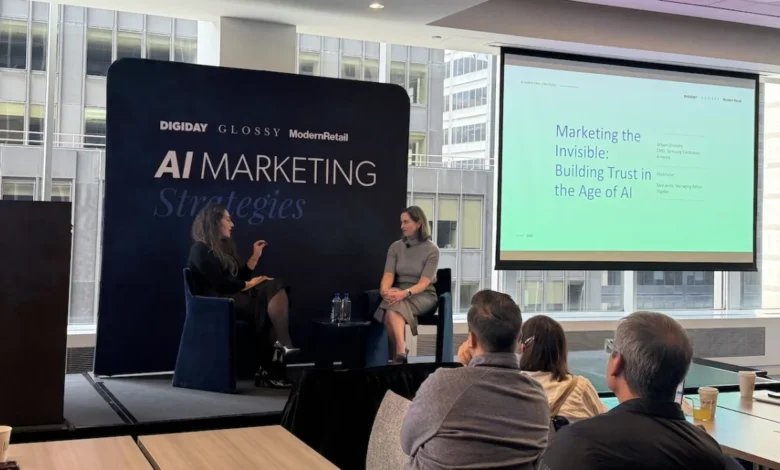
The inaugural AI Marketing Strategies event, co-hosted by Digiday, Glossy, and Modern Retail on September 24, served as a microcosm of this tension. Behind closed doors and under the protection of Chatham House Rules, the industry’s top brand-side marketers convened to address a growing crisis: how to build a talent base and implement rigorous standards in an era where the “human element” is increasingly being sidelined by black-box algorithms.
The Erosion of Brand Equity and the “Good Enough” Trap
The primary concern voiced by participants was the degradation of brand output. As companies scramble to automate their digital supply chains—often as a direct response to AI-driven headcount reductions—they are finding that the volume of content produced is rising while the quality is plummeting.
For premium brands, this trend is catastrophic. One representative from a luxury beauty house noted that the “good enough” culture has become pervasive, with agency partners frequently failing to maintain basic brand identity markers, such as correct logo usage or brand-appropriate tone of voice. The reliance on junior staff to oversee complex AI platforms has created a structural vulnerability. Instead of using AI as a force multiplier for creative excellence, many agencies are using it as a cost-cutting tool, leaving brands to deal with the fallout of inconsistent, often hallucinated, or off-brand creative executions.
This issue of “creative decay” is compounded by the labor market’s current state. Industry data suggests that the ad sector has seen significant turbulence since 2024, with firms trading high-seniority creative roles for automation tools that, while cheaper, lack the institutional knowledge required to curate brand integrity. The result is a feedback loop: brands are forced to invest more time in “prompt engineering” and downstream editing to salvage work that should have been competent from the start.
The 10/80/10 Framework and the Human Oversight Mandate
During the town hall sessions, a consensus emerged regarding the necessary workflow for the modern age. Marketing leaders are increasingly adopting what has been termed the “10/80/10 formula.” In this model, 10% of the effort is spent on upfront strategic prompting, 80% is delegated to the AI engine, and the final 10% is dedicated to human-led quality assurance, refinement, and strategic alignment.
The danger, as highlighted by multiple brand-side executives, is that many agency partners are skipping the final 10%. They are delivering raw, machine-generated outputs that lack the nuance required for premium market positioning. The implication is clear: human oversight is no longer an optional luxury—it is the only safeguard against brand erosion.
The Human Element in the Age of Change Management
The transition to an AI-first operating model has prompted a significant, if belated, discussion on “change management.” The consensus among agency leaders and brand executives is that the industry is undergoing a shift as seismic as the digital migration of the early 2000s.
However, the current transition is occurring at an unprecedented velocity. Where previous technological shifts took years to fully integrate, the transition to agentic AI workflows is happening in a matter of months. This speed creates a psychological vacuum. Employees are understandably anxious about their utility in a world where an AI can generate a campaign brief or a localized social media asset in seconds.
A chief at a boutique agency noted that leadership must now pivot from being task-managers to being “human-value architects.” The challenge for the next three years is not just technical; it is organizational. Leaders must define the unique value of human employees in a workflow where machines handle the heavy lifting. If the human is removed from the process, the brand loses its soul—the idiosyncratic, creative spark that AI, by definition, can only simulate but never authentically possess.
Adapting to the Internet of Two Audiences
Beyond the internal struggles of creative quality, the industry is also grappling with a fundamental shift in the architecture of the internet. Isabel Perry, global executive vice president of strategy at DEPT, highlighted the transition from a human-centric internet to one where agent-driven traffic—bots talking to bots—is becoming the dominant force.
This shift renders traditional metrics increasingly obsolete. Perry argued that the industry is currently “drowning in measurement” while starving for insight. Marketing teams are chasing generic industry KPIs that offer little strategic value in an ecosystem where a significant portion of traffic is non-human. Instead, firms must pivot to “measuring the gaps.” By identifying where the consumer journey remains fundamentally human and where it has been subsumed by AI agents, brands can reallocate their budgets toward high-value human touchpoints rather than chasing hollow impressions.
The Zero-Click World and the Legacy Content Crisis
Rajiv Ragu, vice president of digital at Thorne, further contextualized this shift by discussing the “zero-click world.” As AI-driven search engines and agents aggregate information directly for the user, the traditional web-traffic funnel is disappearing.
For brands, this necessitates a radical curation of legacy content. It is no longer sufficient to have a vast, static archive of blog posts and articles. These digital assets must be constantly audited, updated, and curated to ensure they remain relevant to both human users and the AI agents that are increasingly acting as the gatekeepers of information. Neglecting these libraries is a strategic risk, as the information retrieved by AI models may be outdated or inaccurate, directly damaging brand credibility.
Strategic Implications and Future Outlook
The industry-wide fatigue with the term “AI” is, in itself, a positive indicator. It suggests that the marketing world is moving past the “hype cycle” and entering a phase of sober, necessary structural reform. The implications for the next 24 months are clear:
- Talent Reskilling: Agencies will need to prioritize roles that focus on brand stewardship and high-level creative direction, rather than entry-level content production. The “junior creative” role is the most at-risk position in the current landscape.
- Audit Cycles: The necessity of “content maintenance” will become a standard operational cost. Brands will likely establish dedicated teams to curate and verify the information that feeds into the AI ecosystem.
- The Premium Premium: There will be an increasing bifurcation in the market. Brands that invest in human-led, high-quality creative will be able to command a premium, while those that lean entirely into automated “good enough” output will struggle to maintain brand equity in an increasingly crowded and noisy digital environment.
As we look toward 2027, the success of a marketing department will not be measured by the volume of content produced or the speed of implementation, but by the ability to integrate automation without sacrificing the human resonance that drives consumer loyalty. The era of the “AI-first” agency is over; the era of the “human-centered” AI integration is just beginning. The companies that learn to balance these two forces will be the ones that define the next decade of advertising.