The Evolution of Digital Sabotage How Typosquatting and Negative SEO are Destabilizing the Luxury Jewelry Market

The luxury jewelry e-commerce sector is currently grappling with a sophisticated form of digital warfare that bypasses traditional cybersecurity defenses like firewalls and encryption. While many retailers have historically focused on preventing credit card fraud and data breaches, a new trend involving "typosquatting" paired with "negative SEO" (Search Engine Optimization) has emerged as a significant threat to brand integrity and revenue. Unlike traditional phishing, which aims to steal user credentials through fake storefronts, this coordinated attack focuses on manipulating search engine algorithms to degrade the ranking of legitimate high-end retailers.
The first indications of this activity often appear not in sales reports or customer complaints, but within technical diagnostic tools such as Google Search Console. Industry analysts at Opulent Jewelers recently identified a pattern where referring domains for a single brand jumped by several hundred within a single week. Upon closer inspection, these domains were found to have no relevance to the jewelry industry, yet they were all linked to luxury jewelry retailers through a highly coordinated, automated pattern. This phenomenon marks a shift toward "adversarial SEO," where the goal is to ruin a competitor’s visibility by associating their brand name with "toxic" digital neighborhoods.
Deconstructing the Attack: From Phishing to Algorithmic Bleed
To understand the severity of this threat, one must distinguish between traditional typosquatting and its modern, more malevolent iteration. Historically, typosquatting involved registering a domain name that was a minor misspelling of a famous brand—for example, "gogle.com" instead of "google.com." These sites were typically used to host ads, harvest emails, or deploy malware.
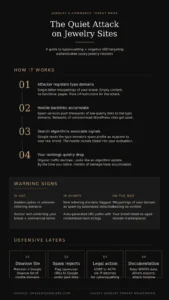
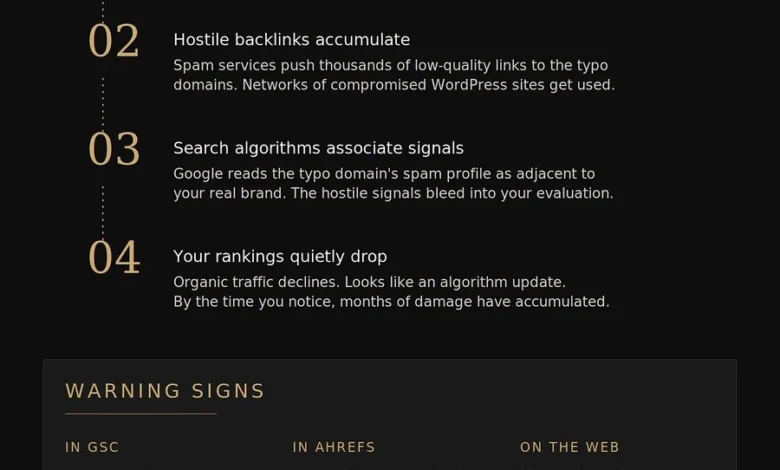
The new pattern targeting luxury jewelry is significantly more patient and technical. In these cases, the typosquat domains are not used to host fake storefronts. Instead, they often sit as "parked" pages with zero outbound links and no visible content. Their power lies in their inbound link profile. Attackers build thousands of spam-flagged links to these misspelled domains over a period of weeks. By doing so, they create a "hostile backlink profile" that search engine algorithms may inadvertently associate with the legitimate brand the typosquat is mimicking.
The owner of Opulent Jewelers, who has been monitoring these patterns for over eighteen months, notes that the attacker exploits the way search engines understand brand identity. Google’s algorithms do not merely look at links pointing directly to a domain; they evaluate the broader "signal landscape" surrounding a brand name. If a domain that is nearly identical to a legitimate brand’s URL is suddenly flooded with thousands of spam links, that negative signal can "bleed" into the evaluation of the real brand. The result is not a confused customer, but a decline in search rankings and organic traffic, causing the legitimate retailer to lose visibility for high-value search queries.
A Chronology of Coordinated Sabotage
The intensification of these attacks has followed a clear timeline, suggesting the involvement of organized entities with significant technical infrastructure.
Late 2022 – Early 2023: The Reconnaissance Phase
During this period, luxury jewelry brands began noticing a slow trickle of misspelled domain registrations. These were largely ignored as "nuisance" registrations, typical of the industry. However, behind the scenes, attackers were likely testing the sensitivity of search algorithms to brand-name variations.
Mid-2023: Infrastructure Development
Analysts observed the growth of link-spam services that openly advertised the ability to manipulate brand signals. Networks of compromised WordPress sites were repurposed to inject commercial anchor text, and aged-domain marketplaces began recycling hostile profiles to be redirected toward luxury jewelry targets.
Late 2024: The Coordinated Surge
By the fourth quarter of 2024, the pattern moved from isolated incidents to coordinated campaigns. Multiple retailers reported spikes in disavow reports. The attacks were no longer random; they were focused on retailers specializing in high-demand, pre-owned luxury goods such as authenticated Cartier and Van Cleef & Arpels pieces.
Economic Incentives: Why Luxury Jewelry is the Prime Target
The selection of the luxury jewelry industry as a primary target for negative SEO is driven by three specific economic factors: high average order value (AOV), keyword specificity, and the "trust premium."
First, the financial impact of a minor ranking drop is magnified in luxury sectors. In an industry where individual transactions frequently range from $5,000 to $50,000, even a 5% drop in organic traffic can result in six-figure revenue losses over a single quarter. Unlike fast-fashion e-commerce, where volume compensates for low margins, luxury jewelry relies on a smaller number of high-intent visitors.
Second, the keyword landscape is incredibly competitive. Phrases such as "pre-owned Cartier Love bracelet" or "authenticated Van Cleef Alhambra" carry immense commercial intent. Because there is a limited inventory of authoritative retailers who can rank for these terms, pushing a competitor down just one or two positions on a Search Engine Results Page (SERP) can shift significant market share to another player—or to the attacker’s own shadow sites.
Third, the vulnerability of the "authentication angle" is central to the attack. Legitimate retailers invest heavily in content that proves provenance and authenticity. This content-rich environment is exactly what search engines reward. By targeting these brands with negative SEO, attackers attempt to undermine the very trust that the retailers have spent years building through their digital presence.
Technical Indicators and Early Warning Signs
For jewelry e-commerce operators, identifying an attack requires a shift in focus toward data points that are often overlooked. Security experts suggest monitoring the following indicators across multiple platforms.
Google Search Console Anomalies
Retailers should watch for sudden spikes in referring domains that occur outside of planned marketing campaigns. A particularly high-risk signal is the appearance of new URLs in the "Links to your site" report that originate from unknown domains and use anchor text combining the brand name with commercial terms like "buy," "discount," or "cheap." Furthermore, a geographic mismatch—such as a sudden surge of links from Eastern Europe or Southeast Asia for a US-based boutique—is a classic hallmark of a coordinated spam injection.
Backlink Monitoring Tool Metrics
Using tools like Ahrefs or Semrush, jewelers can detect when new referring domains are classified as "spam" by automated systems. Red flags include referring URL paths that contain randomized hash strings or auto-generated patterns, as well as inbound links from domains with extremely high outbound link counts. The latter often indicates a "link farm" or a compromised site being used to broadcast toxic signals.
Typosquat Registration Patterns
Proactive monitoring of WHOIS data for single-letter variations of a brand name is essential. If multiple variants of a misspelling appear simultaneously (e.g., adding an extra ‘s’, swapping ‘i’ for ‘l’, or dropping a vowel) and these domains begin accumulating backlinks despite having no content, it is a definitive sign of a coordinated infrastructure being prepared for an attack.
Strategic Defense: Mitigation and Legal Remedies
Defending against typosquatting and negative SEO requires a multi-layered approach that combines technical maintenance with legal action. There is no "silver bullet" solution, as the attack exploits the fundamental architecture of search engines.
1. The Disavow File as Infrastructure
The primary technical defense is the consistent maintenance of a Google Search Console disavow file. This tool allows a site owner to tell Google which domains should be ignored when calculating the site’s authority. For brands under active attack, this is not a one-time task but an ongoing operational requirement. Some luxury retailers now refresh their disavow files weekly, maintaining lists of thousands of malicious domains to prevent "signal bleed."
2. Strategic Spam Reporting
Filing formal reports through Google’s spam reporting tools provides the search engine with the data it needs to improve its automated detection. When reporting typosquats, experts recommend selecting the "paid links" category, as the acquisition of thousands of spam links by an empty domain is technically a violation of link schemes.
3. Intellectual Property and Legal Recourse
If the damage is substantial, legal avenues such as the Uniform Domain-Name Dispute-Resolution Policy (UDRP) or the Anticybersquatting Consumer Protection Act (ACPA) can be utilized.
- UDRP: A process through the World Intellectual Property Organization (WIPO) that can result in the transfer or cancellation of a domain. It is relatively fast (60-75 days) and cost-effective.
- ACPA: A US federal law that allows for statutory damages of up to $100,000 per domain. While more expensive and time-consuming, the threat of high financial penalties can act as a deterrent against domestic attackers.
Both legal strategies require established trademark rights. Security analysts emphasize that federal trademark registration is a critical piece of defensive digital infrastructure, as it significantly strengthens the brand’s position in any domain dispute.
The Broader Impact on the E-commerce Ecosystem
The rise of typosquatting-linked negative SEO represents a "resource asymmetry" problem. An attacker can use automated scripts to register dozens of domains and generate thousands of links for a relatively low cost. In contrast, the defender must invest in expensive monitoring tools, SEO experts, and legal counsel to mitigate the fallout.
This trend also poses a challenge for search engine developers. As long as brand association signals and link velocity remain core components of search algorithms, those signals will be subject to manipulation. Until AI-driven spam detection can perfectly distinguish between a legitimate brand signal and a "poisoned" mimic, the burden of defense remains with the individual business owner.
For independent jewelers and boutique retailers, the most effective defense may be collective awareness. By sharing data on attack patterns and collaborating on industry-wide standards for digital security, the luxury sector can increase the "cost of entry" for attackers. As one industry expert noted, the greatest vulnerability is not the technical loophole itself, but the lack of awareness that such an attack class exists. Once the pattern is recognized, the path to defense becomes clear: constant vigilance, meticulous documentation, and a proactive stance on brand protection.
Related posts: