Luxury Jewelry E-commerce Faces New Wave of Sophisticated Typosquatting and Negative SEO Attacks

The luxury jewelry sector is currently navigating a sophisticated and quiet evolution in digital threats, where traditional phishing and credit card fraud have been superseded by a more patient form of algorithmic sabotage. For many high-end retailers, the first indication of a breach does not come from a customer complaint or a financial discrepancy, but from a subtle anomaly within the Google Search Console. Reports from industry participants, including luxury retailer Opulent Jewelers, indicate a troubling surge in referring domains—often jumping by several hundred in a single week—none of which bear any relevance to the jewelry industry. This pattern marks the emergence of a coordinated campaign combining typosquatting with negative Search Engine Optimization (SEO), a strategy designed to erode the search rankings and organic visibility of established luxury brands.
The Anatomy of a Modern Algorithmic Attack
To understand the gravity of this threat, it is necessary to distinguish it from historical cyber threats. Traditionally, typosquatting involved registering a domain name that was a minor misspelling of a popular brand—such as "Cartierr.com" instead of "Cartier.com"—with the intent of hosting a fraudulent storefront to steal credentials or financial data. However, the current wave of attacks targeting the jewelry industry is significantly more technical. These "shadow" domains often host no content at all; they sit as parked pages with zero outbound links.
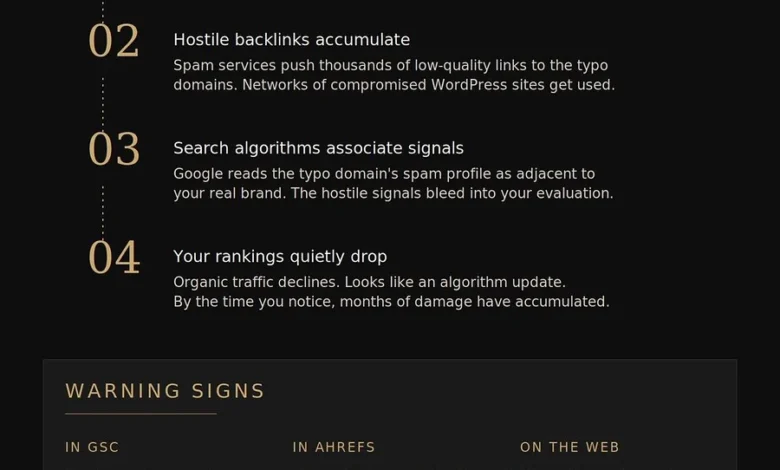
The true weaponization occurs in the backlink profile. These misspelled domains are flooded with thousands of spam-flagged inbound links from high-risk sources, including compromised WordPress sites and link-spam networks. By rapidly building a hostile digital footprint around a domain that closely mimics a legitimate brand, attackers exploit the way search engine algorithms understand brand identity. Search engines like Google do not evaluate a domain in total isolation; they assess the broader "signal landscape" surrounding a brand name. When a domain one letter off from a major retailer is associated with massive quantities of digital "toxic waste," that negative signal can bleed into the evaluation of the legitimate brand, leading to a precipitous decline in search rankings.
A Chronology of the 2024 Jewelry Sector Campaign
The intensification of these attacks has followed a specific timeline that suggests a high degree of coordination and infrastructure investment by the perpetrators.
- Early 2023: Security analysts noted a baseline increase in "parked" typosquat domains targeting luxury sectors, though these were initially dismissed as traditional domain squatting for resale purposes.
- Q1-Q2 2024: Retailers began reporting unusual "link spikes" in their analytics tools. These links did not point to their own sites but to misspelled variants. At this stage, the impact on organic traffic was negligible, leading many to overlook the activity.
- Late 2024: The pattern transitioned into an active offensive. Attackers utilized aged-domain marketplaces to recycle hostile profiles, ensuring the spam links had historical "weight" in the eyes of search algorithms.
- Present Day: The attack infrastructure has become commercialized. Security researchers have identified link-spam services that openly advertise the ability to manipulate brand signals, utilizing networks of compromised sites to inject commercial anchor text into the digital ecosystem.
Economic Rationale: Why the Jewelry Industry is the Prime Target
The targeting of luxury jewelry is a calculated economic decision. Unlike general apparel or consumer electronics, the luxury pre-owned jewelry market operates on exceptionally high average order values (AOV). A single transaction for a pre-owned Cartier Love bracelet or an authenticated Van Cleef & Arpels Alhambra necklace can range from $4,000 to over $50,000.
In this high-stakes environment, search engine real estate is incredibly valuable. Phrases with high commercial intent have a limited number of authoritative retailers ranking on the first page of search results. For an attacker, pushing a legitimate competitor down just one or two positions on a Search Engine Results Page (SERP) can result in a significant redistribution of revenue. Furthermore, the industry’s reliance on "authentication" makes it vulnerable. Legitimate retailers invest heavily in content regarding provenance and authenticity to build trust; attackers seek to undermine this trust by associating the brand name with the "low-quality" signals of spam networks.
Technical Detection and Warning Signs
For jewelry e-commerce operators, identifying an attack requires a shift from monitoring sales to monitoring technical metadata. Experts suggest that the following signals are indicative of an ongoing negative SEO campaign:
Google Search Console Anomalies
The primary indicator is a sudden spike in disavowed referring domains that occurs independently of any legitimate marketing or PR campaigns. Retailers should also monitor the "Links to your site" report for new URLs from unknown domains using anchor text that combines the brand name with aggressive commercial terms (e.g., "discount [Brand Name]" or "buy [Product] cheap"). Geographic mismatches are also common, such as a sudden influx of links from regions where the retailer has no presence or customer base.
Third-Party SEO Tool Metrics
In tools like Ahrefs, Semrush, or Moz, a sudden surge in referring domains classified as "spam" by automated detection systems is a red flag. Attackers often use randomized hash strings in the referring URL paths or link from sites that have an unnaturally high outbound link count—a hallmark of a compromised site or a link farm.
Typosquat Cluster Identification
A single misspelled domain is a nuisance; a cluster of four or five variations (extra letters, swapped characters, missing vowels) suggests a coordinated infrastructure. If these domains show rapid backlink growth despite having no actual content, it is a clear indication of a hostile intent.
Defensive Strategies and Legal Recourse
The defense against this new landscape of "signal manipulation" is layered and requires ongoing maintenance rather than a one-time fix.
1. The Disavow Infrastructure: The most immediate defense is the consistent maintenance of a Google Search Console disavow file. This tool allows a webmaster to instruct Google to ignore specific domains when evaluating their site’s link profile. For retailers under active attack, this file must be treated as a living document, updated weekly or monthly as new typosquat domains emerge.
2. Regulatory and Spam Reporting: Filing formal spam reports with search engines is a necessary step. While these reports do not result in the immediate removal of a domain, they contribute to the algorithm’s ability to identify the attacker’s infrastructure. When reporting, it is crucial to categorize the activity as "paid links" or "manipulative behavior," as this most accurately describes the negative SEO mechanism.
3. Intellectual Property and Legal Action: If the damage is substantial, retailers can turn to the Uniform Domain-Name Dispute-Resolution Policy (UDRP). This process, overseen by the World Intellectual Property Organization (WIPO), can result in the transfer or cancellation of typosquatted domains. The process typically costs approximately $1,500 in filing fees and takes 60 to 75 days. For US-based entities, the Anticybersquatting Consumer Protection Act (ACPA) offers a more aggressive path, allowing for statutory damages of up to $100,000 per domain, though the legal costs are significantly higher.
Expert Analysis and Industry Implications
The owner of Opulent Jewelers, who has been at the forefront of documenting these patterns, notes that the "biggest barrier is that most jewelers don’t know this attack class exists." Once the pattern is identified, the defense is relatively straightforward, but the "quiet" nature of the attack allows it to persist for months before the victim realizes their decline in traffic is not due to a shift in consumer taste or a general algorithm update.
Cybersecurity analysts suggest that this trend reflects a broader shift in the "underground economy" of the internet. As direct hacking of e-commerce platforms becomes more difficult due to better encryption and third-party payment processors, attackers are shifting their focus to the "reputational layer" of the web. By manipulating the signals that search engines use to determine authority and trust, they can exert economic pressure on brands without ever having to breach a server.
Conclusion: The Future of Digital Integrity in Retail
The luxury jewelry industry serves as a canary in the coal mine for this new form of digital warfare. As search engines continue to move toward "entity-based" search—where they try to understand the concept of a brand rather than just matching keywords—the potential for signal bleed and brand-name manipulation will only increase.
For independent jewelers and boutique retailers, the resource asymmetry is the most challenging aspect of this environment. An attacker can automate the registration of dozens of domains and the generation of thousands of links for a nominal cost. The defender, conversely, must invest in technical expertise and legal counsel to protect their digital territory. However, the industry’s strength lies in collective awareness. As retailers share data regarding known spam networks and typosquat patterns, the "noise" created by attackers becomes easier for search engine algorithms to identify and neutralize. The battle for the future of jewelry e-commerce will not just be won on the quality of the diamonds or the prestige of the brand, but on the vigilance of the digital defense.