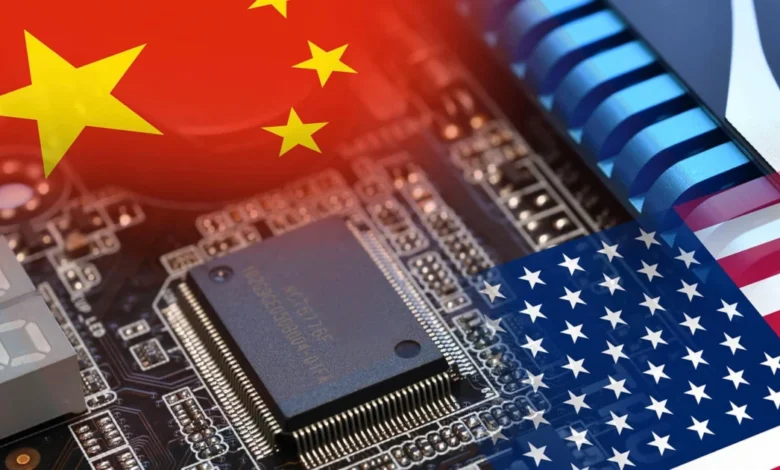
The United States is escalating its concerns over alleged intellectual property theft by Chinese artificial intelligence (AI) firms, with Treasury Secretary Scott Bessent issuing a direct threat of sanctions against companies found to be illicitly leveraging American technological advancements. This declaration, made during an interview on Fox Business on Tuesday, signals a hardening stance in the ongoing technological rivalry between the two global powers, particularly as China’s AI capabilities rapidly advance and begin to challenge the long-held dominance of U.S. companies in the sector.
"This administration supports open source models, but what we do not support is IP theft," Bessent stated unequivocally. "If we see, especially, that overseas models are stealing from our great companies, we have the ability to sanction them because of this theft." This warning comes at a critical juncture, as Chinese AI developers are increasingly releasing sophisticated models that demonstrate remarkable performance, often achieved without direct access to the most advanced semiconductor chips that currently favor U.S. firms.
One such development highlighted in recent reports is the release of Kimi K3 by Moonshot AI, a Chinese artificial intelligence company. This model has garnered attention for its strong performance metrics, even when operating without the cutting-edge hardware that has been a cornerstone of U.S. AI development. The implication is that Chinese firms may be employing innovative methods, potentially including the appropriation of existing intellectual property, to bridge the performance gap.
The U.S. administration’s concerns are not new. For months, American technology companies have been vocal in their warnings to the White House about the potential for foreign entities to replicate their proprietary AI technologies and then disseminate them, often under the guise of open-source initiatives. This proactive communication underscores a growing apprehension within the U.S. tech industry regarding the protection of its considerable investments in AI research and development.
The Shadow of Distillation: A Growing Concern
A key method reportedly employed by some Chinese AI firms, and a central point of contention, is a practice known as "distillation." This technique involves using the outputs of a highly advanced, proprietary AI model – the "teacher" – to train a smaller, more accessible "student" model. While distillation is a recognized and sometimes legitimate method within the AI field, accusations of its illicit use raise significant questions about intellectual property rights.
Earlier this year, Anthropic, a prominent U.S.-based AI research company, publicly accused Moonshot AI, along with two other Chinese AI firms, DeepSeek and MiniMax, of "illicitly" extracting the capabilities of its Claude AI model. This alleged act of distillation is seen by companies like Anthropic as a direct violation of their intellectual property. The process, as explained by sources like Gizmodo, essentially allows a new model to learn and mimic the performance of an established one without undertaking the extensive and costly research and development that the original model required.
The discovery of watermarks from American Large Language Models (LLMs) on Chinese AI models further fuels these allegations. Secretary Bessent pointed to these watermarks as a tangible piece of evidence, drawing parallels to past incidents where intellectual property was demonstrably copied. This is reminiscent of the situation involving Getty Images and Stability AI, where watermarks from Getty’s vast image library were found to be reproducible on images generated by Stability AI’s Stable Diffusion model, leading to significant legal disputes.
A Complex Ethical Landscape: The "Pot Calling the Kettle Black" Argument
The heightened focus on intellectual property theft in AI development has also brought to the fore a complex ethical debate, with some observers highlighting a perceived irony. Many in the creative industries, who have long voiced concerns about AI models being trained on copyrighted material without consent or compensation, now find themselves witnessing AI firms themselves crying foul over alleged IP theft.
This sentiment was recently articulated by Microsoft CEO Satya Nadella. In a post on social media platform X earlier this month, Nadella appeared to address the broader AI community, including those developing LLMs. He stated, "While the great innovation that comes from model providers having fair use rights to train models on public data is needed, I find it ironic that the status quo is to then turn around and impose restrictive terms on distillation." Nadella’s remarks suggest a recognition of the multifaceted nature of intellectual property in the AI era, where lines can become blurred, and accusations of theft can originate from various corners.
The core of the issue lies in the differing perspectives on what constitutes fair use and legitimate training data. While U.S. AI developers often argue for the right to train models on publicly available data, they also seek to protect the specific outputs and underlying architecture of their proprietary models from being directly replicated through methods like distillation by competitors.
Timeline of Escalating Tensions
The current U.S. stance represents an escalation of a situation that has been developing over several years, with specific incidents and policy discussions shaping the current landscape:
- Early 2020s: The rapid advancement of generative AI models, particularly LLMs, by both U.S. and Chinese companies leads to increased competition and scrutiny.
- Late 2023 – Early 2024: U.S. AI companies, including Anthropic, begin to privately voice concerns to the U.S. government about potential IP theft by Chinese competitors.
- Early 2024: Anthropic officially accuses Moonshot AI, DeepSeek, and MiniMax of illicitly distilling its Claude model’s capabilities.
- Mid-2024: Reports emerge of watermarks from American LLMs being discovered on Chinese AI models, further corroborating concerns about IP appropriation.
- July 2024: U.S. Treasury Secretary Scott Bessent publicly threatens sanctions against Chinese AI firms engaged in IP theft.
- July 2024: Axios reports that the U.S. government is actively considering a complete ban on Chinese open-source AI models as a potential response.
- July 2024 (Ongoing): Microsoft CEO Satya Nadella highlights the irony of AI firms complaining about IP theft while potentially benefiting from the use of copyrighted data.
The "coming days or weeks" timeframe mentioned by Secretary Bessent for further investigation and potential action by the Trump administration indicates that the U.S. is preparing to move beyond rhetoric and implement concrete measures.
Broader Implications for the Global AI Landscape
The U.S. threat of sanctions and the ongoing discussions about banning Chinese open-source models have significant implications for the global AI ecosystem.
Economic Ramifications: Sanctions, if imposed, could severely impact the growth and market access of targeted Chinese AI firms. This could lead to retaliatory measures from China, potentially disrupting global supply chains for AI hardware and software, and affecting international trade in technology. The U.S. aims to protect its economic leadership in AI, which is projected to be a multi-trillion-dollar industry in the coming decades. The global AI market size was estimated to be around $150 billion in 2023 and is projected to grow at a CAGR of over 35% from 2024 to 2030, according to various market research firms. Disruptions to this growth trajectory due to geopolitical tensions could have far-reaching economic consequences.
Technological Decoupling: The escalating tensions risk further accelerating a trend of technological decoupling between the U.S. and China. This could lead to bifurcated AI development pathways, with separate ecosystems, standards, and intellectual property regimes emerging. Such a scenario could stifle global collaboration, reduce innovation efficiency, and increase costs for businesses operating internationally.
The Future of Open Source: The debate over distillation and IP theft also raises critical questions about the future of open-source AI. While open-source models have been instrumental in democratizing AI development and fostering innovation, the potential for their misuse in intellectual property theft could lead to more restrictive licensing or increased regulatory oversight. This could slow down the widespread adoption and advancement of AI technologies.
Geopolitical Dynamics: The AI rivalry is a central front in the broader geopolitical competition between the United States and China. The U.S. administration’s firm stance underscores its commitment to maintaining a technological edge and protecting its national security interests, which are increasingly intertwined with AI capabilities. The outcome of these disputes could significantly shape the global balance of power in the 21st century.
The coming weeks and months will be crucial in determining the trajectory of U.S.-China relations in the AI domain. The Treasury Department’s promised actions, coupled with potential government-wide policy shifts, will signal the extent to which the United States is willing to go to safeguard its intellectual property and maintain its leadership in the rapidly evolving world of artificial intelligence. The debate over IP theft, fair competition, and the ethical boundaries of AI development is far from over, and its resolution will have profound consequences for innovation, economies, and international relations worldwide.