Milan Design Week operates on a tempo that rewards velocity over reflection, with hundreds of installations competing for attention across a single compressed week of sensory saturation. Amidst the frantic movement of the Salone del Mobile and the sprawling Fuorisalone events, Marcin Rusak Studio’s Forum Florum: Herbarium of the Present establishes a deliberate counter-rhythm. Staged at the Società d’Incoraggiamento d’Arti e Mestieri (SIAM), an educational institution founded in 1838, the exhibition eschews the traditional commercial showroom format. Instead, it utilizes the historic halls of a 19th-century school to transform the spectacle economy of design into something resembling a quiet, rigorous study hall.
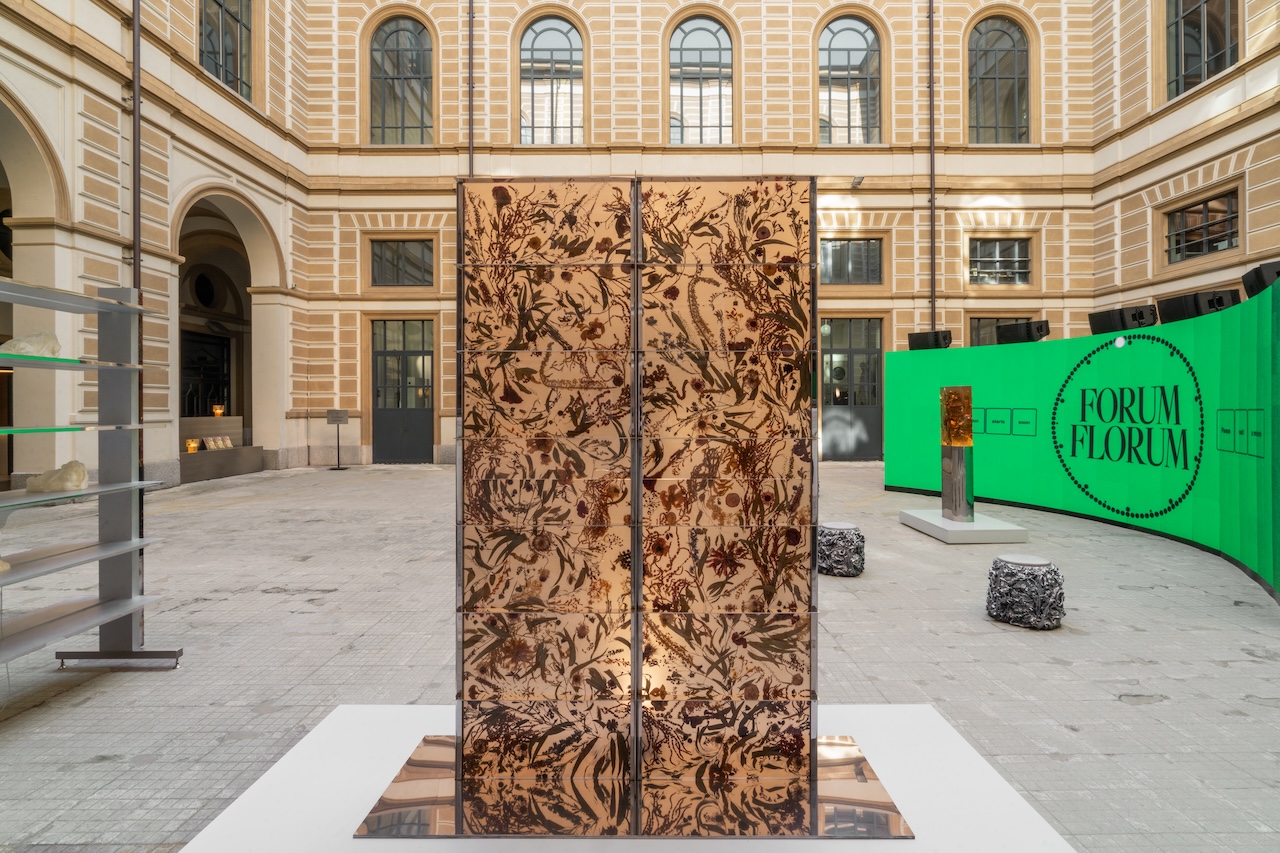
The choice of venue is fundamental to the exhibition’s intent. SIAM was originally established to encourage arts and crafts among Milanese workers, fostering a direct link between technical skill and aesthetic production. Today, it remains a public cultural institution serving students, designers, and a culturally engaged audience rather than the high-end collectors and buyers typically targeted by design week installations. By mounting his new body of work within these academic walls—rather than in a high-traffic Brera gallery or a repurposed Tortona warehouse—Rusak reframes the exhibition as a pedagogical platform. The title, Forum Florum, translates from Latin as "flower market," but in this context, it functions as an invitation to a forum of ideas—a space for intellectual gathering and the exchange of knowledge regarding our ecological interdependencies.
A Chronological Journey Through the Herbarium
The exhibition unfolds as a carefully choreographed sequence through SIAM’s courtyard and two historic interior rooms, beginning with the monumental Flower Journey installation. This portal serves as a physical and conceptual gateway, tracing the global history of the cut flower industry. It highlights an extractive trade that evolved from 19th-century Dutch greenhouse cultivation into a massive global network, where exports are now dominated by Kenyan, Colombian, and Ecuadorian agriculture. The structure of the portal itself reflects this complexity; it is partially 3D-printed and partially cast in bronze, drawing formal inspiration from the skeletal beauty of unfinished Medieval cathedrals and the organic, ornamental thresholds of the Art Nouveau movement.

Moving beyond the portal, visitors enter the realm of Plant Pulses. Developed in collaboration with the historic champagne house Perrier-Jouët, this immersive installation translates the invisible biological activity of plants into a multisensory environment. The project utilized ultrasound recordings of plant activity captured by researchers Bartłomiej Chojnacki and Klara Chojnacka from AGH University of Science and Technology. These micro-sounds, which represent the movement of water and nutrients through plant tissues, were shaped into a cohesive soundscape by composer Justyna Stasiowska and digital artist Eli Magaziner. The resulting data-driven images and audio give form to a register of plant communication that exists entirely below the threshold of human perception, forcing the viewer to confront the "liveness" of the botanical world.
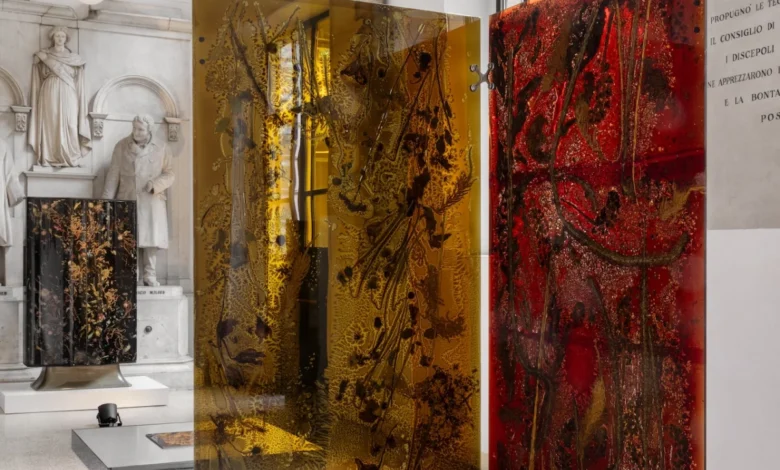
The final stage of the exhibition debuts several new statement pieces that represent a stylistic and technological evolution for Marcin Rusak Studio. Central to this display are 2.5-meter-high herbarium panels, which feature selected flowers and plants laminated with precision between massive sheets of glass. These are accompanied by a new shelving system, a coffee table, and a mirror that extend Rusak’s flagship Flora series—a collection known for capturing the ephemeral beauty of decaying flowers in resin. The presentation is rounded out by custom 3D-printed biodegradable sconces, which provide a soft, ambient light that encourages visitors to sit, recline, and linger in a space designed for contemplation.

Historical Context and the Evolution of the Cut Flower Trade
To understand the weight of Forum Florum, one must consider the industrial history it critiques. The global cut flower industry is a $35 billion market that exemplifies the "fast" nature of modern consumption. Historically, the trade was localized; in the 1800s, flowers were grown in the peripheries of major cities for immediate sale. However, the development of refrigerated transport and air freight in the mid-20th century shifted production to the Global South, where year-round sunlight and lower labor costs allowed for mass production.
Today, Kenya provides roughly 40% of the European Union’s cut flower imports, while Colombia and Ecuador dominate the North American market. This shift has come with significant environmental and social costs, including high water consumption in arid regions and the use of pesticides that impact local ecosystems. Rusak’s Flower Journey portal serves as a silent witness to this transition, using the permanence of bronze and the precision of 3D printing to memorialize the fragile, often invisible labor involved in the production of temporary beauty. By placing this narrative in SIAM, a place dedicated to the "encouragement of arts and crafts," Rusak asks whether the modern craft of flower production has become too detached from the nature it seeks to celebrate.

Technical Innovation and Bio-Acoustics in Design
The technical sophistication of Forum Florum marks a significant departure from traditional decorative arts. The collaboration with AGH University researchers highlights a growing trend in "bio-design," where scientific data is used as a primary material. The ultrasound sensors used to record the "pulses" of the plants are typically employed in agricultural science to monitor crop health and drought stress. By repurposing this technology for an art installation, Rusak bridges the gap between empirical data and emotional experience.
Furthermore, the 3D-printed components of the exhibition represent a commitment to material sustainability. The biodegradable sconces used in the staging are not merely functional objects but are part of a broader exploration into how digital fabrication can utilize organic polymers to create complex, Art Nouveau-inspired forms without the environmental footprint of traditional plastics. This integration of high-tech manufacturing with organic, decaying matter has become a hallmark of Marcin Rusak’s practice, pushing the boundaries of how furniture and sculpture can serve as "living archives."

Official Perspectives and Philosophical Implications
Marcin Rusak has described the exhibition as more than a collection of objects, stating, "Forum Florum is an invitation to see plants as carriers of memory, knowledge, and interdependence—living archives through which we can rethink our relationship with materials, time, and nature." This philosophy aligns with the "Slow Design" movement, which emphasizes the history of materials and the long-term impacts of production.
The collaboration with Perrier-Jouët also adds a layer of historical continuity. The champagne house has a long-standing association with the Art Nouveau movement, most notably through the anemone design created by Emile Gallé in 1902. By partnering with Rusak, the brand continues its tradition of supporting artists who explore the relationship between nature and artifice. This synergy suggests that even within commercial partnerships, there is room for profound ecological inquiry.

Industry analysts suggest that Rusak’s approach reflects a broader shift in the design world. As climate change becomes an unavoidable reality, designers are moving away from purely aesthetic concerns toward "critical design"—work that questions the origins of materials and the ethics of the supply chain. Forum Florum serves as a case study for how a designer can use a high-profile platform like Milan Design Week to advocate for a more reflective and responsible approach to creation.
Broader Impact on the Global Design Community
The impact of Forum Florum extends beyond the week of the exhibition. By documenting the "pulses" of plants and laminating botanical specimens into architectural glass, Rusak is creating a permanent record of the present ecological moment. These works serve as a "herbarium," a traditional scientific collection of dried plants, but updated for the 21st century through the lens of art and technology.

The exhibition also challenges the traditional "fair" model of design events. While the Salone del Mobile is essential for the industry’s economic health, installations like Forum Florum provide the necessary intellectual friction that prevents design from becoming a purely consumerist endeavor. It encourages a "study hall" mentality where the viewer is a student of the environment rather than just a potential buyer.
As Milan Design Week continues to grow in scale, the success of Marcin Rusak Studio’s intervention at SIAM suggests that there is a deep hunger for depth and slowness. In a world characterized by "velocity over reflection," the act of stopping to listen to the ultrasound pulse of a plant or to trace the bronze history of a flower becomes a radical gesture. Forum Florum stands as a testament to the power of design to not only occupy space but to change the way we perceive the time and nature that sustain us. Through this exhibition, Rusak reinforces the idea that the objects we live with should be more than just beautiful; they should be repositories of the complex, interconnected stories of our planet.