Beyond the Open-Plan Cubicle: How ROOM Redefined Itself for the Modern Workplace Evolution


Eight years after introducing its disruptive acoustic phone booth to the commercial real estate market, workplace furniture and architectural brand ROOM is undergoing a profound structural and visual transformation. Known initially for carving out solitary zones of quiet within chaotic open-concept offices, the company has officially evolved into a comprehensive provider of modular architecture and flexible workplace systems. To capture this expansive evolution, ROOM has rolled out a sweeping brand refresh—a strategic pivot designed to de-emphasize isolated products in favor of the human experiences, spontaneous interactions, and micro-moments that populate the contemporary workday.
The milestone rebranding campaign, developed in collaboration with global creative agency Blonde Inc. and fashion-industry creative firm ©Public Image, centers on a new corporate promise: "Room for What Matters." Rather than relying on traditional, sterile B2B catalogs, the revitalized visual identity utilizes fashion-forward, unexpected framing and human-centric storytelling. By repositioning its modular architecture as a subtle backdrop rather than the hero of the frame, ROOM aims to capture the fluid nature of modern professional environments at a time when the physical definition of the office remains in continuous flux.
A Chronological Leap: From Single Phone Booths to Modular Architecture
To understand the weight of ROOM’s current rebranding, one must trace its trajectory over the past decade. Launched in the mid-2010s, ROOM capitalized on a distinct pain point in corporate architecture: the rapid, cost-cutting industry shift toward open-plan offices, which eliminated private offices in favor of collaborative layouts. While open offices successfully fostered teamwork, they simultaneously created unprecedented levels of workplace noise and a severe deficit of privacy for confidential phone calls, video conferences, or deep-focus tasks.
ROOM’s original Phone Booth offered an elegant, turnkey solution. Constructed as a modular, sound-damped enclosure that could be slotted directly into an existing office floor plate without permanent drywall construction, the product became an instant hit among tech startups, creative agencies, and Fortune 500 corporations alike.

However, the nature of work did not stand still. Over the ensuing eight years, global workspace trends accelerated dramatically. The COVID-19 pandemic permanently disrupted traditional five-day in-office mandates, giving rise to hybrid work models, flexible schedules, and activity-based working. Corporate real estate footprints shrank as companies downsized, shifting their priorities toward dynamic, multipurpose spaces that could seamlessly transition from individual focus zones to collaborative meeting hubs.
In response to these shifting demands, ROOM steadily expanded its product ecosystem. The brand moved well beyond the solitary phone booth to introduce larger meeting pods, modular acoustic rooms, and flexible architectural furniture systems capable of adapting to a wide array of spatial requirements. By 2026, the company found itself grappling with a classic marketing dilemma: Its product portfolio had outgrown its original identity. The brand was no longer just a "phone booth company," yet its visual identity and market perception remained anchored to its founding product.
Challenging the Conventions of Workplace Marketing
To solve this identity crisis, ROOM enlisted Blonde Inc. to spearhead a comprehensive creative overhaul. Breaking away from conventional B2B architectural marketing—which typically relies on clinical, brightly lit photographs of empty office interiors—the creative team looked entirely outside the office furniture sector for inspiration.
"We looked to the fashion world for inspiration," notes Alfred Lauritzen, executive producer and partner at Blonde Inc. To execute this vision, Blonde brought in ©Public Image, a creative studio widely recognized for its design work with leading global fashion houses. This cross-industry collaboration infused the campaign with a sophisticated, editorial perspective, treating architectural elements not as static industrial inventory, but as framing devices for human activity.
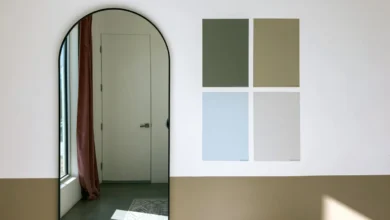
The resulting visual campaign deliberately extracts ROOM’s architecture from conventional corporate settings, placing products in unexpected spatial contexts. This surrealist or art-directed framing deliberately shifts the viewer’s eye away from the seams, glass panels, and acoustic padding, directing it instead toward the human subjects utilizing the space.

"The product’s design became the visual frame for the campaign," Lauritzen explains. In the newly released photography suite and a mesmerizing, ASMR-inspired 30-second brand film directed by Corey Hess, the architecture recedes. The imagery highlights intimate scenes of everyday working life: colleagues gathering for an impromptu chat, a lone employee finding deep focus through headphones, or individuals pausing in transition.
Shifting the Corporate Narrative: "Room for What Matters"
At the heart of the refreshed brand identity is the new corporate ethos: "Room for What Matters." This strategic shift moves the company’s value proposition away from a purely physical metric—such as square footage saved, decibels reduced, or desks installed—and toward qualitative, human-centric outcomes.
Elyse Heckman, ROOM’s Senior Vice President of Brand and Communications, emphasizes that the product has never truly been the core of the company’s mission. "Workplaces are full of products, but we know the most meaningful asset within workplaces is the people inside of them," Heckman states.
According to Heckman, the true value of workplace architecture lies in facilitating micro-moments: a spontaneous conversation that sparks an innovative business idea, a quiet reprieve between high-stakes presentations, or a moment of psychological safety in a bustling office. "Those are the moments that make work, work," she adds. "And ROOM creates space for every one of them."
This philosophy addresses a critical psychological hurdle in contemporary human resources and corporate real estate. As employers struggle to incentivize workers to return to physical offices rather than working remotely, the justification for a commute must extend beyond simply replicating a home desk in a corporate tower. Offices must offer environments that foster genuine connection, mentorship, and collective problem-solving—amenities that cannot be easily replicated through a video conference screen. By designing flexible spatial infrastructure, ROOM positions itself as an enabler of this cultural return to the office.

Broader Industry Implications and Market Analysis
ROOM’s brand refresh arrives at a pivotal juncture for the commercial real estate and interior architecture sectors. Industry analysts point out that the traditional office is undergoing its most radical redesign in a century. The rigid, highly segregated floor plans of the late 20th century—characterized by miles of executive corner offices and monotonous rows of identical cubicles—have been thoroughly dismantled. They have been replaced by agile, fluid workspaces where zones must morph rapidly to suit changing team sizes and project scopes.
This architectural fluidity requires furniture and spatial solutions that are equally adaptable. Permanent drywall construction is increasingly viewed as an expensive, inflexible liability in a business climate where corporate headcounts and spatial needs can fluctuate rapidly year over year. Modular architecture—systems that can be reconfigured, expanded, or relocated without major structural renovation—represents the fastest-growing segment of the commercial interiors market.
By shedding its narrow association with acoustic phone booths and embracing a holistic identity as a provider of human-centric architectural infrastructure, ROOM is signaling its readiness to compete directly with legacy commercial furniture giants and high-end architectural systems manufacturers. The company’s evolution reflects a broader truth about the modern built environment: the most successful design products are those that stop drawing attention to themselves, serving instead as quiet, supportive catalysts for human collaboration and well-being.
The updated brand identity—spanning the new photography suite, a refined digital color palette, revamped web and social media channels, and the newly launched cinematic campaign—is now live across ROOM’s global touchpoints, marking a mature, forward-looking chapter in the company’s history.