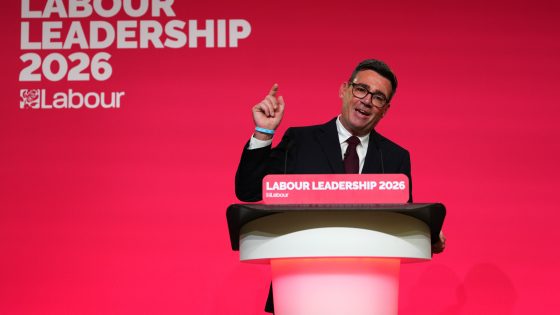
In a historic shift for British politics, Andy Burnham, the Member of Parliament for Makerfield, has officially been confirmed as the new leader of the Labour Party today, July 17, 2026. The announcement follows a high-stakes leadership contest that has captivated the United Kingdom for the past six weeks, culminating in a decisive victory for the man frequently dubbed the "King of the North." This leadership transition marks the final precursor to Burnham’s scheduled arrival at 10 Downing Street on Monday, July 20, 2026, where he will be invited by the Monarch to form a new government and succeed as the Prime Minister of the United Kingdom.
Burnham’s ascension represents a significant ideological and geographical pivot for the Labour Party. Having spent years outside the Westminster bubble as the Mayor of Greater Manchester, Burnham returned to Parliament via a by-election in his former seat of Makerfield earlier this year, a move that many analysts correctly identified as the opening salvo in a bid for the highest office in the land. His victory today is seen not just as a personal triumph, but as a mandate for a "place-based" political philosophy that prioritizes regional devolution and social equity.
A Decisive Mandate for Change
The internal party ballot results, released at 10:00 AM this morning, revealed that Burnham secured 61.4% of the total vote share among party members, affiliated supporters, and registered supporters. His closest rival, the Shadow Chancellor, trailed with 28.2%, while the remaining 10.4% was split among smaller candidates. This clear majority provides Burnham with a robust platform to implement his "New Regionalism" agenda, which promises to overhaul the relationship between Whitehall and the various regions of the UK.
In his victory speech, delivered at a community center in Wigan rather than the traditional London headquarters, Burnham emphasized unity and a "bottom-up" approach to governance. "The era of Westminster-centric politics is coming to a close," Burnham told a crowd of supporters. "Today, we start the work of rebuilding our country from the outside in, ensuring that every town and every village feels the benefit of a government that listens and acts on their behalf."
The Road to Leadership: A Ten-Year Journey
The path to today’s announcement has been long and unconventional. Burnham first ran for the Labour leadership in 2010, finishing fourth, and again in 2015, where he finished second to Jeremy Corbyn. Following those defeats, he pivoted to regional governance, serving two terms as the Mayor of Greater Manchester. It was during this tenure that he built the national profile that ultimately carried him to victory today.
His handling of the COVID-19 pandemic, his vocal opposition to central government funding cuts, and his successful integration of the Manchester transport system—the "Bee Network"—served as a prototype for the national policies he now intends to implement. Critics and supporters alike agree that his time away from the "Westminster Village" allowed him to cultivate an image of an authentic, relatable leader who understands the daily struggles of the working class in a way that career parliamentarians often do not.
Chronology of the 2026 Leadership Contest
The timeline leading to Burnham’s victory today has been marked by rapid political shifts and a sense of urgency within the Labour movement.
- May 12, 2026: Following a period of significant polling volatility, the outgoing Labour leader announces their resignation, citing a need for "new energy" to lead the party into the next decade.
- May 15, 2026: Andy Burnham, having recently returned to the House of Commons as MP for Makerfield, officially declares his candidacy, promising a "radical devolution of power."
- June 1, 2026: The formal nomination period closes. Burnham secures the backing of over 150 MPs and the UK’s three largest trade unions.
- June 15 – July 10, 2026: A series of televised debates across Birmingham, Glasgow, Cardiff, and Leeds see Burnham focusing on social care reform and "re-nationalizing the spirit of public service."
- July 12, 2026: Voting closes for the party membership.
- July 17, 2026 (Today): Burnham is officially named Labour leader.
- July 20, 2026 (Upcoming): Burnham will attend the Palace for the "kissing of hands" ceremony, officially becoming Prime Minister.
Policy Pillars: The "Burnhamism" Agenda
As Burnham prepares to take the reins of government on Monday, several key policy areas have emerged as the foundation of his upcoming administration. Central to his platform is the "National Care Service," a proposal to bring social care into the same framework as the NHS, funded through a combination of wealth tax reforms and national insurance adjustments.
Furthermore, Burnham has committed to a "Green Industrial Revolution" that specifically targets the "Rust Belt" areas of the Midlands and Northern England. By investing in hydrogen energy and carbon capture technology, the Burnham administration aims to create 500,000 new high-skilled jobs by 2030.
In terms of constitutional reform, Burnham has hinted at a massive transfer of powers to regional mayors and local councils. This includes control over housing budgets, post-16 education, and local transport networks. His "Bee Network" model is expected to be rolled out across all major metropolitan areas within the first two years of his premiership.
Supporting Data and Economic Outlook
Market reactions to Burnham’s victory have been cautiously optimistic. The FTSE 100 remained stable following the announcement, though the pound saw a slight 0.4% increase against the Euro, signaling investor confidence in the projected stability of a Burnham-led government.
Economic data supporting his platform includes:
- Regional Inequality: Recent ONS data shows that the productivity gap between London and the North East has widened by 12% over the last decade, a statistic Burnham cited frequently during his campaign.
- Social Care Crisis: With an aging population, the UK faces a projected £15 billion funding gap in social care by 2028. Burnham’s National Care Service is touted as a long-term solution to this structural deficit.
- Energy Independence: Burnham’s team has released figures suggesting that his proposed offshore wind expansion could reduce average household energy bills by £300 annually by the end of his first term.
Official Responses and Reactions
The reaction from across the political spectrum has been swift. A spokesperson for the outgoing Prime Minister issued a brief statement: "We congratulate Mr. Burnham on his victory and wish him well in the significant responsibilities he is about to undertake. The smooth transition of power is a hallmark of our democracy."
From within the Labour Party, Deputy Leader Angela Rayner praised the result, stating, "Andy represents the heart and soul of our movement. He knows what it’s like for families who feel forgotten, and as Prime Minister, he will ensure they are forgotten no longer."
The Leader of the Opposition was more critical, suggesting that Burnham’s "ambitious spending plans" would lead to a "tax burden not seen since the post-war era." In a statement released on social media, the Opposition warned that "the ‘King of the North’ may find that governing a whole nation requires more than just regional rhetoric."
Internationally, leaders from the European Union and the United States have extended early congratulations. A White House press release noted that the President looks forward to working with Mr. Burnham on "shared goals of climate resilience and transatlantic security."
Broader Impact and Implications
The implications of Burnham’s leadership extend far beyond the walls of Parliament. For the first time in decades, the UK will have a Prime Minister whose political identity is forged in municipal leadership rather than the traditional cabinet ladder. This could lead to a fundamental restructuring of how the UK government operates.
One of the most significant challenges Burnham will face is the question of Scottish independence and the stability of the Union. By advocating for a "federal" UK, Burnham hopes to satisfy the desire for autonomy in Scotland and Wales without the need for full secession. His ability to navigate these constitutional waters will likely define the first year of his premiership.
Additionally, the "Burnham era" is expected to see a shift in the UK’s diplomatic stance. While maintaining a strong commitment to NATO, Burnham has signaled a desire for a "closer, more pragmatic" relationship with the European Single Market, aimed at reducing trade barriers that have hampered British SMEs since the early 2020s.
The Road to Monday: The Transition of Power
Between now and Monday morning, Burnham will be finalizing his Cabinet appointments. Speculation is rife regarding who will occupy the "Great Offices of State." Sources close to the leader suggest that his Cabinet will be "the most geographically diverse in British history," with a deliberate effort to include representatives from every region of the UK.
On Monday, July 20, the formal process will begin. After the outgoing Prime Minister tenders their resignation to the Monarch, Andy Burnham will be summoned. Following the ceremony, he will travel to Downing Street to deliver his first address to the nation as Prime Minister.
As the digital edition of this report goes to press, the mood in Makerfield and Manchester is one of celebration, while in the corridors of Westminster, the atmosphere is one of intense preparation. The "Burnham era" has officially begun, and the eyes of the world are now on the man who promised to bring the power of the North to the heart of the British state.
Related posts: