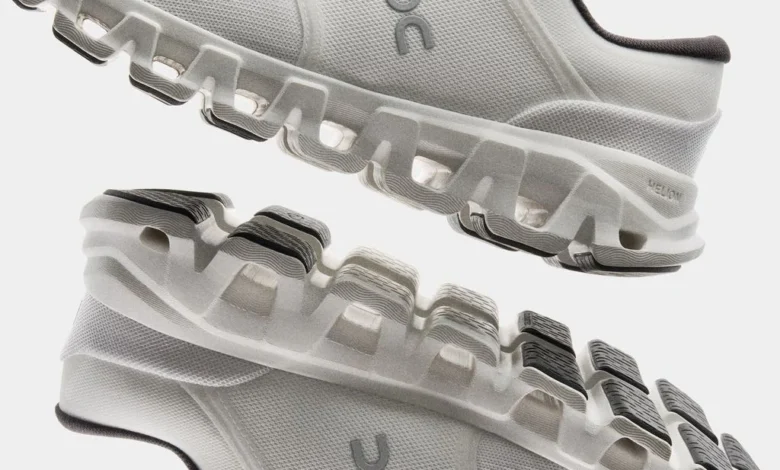
Swiss sportswear innovator On is dramatically accelerating its ambitious sustainability goals, announcing plans to produce one million pairs of its popular Cloud X 5 running shoe featuring a revolutionary midsole crafted from captured carbon dioxide emissions. This rapid scaling, achieved four years ahead of its initial projections, marks a significant milestone in the brand’s commitment to replacing fossil-derived materials in high-performance athletic footwear without compromising on the agility, cushioning, and energy return that defines its products.
The pioneering technology, dubbed CleanCloud, utilizes industrial carbon emissions as a fundamental building block for its advanced EVA (ethylene vinyl acetate) foam. This innovative approach directly challenges the long-standing reliance of the footwear industry on petroleum-based feedstocks for midsole production, a critical component responsible for a substantial portion of a shoe’s overall weight and performance characteristics.
Disrupting the Fossil Fuel Cycle in Footwear
For decades, the vast majority of athletic shoe midsoles have been manufactured using EVA or PU (polyurethane), both of which are derived from crude oil processing. These materials have been chosen for their durability, shock absorption, and lightweight properties, making them indispensable for performance footwear. However, their petroleum origins contribute to the industry’s significant carbon footprint.
CleanCloud offers a compelling alternative by intercepting carbon emissions from industrial sources before they are released into the atmosphere. Through a sophisticated process, these captured CO2 emissions are combined with green hydrogen, produced using renewable energy sources. This reaction is then catalysed to create e-naphtha, a crucial precursor that serves as the foundational ingredient for producing the final EVA foam. The resulting material, while molecularly identical to conventional EVA, represents a paradigm shift in sustainable manufacturing, transforming a pollutant into a high-performance component.
Jean-Philippe Romain, On’s Director of Polymer Science and Engineering, emphasized the seamless integration of this new technology into the brand’s established performance standards. "When you step into our new Cloud X 5, you will feel the exact same signature On cushioning, agility and energy return you expect," Romain stated. "There is absolutely zero compromise on performance. In simple terms, the foam does not care about where its carbons come from." This assurance is rooted in the scientific reality that the ethylene produced from captured carbon is chemically indistinguishable from standard ethylene. Consequently, the resulting EVA foam possesses identical technical specifications, including molecular weight, polymer chain length, and melting point, to its conventionally produced counterpart.

Quantifying Environmental Impact: A Life Cycle Assessment
While the performance parity is critical for consumer acceptance, the environmental benefits are equally profound. To rigorously assess the ecological advantages of CleanCloud, On commissioned a comprehensive Life Cycle Assessment (LCA). This study, conducted by CarbonMinds and independently reviewed by TÜV SÜD in accordance with ISO14040/44/71 standards and following the credit approach of the TfS (Together for Sustainability) method, provides robust data on the material’s environmental footprint.
The LCA results are striking: the manufacturing pathway for CleanCloud foam demonstrates at least an 80% reduction in carbon emissions compared to conventional EVA production methods. Given that the midsole constitutes more than half of a shoe’s total weight, prioritizing innovation in this area offers the most significant potential for reducing the overall environmental impact of footwear.
From Audacious Idea to Global Scale: A Supply Chain Revolution
The journey of CleanCloud from a nascent concept to a commercially viable, large-scale product is a testament to On’s commitment to radical innovation and strategic collaboration. Romain recounted the initial skepticism surrounding the project: "I remember my very first one-on-one with my manager when he handed me this project and to be completely honest, at first, I thought it was a crazy, silly idea." He elaborated on the core impetus: "This initiative came purely from a raw innovation mindset – Can we take a resource that is abundant in the atmosphere and do something positive with it? Can we make the problem part of the solution?"
The rapid acceleration of CleanCloud’s development and deployment is largely attributed to its design as a "plug-and-play" solution within the existing chemical industry infrastructure. By forging direct partnerships with specialized chemical companies, On has enabled the integration of CleanCloud into established chemical reactors, bypassing the need for the construction of entirely new manufacturing facilities. This agile approach has been instrumental in achieving its ambitious scaling targets.
The foundation of this new chemical value chain involves a network of key partners. Infinium Energy, based in Abingdon, UK, plays a pivotal role in converting captured CO2 emissions into liquid e-naphtha. This intermediate product is then transferred to Borouge International, a leading global polymers player headquartered in Vienna, Austria. Borouge International transforms the e-naphtha into commercially ready e-EVA pellets, which are subsequently used by footwear manufacturers to produce the final EVA foam.
Securing these partnerships was not without its challenges. On faced initial rejections from traditional industry players who were hesitant to invest in what they perceived as a high-risk, unproven concept. However, Borouge International recognized the transformative potential of CleanCloud and committed to the vision, providing the crucial validation and industrial capacity needed for widespread adoption.

"We didn’t have a massive business case – we just had a few slides, immense enthusiasm, and a big dream, but by rethinking how a supply chain can collaborate, we have scaled to over a million pairs today," Romain concluded. "The speed at which we went from a single wild prototype to commercial-scale production is incredibly fast for the chemical and footwear industries." This collaborative model underscores a broader trend in sustainable manufacturing, where cross-industry partnerships are essential for driving innovation and achieving significant environmental impact.
Expanding the CleanCloud Footprint
The successful integration of CleanCloud into the Cloud X 5 model is just the beginning of On’s strategy. The company has explicitly stated its intention to replace traditional EVA midsole units with sustainable alternatives like CleanCloud across a wider range of its product portfolio. This expansion signifies a long-term commitment to embedding circular economy principles into its core business operations and product development.
The implications of this advancement extend beyond On’s own brand. The success of CleanCloud could serve as a powerful catalyst for other companies in the sports and outdoor industry, as well as the broader apparel sector, to explore similar carbon-negative or carbon-neutral material solutions. The demonstration of a scalable, high-performance, and environmentally beneficial alternative to petroleum-derived materials provides a tangible blueprint for the industry’s transition towards greater sustainability.
As consumer demand for environmentally responsible products continues to rise, and regulatory pressures on carbon emissions intensify, innovations like CleanCloud are poised to become increasingly critical for brand differentiation and long-term business viability. On’s bold move to scale this technology rapidly suggests a proactive approach to shaping the future of sustainable athletic footwear, proving that high performance and environmental responsibility can indeed go hand-in-hand. The company’s website, www.on.com, is expected to provide further details on the product and its sustainability initiatives.
Related posts: