The psychological impact of male pattern baldness often begins in mundane environments: an overhead fluorescent light in an office elevator, or an accidental glance at a smartphone front-facing camera. For decades, men facing the early stages of androgenetic alopecia have confronted a frustratingly binary choice: accept progressive hair thinning or undergo an invasive surgical hair transplant. However, rapid advancements in regenerative medicine have quietly carved out a robust middle ground in men’s grooming and aesthetics. Among the most closely watched developments in this category is Autologous Micrografting Technology (AMT), a tissue-transfer protocol frequently marketed under the umbrella of stem cell and exosome therapies.
To evaluate the efficacy, practical experience, and clinical reality of this emerging treatment, a comprehensive examination was conducted following a procedure performed at Ouronyx, an advanced aesthetic clinic situated on St James’s Street in London. The appointment, completed in April, serves as a case study for understanding how regenerative procedures operate, how they compare to traditional alternatives, and what patients can realistically expect regarding quantitative hair density recovery.
Understanding Autologous Micrografting Technology: Mechanism and Science
Stripped of commercial marketing terminology, Autologous Micrografting Technology is fundamentally a mechanical tissue transfer rather than a pharmaceutical intervention or a surgical relocation of hair follicles. The procedure begins with a clinician harvesting two or three microscopic skin punches—typically measuring approximately 2.5 millimeters in diameter—from the mastoid region located directly behind the ear or from the lower nape of the neck.
These specific donor areas are deliberately selected because hair follicles in this zone are genetically resistant to dihydrotestosterone (DHT), the primary androgen responsible for miniaturization and hair loss in male pattern baldness. Once extracted, the harvested tissue is placed into a specialized medical device that mechanically dissociates and filters the sample into a concentrated liquid suspension. This resulting serum is entirely autologous, meaning it contains the patient’s own progenitor cells, local growth factors, and natural signaling vesicles known as exosomes.
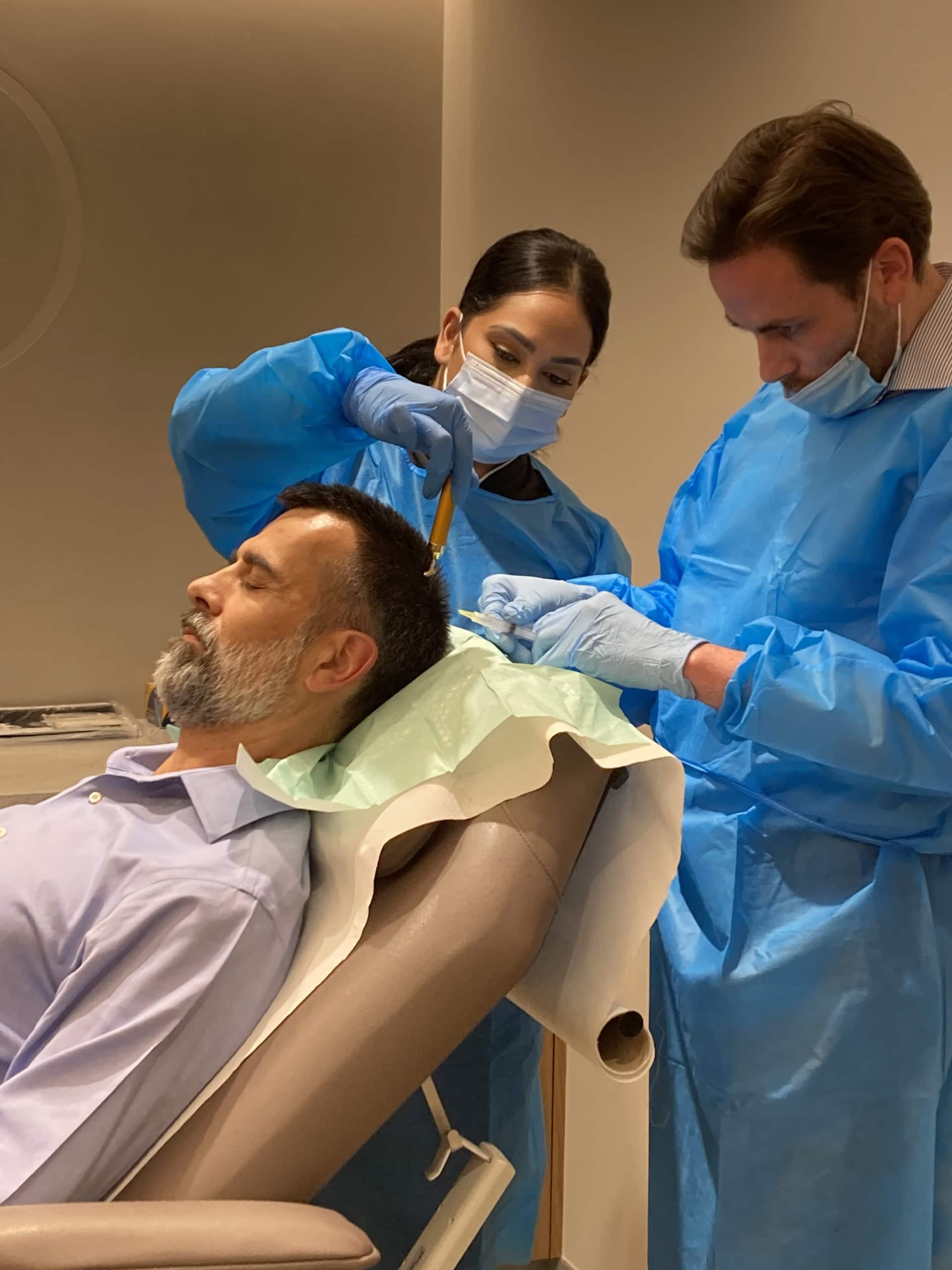
Unlike therapies that rely on donor-derived products, nothing in AMT is cultured, frozen, chemically altered, or sourced from an external vial. The resulting cellular suspension is subsequently reintroduced across the thinning areas of the scalp via a grid of superficial mesotherapy-style micro-injections. The entire procedure is completed in a single clinical sitting.
According to current scientific literature, the primary mechanism of AMT does not involve the generation of entirely new hair follicles de novo. Instead, the intervention functions through intercellular signaling. The delivered cytokines, growth factors, and exosomes act on struggling follicular units, suppressing cell-death pathways, reducing localized tissue inflammation, and stimulating angiogenesis to enhance the microvascular blood supply. In practical terms, the treatment aims to reverse miniaturization, persuading dormant or weakening follicles to prolong their anagen (growth) phase rather than creating new hair from previously smooth, scarred scalp tissue.
Dr. Marco Nicoloso, Medical Director at Ouronyx in London, emphasizes the biological compatibility of the approach. "Micrografting Technology is the ability of micrografts to stimulate dormant hair follicular units, reverting the shrinking process typical in androgenetic alopecia and thereby inducing the development of healthier, thicker hair," Dr. Nicoloso explains. "It uses tiny samples of the patient’s own skin tissue, left completely unaltered, containing the same natural components already present in the body—allowing them to be easily recognized and accepted when reintroduced into the scalp."

Clinical Application and the Patient Experience
The clinical protocol at specialized facilities typically begins with an exhaustive diagnostic consultation rather than an immediate commitment to treatment. At Ouronyx, this initial phase incorporates 3D trichoscopy imaging—a high-magnification digital scanning system that precisely maps and measures baseline follicle density, individual hair calibre, and local scalp inflammation. By establishing a coordinate-mapped baseline, clinics can convert subjective patient anxiety regarding perceived hair loss into objective, quantifiable data points for future comparison.
The procedure itself is relatively brief, typically lasting approximately one hour. Following the administration of a localized anesthetic block behind the ear, the tissue punches are extracted. Patients generally report experiencing minor mechanical pressure rather than sharp pain during the harvest. While the tissue is processed on-site, the patient remains in the clinic chair prior to the final micro-injection phase. While discomfort during the scalp injections is minimal, recovery realities occasionally diverge from promotional claims of immediate, invisible recovery.
Post-procedure management typically requires a small protective dressing behind the ear for approximately 48 hours, alongside minor visible extraction points that generally resolve within two weeks as surrounding hair conceals the donor sites. While there is virtually no functional downtime—allowing patients to resume normal daily routines immediately—those with extremely short hairstyles should factor minor temporary marks into their social or professional schedules.
Quantitative Results and Longitudinal Data
Evaluating the success of regenerative hair therapies requires objective metrics over a multi-month timeline. Follow-up evaluations utilizing the same high-magnification trichoscopy mapping system provide a clear window into physiological changes. In longitudinal assessments tracking patients over a four-month post-treatment window, significant quantifiable improvements across multiple scalp zones are frequently documented.
Clinical tracking typically evaluates distinct regions, including the vertex (crown), the frontal hairline, and the temporal zones, using an untreated occipital reference area to control for external variables. In typical patient cohorts following AMT protocols, metrics demonstrate measurable gains:
- Vertex Density: Increases in total hair counts per square centimeter, alongside improvements in cumulative hair thickness (combining density and individual calibre).
- Frontal Scalp: Noticeable upward shifts in shaft thickness and overall follicular population.
- Temporal Regions: Substantial percentage increases in hair counts per square centimeter, accompanied by a marked shift in the ratio of terminal (thick, mature) hairs to vellus (fine, wispy) hairs.
This shift toward a higher ratio of terminal hairs closely mirrors the physiological reversal of androgenetic alopecia. Derived clinical scoring systems, such as the Sinclair scale, similarly reflect localized improvements in hair coverage over a standard evaluation period.
However, isolating the precise variable responsible for these gains presents a clinical challenge. Many patients concurrently utilize pharmaceutical therapies such as topical or oral minoxidil or 5-alpha-reductase inhibitors like finasteride. Because pharmaceutical interventions typically require three to six months to produce visible changes, early quantitative improvements within the first 90 days are widely attributed to the rapid biological signaling initiated by autologous micrografting. Nevertheless, distinguishing the exact contribution of each modality in a combined therapeutic "stack" remains complex, underscoring the reality that regenerative treatments function best as part of a comprehensive management strategy rather than as isolated cures.
Comparative Analysis: AMT Versus Alternative Hair Restoration Modalities
To understand where Autologous Micrografting Technology fits within the broader spectrum of hair loss management, it must be evaluated alongside established alternatives, each serving distinct clinical indications:
-
Autologous Micrografting Technology (AMT): Best suited for patients experiencing early to moderate hair thinning where the primary objective is the preservation, revitalization, and thickening of existing follicular units. It requires a single initial appointment with minimal downtime and is typically repeated on an annual or multi-year basis depending on disease progression.
-
Follicular Unit Extraction (FUE) Hair Transplants: The definitive surgical intervention for advanced hair loss. FUE physically relocates permanent, DHT-resistant hair follicles from the donor zone to completely bald areas or receding hairlines. It involves a true surgical procedure, a longer recovery window measured in weeks, and a timeline of six to twelve months for final aesthetic maturation.
-
Platelet-Rich Plasma (PRP) Therapy: A procedure involving the centrifugation of whole blood to concentrate platelets and growth factors, which are subsequently injected into the scalp. While sharing the philosophical foundation of using autologous biological material, PRP delivers growth factors without the progenitor cells and tissue architecture present in micrografts. PRP typically requires an initial series of three to six treatment sessions followed by regular maintenance intervals.
-
Donor-Derived Exosome Products: Commercially available, cultured cellular derivatives supplied in external vials. While frequently marketed under broad regenerative terminology, off-the-shelf exosome products represent a fundamentally different regulatory and biological proposition compared to autologous treatments.
The Regulatory Landscape and the Exosome Controversy
The widespread adoption of regenerative aesthetics has popularized the term "exosome therapy," yet significant regulatory and safety distinctions separate autologous treatments from donor-derived alternatives. Regulatory bodies, including the UK Medicines and Healthcare products Regulatory Agency (MHRA), classify injected exosome products as medicinal goods. Currently, human-derived, allogeneic exosome products lack formal marketing authorization for cosmetic and aesthetic applications within the United Kingdom and the European Union.
Academic and clinical pathologists have frequently cautioned against the routine injection of cultured, donor-derived human cell products into unrelated recipients due to potential immunogenic and safety variables. In contrast, Autologous Micrografting Technology circumvents many of these regulatory and biological concerns by utilizing the patient’s own tissue, processed mechanically and reintroduced during the exact same clinical encounter. Clinicians emphasize that prospective patients considering exosome-based therapies must critically evaluate the origin of the cellular material being introduced into their bodies.

Economic Considerations and Maintenance Protocols
The financial investment associated with advanced hair restoration varies significantly across modalities. In major metropolitan markets such as London, specialized AMT procedures are typically priced around £2,950 per session. When compared to surgical hair transplantation—which generally ranges from £3,000 to upwards of £10,000 depending on graft counts and surgical complexity—micrografting represents a markedly different financial and physiological commitment. Conversely, when compared against long-term pharmaceutical regimens such as daily topical minoxidil or oral medications, regenerative procedures represent a distinct tier of aesthetic expenditure.
Regarding maintenance frequency, clinical protocols vary across the industry. While some centers advocate for routine annual maintenance sessions every 12 to 18 months, published trial data regarding mechanical micrografting systems suggests that secondary treatments administered prematurely may yield minimal incremental benefit over a single well-executed session. Consequently, leading specialists increasingly advocate for a data-driven approach: performing a single initial treatment, auditing results via quantitative trichoscopy mapping at 6 and 12 months, and scheduling subsequent interventions strictly according to objective shifts in follicular density rather than rigid calendar intervals.
Implications and Future Outlook
Autologous Micrografting Technology occupies a valuable, highly specialized niche in modern aesthetic medicine. It bridges the historical gap between passive topical maintenance and permanent surgical intervention, offering a biologically compatible preservation strategy for individuals in the early-to-moderate stages of hair thinning.
As the medical community continues to accumulate longitudinal data on regenerative aesthetics, the emphasis within hair restoration is shifting toward objective measurement, patient safety, and combination therapy stacks. For men navigating the psychological challenges of progressive hair loss, technologies like AMT provide a scientifically grounded, non-surgical pathway to extend the operational lifespan of their natural hair—provided patients approach the procedure with realistic expectations and a commitment to data-verified monitoring.
Related posts: