The Invisible Threat to Luxury Jewelry E-commerce How Typosquatting and Negative SEO are Destabilizing the High-End Market

The luxury jewelry sector is currently facing a sophisticated and largely invisible cyber threat that combines traditional typosquatting with aggressive negative SEO tactics, a trend that has seen a significant surge in late 2024. Unlike traditional phishing or credit card fraud, which aim to steal immediate data or funds, this new wave of attacks is designed to erode the digital authority and search engine rankings of established retailers. By exploiting the architectural vulnerabilities of how search engines like Google evaluate brand identity and link profiles, anonymous attackers are systematically targeting high-value jewelry brands, causing substantial revenue loss through the gradual decline of organic search visibility.
The Anatomy of a Hybrid Digital Attack
At the core of this emerging threat landscape is a two-pronged strategy: typosquatting and negative SEO. Historically, typosquatting involved registering domain names that were minor misspellings of famous brands—such as "Cartierr.com" instead of "Cartier.com"—to host fake storefronts or harvest user credentials. However, the current campaign targeting luxury jewelers is markedly different. These misspelled domains often host no content at all; they sit as "parked" pages with zero outbound links and no visible storefront.
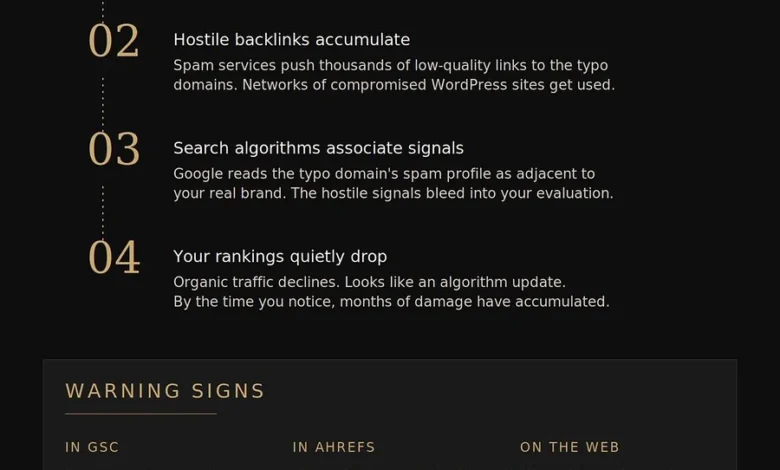
The danger lies in the "backlink profile" of these dormant domains. Attackers use automated infrastructure to point thousands of spam-flagged, low-quality links toward these misspelled domains. Because these domains are so phonetically and orthographically similar to the legitimate brand, search engine algorithms can struggle to decouple the "toxic" signals of the typosquat from the reputation of the real brand. This phenomenon, known as "signal bleeding," results in the legitimate retailer being penalized by search algorithms for perceived associations with spam networks, leading to a precipitous drop in search engine results page (SERP) rankings.
Chronology of the 2024 Surge
The evolution of this threat has followed a distinct timeline, moving from isolated incidents to a coordinated industry-wide phenomenon.
- Early 2023 – Initial Probing: Reports first surfaced of luxury brands noticing unusual spikes in "referring domains" within Google Search Console. These were initially dismissed as routine internet "noise" or low-level spam.
- Mid-2023 – Infrastructure Building: Attackers began acquiring "aged domains"—older websites with existing history—to act as the foundations for their spam networks. This made the toxic links appear more established to search algorithms.
- Late 2023 to Early 2024 – Pattern Recognition: Specialized e-commerce retailers, such as Opulent Jewelers, began identifying a coordinated pattern. Multiple typosquat domains were being registered simultaneously, each targeting a specific misspelling of a brand name and accumulating thousands of links within a matter of weeks.
- Late 2024 – The Intensification: The attack reached a peak in the final quarter of 2024. The infrastructure had become highly automated, utilizing compromised WordPress sites and link-injection services that openly advertised their ability to manipulate search rankings.
Economic Incentives and Industry Vulnerabilities
The luxury jewelry industry is an ideal target for this form of digital sabotage due to its unique economic structure. High average order values (AOV) mean that even a minor fluctuation in traffic can have devastating financial consequences. For a retailer selling pre-owned Cartier or Van Cleef & Arpels items, where individual transactions often range from $5,000 to $50,000, a 5% loss in organic traffic can translate to hundreds of thousands of dollars in lost monthly revenue.
Furthermore, the keyword landscape for luxury jewelry is exceptionally competitive but narrowly defined. Specific long-tail queries, such as "authenticated Van Cleef Alhambra" or "pre-owned Cartier Love bracelet," carry immense commercial intent. Because there is a limited inventory of authoritative retailers for these specific items, pushing a competitor down just one or two positions on a search page allows an attacker (or a malicious competitor using these services) to capture a significant portion of the market share.
The "authentication" factor also plays a role. Legitimate retailers invest heavily in content that proves provenance and authenticity. This content-rich environment is exactly what search engines reward, but it also provides a large "surface area" for negative SEO attacks to target. By undermining the brand’s digital authority, the attacker effectively devalues the trust the retailer has spent years building.
Identifying the Indicators of an Active Attack
For many jewelers, the first sign of trouble is not a customer complaint but a quiet anomaly in their technical data. Security experts and SEO analysts point to several key warning signs that a brand is being targeted by a typosquatting and negative SEO campaign.
Google Search Console Anomalies
Retailers are advised to monitor the "Links to your site" report for sudden spikes in referring domains that have no logical connection to their marketing efforts. A surge of several hundred domains in a single week is a primary red flag. Often, these links will use "anchor text" (the clickable part of a link) that combines the brand name with commercial terms like "buy," "discount," or "cheap," specifically designed to look like manipulative marketing to Google’s spam filters.
Geographic and Language Mismatches
A sudden influx of links from regions where the retailer does not operate—such as a US-based luxury jeweler receiving thousands of links from Russian, Chinese, or Vietnamese-language forums—is a strong indicator of a coordinated spam attack.
Third-Party SEO Tool Metrics
Tools such as Ahrefs, Semrush, or Moz can detect "toxic" link profiles before they fully impact search rankings. Analysts look for referring URL paths that contain randomized strings or auto-generated patterns, as well as domains with extremely high outbound link counts, which are typical of compromised "link farms."
Defensive Strategies and Legal Frameworks
The defense against these attacks is multi-layered, requiring a combination of technical maintenance and legal action.
The Disavow File
The most immediate technical defense is the maintenance of a Google Search Console "disavow file." This tool allows site owners to provide Google with a list of domains they wish the algorithm to ignore. For brands under active attack, this is not a one-time task but an ongoing operational requirement. Some retailers now maintain disavow lists containing thousands of domains, updated on a weekly basis to keep pace with the attackers’ automation.
Legal Recourse: UDRP and ACPA
When technical defenses are insufficient, brands must turn to established legal frameworks for protecting intellectual property online.
- Uniform Domain-Name Dispute-Resolution Policy (UDRP): Administered by the World Intellectual Property Organization (WIPO), this process allows trademark holders to challenge and seize typosquat domains. While effective and relatively fast (60–75 days), it requires the brand to prove the domain was registered in bad faith and is being used to cause confusion.
- Anticybersquatting Consumer Protection Act (ACPA): This US federal law provides a more aggressive path. It allows for statutory damages of up to $100,000 per domain. While more expensive and time-consuming than a UDRP filing, the threat of significant financial penalties can serve as a deterrent to domestic attackers.
Documentation as Infrastructure
Legal and SEO experts emphasize that documentation is a critical, yet often overlooked, part of the defense. Maintaining a chronological record of WHOIS data for typosquat domains, screenshots of the sites, and exports of backlink profiles is essential for winning UDRP cases or filing reconsideration requests with search engines.
Industry Implications and the Broader Impact
The rise of these attacks highlights a broader shift in the digital landscape: the weaponization of search engine algorithms. As Google and other search engines become more reliant on complex "signals" to determine brand authority, they inadvertently create new vectors for bad actors to exploit.
The "resource asymmetry" is the most challenging aspect for independent jewelers. While an attacker can use low-cost scripts to generate thousands of hostile links, the defender must employ human experts—SEO analysts, technical developers, and IP attorneys—to mitigate the damage. This creates a "tax" on legitimate digital commerce that smaller boutiques and single-location stores may find difficult to sustain.
Furthermore, the "don’t buy the domain" rule is a critical piece of advice that many retailers learn too late. In a traditional typosquatting scenario, buying the misspelled domain is a sound defensive move. In the negative SEO era, however, buying a "poisoned" domain means inheriting its toxic backlink profile. If a retailer redirects that misspelled domain to their main site, they are essentially "piping" the spam links directly into their own domain, accelerating the ranking decline they were trying to prevent.
Future Outlook
The consensus among digital security experts is that these attacks will continue to evolve. As AI-generated content becomes more prevalent, attackers may begin to populate typosquat domains with sophisticated, AI-generated "fake" reviews or articles to further confuse search algorithms and consumers.
The long-term solution lies in the evolution of search engine technology. Google’s algorithms must become more adept at identifying and automatically discounting "hostile associations" without penalizing the target. Until then, the burden of defense rests on the retailers.
Industry awareness is currently the most effective shield. By sharing data and patterns, luxury jewelers can move from a reactive posture to a proactive one. The transition from seeing these events as "algorithm changes" to recognizing them as "targeted attacks" is the first and most crucial step in securing the future of luxury e-commerce. As the owner of Opulent Jewelers noted, the defense is often straightforward once the pattern is recognized; the true challenge lies in the vigilance required to notice the threat before the damage becomes irreversible.