The Stealth Evolution of Typosquatting and Negative SEO Targeting the Luxury Jewelry Sector

A sophisticated and increasingly prevalent form of cyber-attack is quietly eroding the digital foundations of the luxury jewelry industry, marking a shift from traditional fraud toward long-term search engine manipulation. For years, the primary concern for e-commerce retailers was the direct theft of customer data or the creation of fraudulent storefronts. However, recent reports from industry leaders, including Opulent Jewelers, indicate a more insidious strategy: the pairing of typosquatting with aggressive negative SEO (Search Engine Optimization) campaigns. This tactic does not target the customer’s wallet directly but rather the retailer’s visibility in organic search results, effectively choking off revenue at the source.
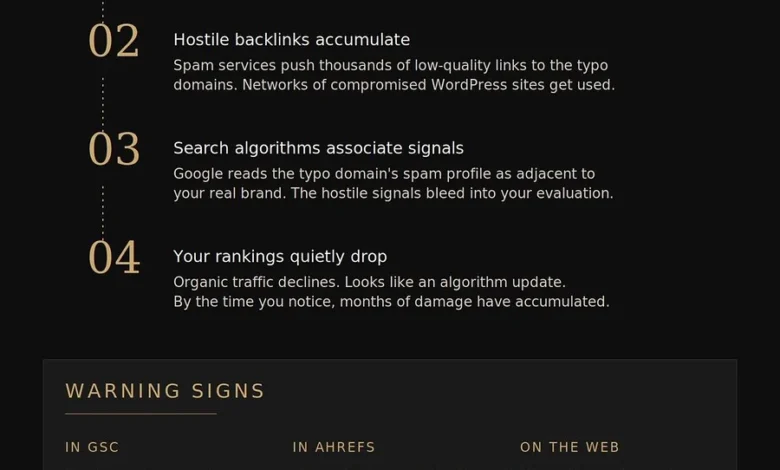
The first indication of this activity often arrives not via customer complaints or transaction alerts, but through subtle anomalies in Google Search Console. Retailers have reported sudden, unexplained surges in referring domains—often jumping by several hundred in a single week. These domains typically bear no relation to the jewelry industry and follow a coordinated pattern, linking back to luxury retailers through a network of misspelled domain names. This "new threat landscape" is defined by its patience and technical precision, often remaining undetected until a brand’s search rankings begin a terminal decline.
The Mechanics of Modern Typosquatting and Negative SEO
Traditionally, typosquatting involved registering a domain name that was a minor misspelling of a popular brand—such as replacing an "m" with an "rn" or adding an extra "s"—to capture direct type-in traffic. These sites were usually designed for phishing, intended to harvest credit card details or login credentials. The current iteration of the attack, however, is significantly more complex.
In this new model, the typosquat domains do not host content. They are "parked" pages with no outbound links and no storefront. Their purpose is entirely structural. The attackers build thousands of inbound links to these misspelled domains from spam-heavy, flagged sources. By doing so, they create a "hostile backlink profile" that is algorithmically associated with the legitimate brand.
Search engines like Google do not evaluate a domain in total isolation; they look at the broader signal landscape surrounding a brand name. When a domain that is nearly identical to a legitimate brand becomes the target of massive spam campaigns, those negative signals can "bleed" into the real brand’s evaluation. The result is a decline in the real site’s E-E-A-T (Experience, Expertise, Authoritativeness, and Trustworthiness) score. As the algorithm begins to associate the brand name with low-quality, spam-saturated environments, organic rankings drop, and visibility on high-value queries is lost.
Why the Luxury Jewelry Industry is Uniquely Vulnerable
The targeting of luxury jewelry retailers is a calculated economic decision. Several factors make this sector an ideal environment for negative SEO campaigns:
High Average Order Value (AOV)
In the luxury pre-owned jewelry market, individual transactions frequently range from $5,000 to over $50,000. Because the margins and price points are so high, even a minor fluctuation in organic traffic—such as a 5% or 10% drop—can result in the loss of hundreds of thousands of dollars in monthly revenue. The economic impact of pushing a competitor down just one or two spots on a Search Engine Results Page (SERP) is immediate and substantial.
Competitive Keyword Specificity
The industry relies on highly specific, high-intent keywords. Terms such as "pre-owned Cartier Love bracelet" or "authenticated Van Cleef Alhambra" have immense commercial value but a limited number of authoritative retailers competing for them. By undermining the SEO health of a top-tier competitor, an attacker can create a vacuum in the SERPs that other players—potentially those behind the attack—can fill.
The Trust and Authentication Variable
Trust is the primary currency of the luxury jewelry trade. Retailers invest heavily in creating content around provenance, authentication processes, and gemstone education. This content-rich environment is exactly what search engines reward with high rankings. By targeting these brands with negative SEO, attackers weaponize the very authority the brands have worked to build, using the brand’s own prominence against it.
A Chronology of the 2024-2025 Offensive
The intensification of these attacks was noted in late 2024, moving from sporadic instances of spam to a coordinated, industrial-scale effort.
- Late 2024: Initial reports surfaced of "ghost domains" mimicking major luxury boutiques. These domains showed no activity on the front end but displayed rapid backlink growth in SEO monitoring tools.
- December 2024: Attackers began utilizing sophisticated infrastructure, including link-spam services that specialized in "negative reputation management." This period saw the integration of compromised WordPress sites, which were used to inject commercial anchor text into existing, legitimate articles across the web to further confuse search algorithms.
- Early 2025: The emergence of aged-domain marketplaces became a central part of the strategy. Attackers began purchasing domains with existing history and repurposing them as typosquat hubs, allowing them to bypass the "sandbox" period usually applied to new domains by search engines.
Industry analysis suggests that the attackers are not just individual hackers but are often organized entities with access to significant computational resources. They utilize automated scripts to monitor brand registrations and immediately secure typosquat variants as soon as a brand gains traction in the market.
Identifying the Warning Signs
For e-commerce operators, the ability to distinguish between an algorithm update and a targeted attack is critical. There are specific technical indicators that point toward a negative SEO campaign.
Google Search Console Indicators
Retailers should monitor for spikes in referring domains that occur outside of any planned marketing or PR campaigns. A sudden influx of links from regions that do not match the brand’s target demographic—such as a surge in Russian or Southeast Asian links for a US-based boutique—is a primary red flag. Furthermore, the appearance of new URLs in the "Links to your site" report that utilize brand names combined with unrelated commercial terms (e.g., "buy [Brand Name] cheap" or "[Brand Name] discount pharmacy") suggests a coordinated attempt to poison the brand’s anchor text profile.
Backlink Monitoring Anomalies
Using tools like Ahrefs, Semrush, or Moz, retailers can identify referring URL paths that contain randomized hash strings or auto-generated patterns. A hallmark of a compromised site network is a high outbound link count; if a single page is linking to thousands of unrelated sites, any link from that page is likely toxic.
Typosquatting Clusters
Attackers rarely register just one misspelled domain. Usually, they register a "cluster" of four or five variants. If a retailer discovers one typosquat domain, a WHOIS search often reveals several others registered around the same date, often using the same registrar or privacy protection service.
Defensive Strategies and Legal Remedies
Defending against a negative SEO attack requires a multi-layered approach that combines technical maintenance with legal enforcement.
1. The Disavow Protocol
The primary technical defense is the maintenance of a Google Search Console disavow file. This allows a site owner to tell Google which domains should be ignored when calculating the site’s ranking. In an active attack, this cannot be a one-time task. Large retailers are increasingly treating the disavow file as ongoing infrastructure, updating it weekly to account for new spam domains.
2. Formal Spam Reporting
Google provides specific channels for reporting search quality issues. When filing these reports, it is essential to categorize the issue correctly. Reporting typosquats as "paid links" is often more effective than reporting them as phishing if the domains are parked, as the algorithm for detecting link manipulation is more sensitive to these patterns.
3. Legal Action: UDRP and ACPA
When the damage is significant, legal intervention is often the only way to permanently remove the offending domains.
- UDRP (Uniform Domain-Name Dispute-Resolution Policy): Administered by WIPO, this is a relatively fast process (60-75 days) to have a domain transferred or cancelled. It requires proving that the domain is identical or confusingly similar to a trademark and that the registrant has no legitimate interest in it.
- ACPA (Anticybersquatting Consumer Protection Act): This US federal law allows trademark owners to sue for statutory damages ranging from $1,000 to $100,000 per domain. While more expensive than a UDRP filing, the threat of high financial penalties can act as a significant deterrent.
Strategic Pitfalls to Avoid
In the face of an attack, certain instinctive responses can actually exacerbate the problem. One common mistake is attempting to buy the typosquat domains from the attacker. By purchasing a domain that has already been saturated with spam links, the retailer "inherits" the poisoned backlink profile. If that domain is then redirected to the main site, the negative SEO signals are funneled directly into the legitimate brand.
Similarly, public confrontation is generally discouraged. Most attackers operate through automated infrastructure and are insulated from public shaming. High-profile call-outs often serve only to alert the attacker that their efforts are working, potentially leading them to increase the intensity of the campaign.
The Future of Brand Protection
The rise of typosquatting-based negative SEO represents a maturing of cyber-aggression in the e-commerce space. As search engine algorithms become more reliant on broad brand signals rather than just direct links, the "surface area" for attacks grows.
Industry experts suggest that the next phase of this threat will involve AI-generated content. Instead of parked pages, attackers may soon use Large Language Models (LLMs) to create thousands of fake "review" sites that look legitimate to an algorithm but are designed to siphon authority away from real brands.
For the luxury jewelry industry, the best defense remains a combination of vigilance and collective intelligence. Sharing data on attack patterns and maintaining rigorous technical hygiene are no longer optional tasks for e-commerce directors; they are essential components of brand preservation in a digital-first economy. The "silent" nature of these attacks means that for many jewelers, the work is not just in the defense, but in the noticing. In an era where a search ranking is as valuable as a storefront on Fifth Avenue, protecting that digital real estate is a matter of survival.