The UK Market for Eco-Friendly Washing-Up Liquids: A Comprehensive Environmental Audit and Brand Guide

The global consumer goods market has experienced a profound structural shift toward sustainability over the past decade, with household cleaning products emerging as a primary battleground for environmental accountability. In the United Kingdom, where household cleaning accounts for a significant share of domestic carbon footprints and single-use plastic consumption, the demand for genuinely eco-friendly alternatives to conventional washing-up liquids has surged. However, beneath the polished marketing campaigns of sparkling clean dishes and vibrant natural motifs lies a complex web of corporate ownership structures, ambiguous recycling statistics, and complex chemical supply chains. Navigating this landscape requires a rigorous examination of what constitutes genuine environmental stewardship versus sophisticated greenwashing.
A critical evaluation of the UK cleaning product sector reveals that while consumer awareness is at an all-time high, systemic challenges persist. Traditional market leaders—such as Procter & Gamble’s Fairy, Unilever’s Persil, and Reckitt’s Finish—continue to dominate supermarket shelves despite well-documented environmental concerns regarding their reliance on petrochemical surfactants, virgin plastics, and complex supply chains. Furthermore, corporate consolidation has blurred the lines between independent eco-brands and multinational conglomerates. For instance, pioneering sustainable brands like Ecover and Method are owned by SC Johnson, a cleaning giant that has faced ongoing scrutiny from consumer advocacy groups regarding animal testing, labor practices, and questionable environmental claims.
To understand the broader implications of these corporate practices, it is necessary to examine the regulatory and environmental frameworks governing household detergents in the UK. The environmental impact of washing-up liquid extends far beyond the liquid itself, encompassing three primary pillars: packaging lifecycle management, chemical composition and aquatic toxicity, and supply chain ethics, including carbon emissions and animal testing.

The Packaging Dilemma: Beyond Widely Recycled Claims
For decades, plastic packaging has been marketed as a circular solution due to municipal collection schemes deemed "widely recycled" across the UK. Yet, recent investigative reporting and data from environmental organizations such as Greenpeace paint a starkly different picture. A substantial volume of supposedly recyclable plastic waste collected from British households is ultimately incinerated domestically or exported to developing nations, where regulatory oversight regarding disposal is less stringent.
Even when plastic packaging successfully enters a recycling stream, it carries an inherent carbon footprint and a disposal challenge. Plant-based plastics (bioplastics) and packaging featuring high percentages of post-consumer recycled (PCR) content represent incremental improvements, but they fail to address the foundational issue of single-use consumption. Consequently, environmental scientists and zero-waste advocates emphasize that the waste hierarchy prioritizes refusal, reduction, and reuse above recycling.
In response to consumer demand and tightening regulatory pressures, innovative UK brands have pioneered alternative packaging models. Closed-loop systems, refillable glass containers, concentrated powder-to-gel sachets, and bulk 5-litre or 20-litre commercial containers have transformed the market. These systems drastically reduce the frequency of single-use bottle purchases, mitigating the volume of plastic entering the waste stream and lowering transportation emissions by eliminating the unnecessary shipping of water.

Chemical Composition and Aquatic Impact
The formulation of washing-up liquid introduces another layer of environmental complexity. Conventional cleaning products rely on synthetic surfactants—compounds designed to lower surface tension, break down grease, and suspend dirt in water. Under current European and UK chemical regulations, these surfactants must demonstrate aerobic biodegradability, meaning they must break down by at least 60 percent in the presence of oxygen within a 28-day window.
While this regulatory standard represents a baseline of environmental protection, critics note that biodegradability is highly contingent on the specific biological and chemical conditions of natural waterways. Nature does not operate within laboratory parameters, and persistent chemical residues can disrupt aquatic ecosystems. Moreover, surfactants are synthesized from diverse feedstocks, including petroleum industry byproducts, tropical plant oils such as coconut, and agricultural sugars. Without robust supply chain transparency, the sourcing of these ingredients can be directly linked to large-scale deforestation, habitat destruction, and the exploitation of agricultural labor.
Carbon Emissions and the Logistics of Water

Transportation emissions constitute a major component of the cleaning products industry’s carbon footprint. Standard commercial washing-up liquids are formulated primarily of water—often comprising up to 80 to 90 percent of the total volume. Transporting heavy liquid formulations across national and international distribution networks consumes substantial fossil fuels and generates high carbon dioxide emissions.
Forward-thinking brands are addressing this inefficiency by offering highly concentrated liquids, solid dishwashing bars, and anhydrous powder-to-liquid formats. By allowing consumers to add water at home, these products dramatically reduce shipping weight and volumetric requirements, translating to leaner supply chains and lower relative carbon outputs. Furthermore, leading ethical companies are increasingly aligning their emissions reduction targets with international climate agreements, publishing comprehensive carbon audits across all tiers of their supply chains.
The Regulatory Landscape of Animal Testing
The ethical dimensions of cleaning product manufacturing extend to animal welfare standards. In 2015, the UK enacted a formal ban on animal testing for finished household cleaning products. However, a significant legal and regulatory loophole remains: the individual chemical ingredients used to formulate these products may still undergo animal testing outside the UK, or their historical safety data may rely on past animal trials.

Because supply chains are frequently opaque, consumers cannot rely solely on the "Made in the UK" label to guarantee cruelty-free status. Independent third-party accreditations—such as those granted by Cruelty Free International (The Leaping Bunny), PETA, and the Vegan Society—remain the gold standard for verifying that neither the final product nor its constituent ingredients have been subjected to animal testing at any stage of development.
Evaluating the UK’s Leading Ethical Washing-Up Liquid Brands
A survey of the current UK marketplace highlights several standout brands that successfully reconcile high cleaning performance with rigorous ethical and environmental standards. These enterprises demonstrate that commercial viability does not require compromising on ecological integrity.
Faith in Nature
Operating out of the UK, Faith in Nature has established a robust reputation for plant-derived, cruelty-free personal and household care. Their washing-up liquid formulations utilize natural lemon oil and biodegradable ingredients, avoiding parabens, artificial sulphates, and silicones. Certified by the Vegan Society, the brand minimizes plastic waste primarily through bulk 5-litre containers. A single 5-litre jug yields approximately 350 washes—roughly a year’s supply for an average household—and the containers are fully recyclable or eligible for return schemes.

Bower Collective
Bower Collective operates as a certified B-Corp, holding itself to stringent social and environmental performance standards. Their washing-up liquids are formulated from naturally derived ingredients and pure essential oils, offering high grease-cutting performance without synthetic toxins. Available in multiple fragrances alongside a fragrance-free option, Bower employs an innovative closed-loop refill system known as the BowerPack™. Customers receive 1-litre refill pouches that, once emptied, can be mailed back via a freepost envelope for specialized cleaning and reuse. Additionally, every purchase supports CleanHub, an initiative that intercepts ocean-bound plastic waste in coastal regions of India.
Miniml
Based in Yorkshire, Miniml champions a strict closed-loop manufacturing model across its entire range of household cleaning goods. Their washing-up liquids are vegan, cruelty-free, readily biodegradable, and formulated without volatile organic compounds (VOCs), sulphates, or parabens. Miniml products are distributed via 1-litre and 5-litre refill pouches that are returned to the company for sanitization and redistribution, or topped up via independent zero-waste refill stations located throughout the UK.
Ecoleaf
Distributed by Suma Wholefoods—a pioneering workers’ cooperative based in West Yorkshire—Ecoleaf offers a sustainable washing-up liquid formulated from plant extracts and Roundtable on Sustainable Palm Oil (RSPO)-certified ingredients. The brand is entirely vegan, cruelty-free, and free from synthetic preservatives such as parabens and phthalates. Suma’s cooperative business model ensures that every worker receives equal pay and has an equal democratic voice in enterprise management, setting a high benchmark for corporate social responsibility. Ecoleaf is available in bulk formats ranging from 5-litre to 20-litre containers, significantly curbing single-use packaging waste.
Kit & Kin
Co-founded by television personality Emma Bunton, Kit & Kin combines high-performance plant-based formulations with premium branding. Their washing-up liquid features 100% naturally derived ingredients infused with essential oils like pink grapefruit and orange. Distributed in stylish amber glass bottles paired with recyclable refill pouches, the brand provides closed-loop recycling infrastructure for its flexible packaging. The formulas are hypoallergenic, pet-friendly, and certified cruelty-free.

Homethings
Representing a technological pivot in sustainable cleaning, Homethings addresses the carbon footprint of water transportation by utilizing an anhydrous powder-to-gel format. Consumers purchase reusable glass or plastic bottles and fill them with tap water, adding a concentrated powder sachet that dissolves into a high-performance washing-up liquid. The sachets decompose or recycle easily alongside paper waste, and the entire logistical model slashes transport-related carbon emissions by removing heavy water weight from the distribution chain.
Greenscents
For consumers seeking organic certification, Greenscents offers a highly concentrated washing-up liquid formulated from certified organic soap nuts and shikakai pods. Certified by the Soil Association, the formula completely eschews synthetic foaming agents, palm oil, and artificial fragrances. Greenscents provides products in refillable glass bottles, supported by 5-litre and 20-litre returnable bulk containers that undergo professional sanitization and reuse.
Bio-D
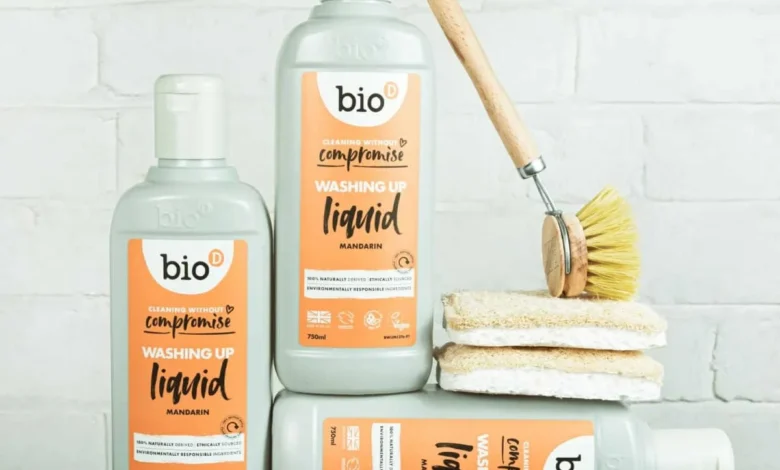
As a long-standing pioneer in the UK eco-cleaning sector, Bio-D formulates hypoallergenic, vegan, and cruelty-free cleaning products in the UK. Utilizing RSPO-certified palm oil and avoiding synthetic chemicals, Bio-D products are packaged in 100% post-consumer recycled plastic bottles. The brand also offers a solid dishwashing bar designed to eliminate plastic packaging entirely from the washing-up routine.
The Fallacy of Homemade Alternatives

In the pursuit of zero-waste lifestyles, many consumers experiment with homemade washing-up liquid recipes utilizing basic kitchen ingredients such as castile soap, washing soda, and essential oils. However, extensive practical testing by sustainability experts indicates that DIY formulations rarely match the efficacy of commercially manufactured eco-detergents. Natural soaps lack the advanced surfactants and stabilizing agents required to consistently lift heavy grease, emulsify oils, and prevent streaking on glassware. Consequently, users frequently find themselves consuming higher volumes of hot water and soap to achieve acceptable cleanliness, negating the intended environmental benefits. Commercial eco-brands bridge this gap by utilizing advanced green chemistry to engineer high-performance surfactants derived from sustainable, biodegradable feedstocks.
Implications and Future Outlook
The evolution of the UK eco-friendly washing-up liquid market reflects a broader maturation of consumer sustainability. As regulatory scrutiny tightens and environmental reporting standards become more rigorous, greenwashing by multinational conglomerates is increasingly exposed by consumer watchdogs and independent certifiers.
For the modern British consumer, the path forward involves looking beyond superficial marketing imagery and evaluating products through a holistic lens: assessing packaging circularity, ingredient sourcing, supply chain ethics, and carbon transparency. By supporting certified B-Corps, workers’ cooperatives, and brands utilizing closed-loop refill infrastructures, households can transform a mundane domestic chore into an active contribution to ecological preservation.